Introduction
This appendix is not part of the self-consistent branch-selection argument. The thesis uses mean-field theory to determine whether a static superconducting branch is selected, and uses relative-phase response only as an observable consequence of such a branch. Caustics enter at a later, optional level: after a selected phase texture has been linearised into a collective-mode or phase-wave problem, a short-wavelength approximation may describe propagation by rays, and those rays can focus at fold or cusp singularities.
The material below is therefore retained only as supplementary language for possible semiclassical focusing of Josephson, Leggett, or quasiparticle envelopes, not as evidence for the ground-state mechanism. The main text needs only the fact that inhomogeneous phase dynamics may be described semiclassically by rays and that these ray families can develop focusing singularities. The more detailed optics-style machinery is recorded here.
The central objects are caustics: singular envelopes of ray families where geometrical theory predicts diverging intensity and where the correct wave description is given by universal uniform approximations.
Definition of a caustic
A caustic is the envelope of a family of rays or classical trajectories for which the Jacobian of the mapping from initial conditions to observation point vanishes. In geometrical optics or stationary-phase theory this produces a divergence in the naive intensity. Wave mechanics regularises the divergence into universal interference patterns.
The simplest structurally stable cases are:
- the fold, with Airy-type regularisation;
- the cusp, with Pearcey-type regularisation.
This is the standard framework of catastrophe optics. [6,11]
Why caustics arise in phase dynamics
Many Josephson and collective-mode problems admit:
- a classical or mean-field limit in which phase variables obey Hamiltonian-like equations;
- a semiclassical approximation for wavepackets, correlators, or mode envelopes.
When several stationary points of the action coalesce, ordinary stationary phase fails. The correct local description is then a uniform approximation controlled by catastrophe theory. This is relevant for:
- Josephson-junction phase dynamics;
- sine-Gordon-type equations in long junctions or coupled condensates;
- bosonic Josephson-junction quenches;
- semiclassical quasiparticle propagation in superconductors. [7–10]
Eikonal structure for superconducting collective modes
Many collective modes in inhomogeneous superconductors can be described by a wave equation
where is the local dispersion relation.
In the short-wavelength limit, use the WKB ansatz
At leading order this yields the Hamilton–Jacobi equation
Defining
one obtains ray equations generated by the Hamiltonian :
The caustic is the locus where the corresponding ray map ceases to be locally invertible. [6,11]
What “intensity” means in superconducting problems
The focused quantity depends on the field being propagated:
- Josephson plasma waves: enhanced local phase oscillation and supercurrent response;
- bulk plasma-like modes: enhanced electromagnetic energy density;
- Leggett waves: enhanced relative-phase oscillation, limited by damping if overlaps the pair-breaking continuum;
- semiclassical quasiparticle trajectories: enhanced local density-of-states or current patterns in the clean limit. [2,4,9]
Thus the optics language of “intensity” is system-dependent, but the underlying mathematics of focusing is the same.
Fold and cusp catastrophes
The generic fold and cusp are the most common structurally stable singularities in low-dimensional ray problems.
Fold
At a fold, two stationary points coalesce. The universal wave regularisation is the Airy function. Across a fold caustic the number of geometrical rays through a point changes by two.
Cusp
At a cusp, folds themselves meet and the stationary point becomes more degenerate. The universal regularisation is the Pearcey function. Cusps are the natural next singularity after folds in two-parameter families of rays.
Ocean-wave caustics as a model example
A standard visual example of caustics is the bright moving network produced by sunlight refracting through a rippled water surface. The water surface acts as a lens, and the focused brightness on the floor of a pool or on the seafloor is the caustic pattern. [11–14]
This example is useful because it makes the main structural point transparent: a smooth map from initial ray labels to observation coordinates becomes singular, and wave theory then regularises the apparent divergence.
Snell-law ray map
Consider light incident from air with refractive index onto water with refractive index across an interface
The local unit normal is
If the incident direction is , the transmitted direction is given by vector Snell refraction:
where
If the observation plane is , then the ray starting at arrives at transverse coordinates
This defines the ray map
The caustic is the singular set of this map:
Generically gives folds, and fold intersections generate cusps. [6,11]
Oscillatory integral and cusp reduction
A standard semiclassical wavefield on the observation plane has the form
where stationary points of correspond to geometrical rays.
Near a cusp, one may reduce the local phase to the canonical normal form
This corresponds to a higher-order stationary point in which the lower derivatives vanish at the singular point.
Pearcey uniform approximation
With the cusp normal form, the leading uniform approximation is the Pearcey integral
The observable intensity is
This is the universal wave regularisation of a cusp caustic. The detailed physical system enters only through the mapping of its local control parameters to the scaled variables and . [6,11]
Relevance to superconducting phase dynamics
The same catastrophe structure can appear in superconducting settings whenever collective-mode propagation or phase evolution admits a short-wavelength or semiclassical description. The specific physical field may be:
- a Josephson phase wave in an inhomogeneous junction;
- a relative-phase oscillation in a multicomponent condensate;
- a plasma-like collective mode;
- a semiclassical quasiparticle envelope.
The common structure is the same: a ray family, a singular projection map, and a wave-uniform approximation near the singular set.
Summary
This appendix records the additional semiclassical machinery associated with focusing phenomena in phase dynamics:
- caustics are singular envelopes of ray families;
- folds and cusps are the main structurally stable cases used here;
- their wave regularisations are the Airy and Pearcey forms;
- in superconducting settings, these structures arise naturally in inhomogeneous phase and collective-mode propagation.
Figures
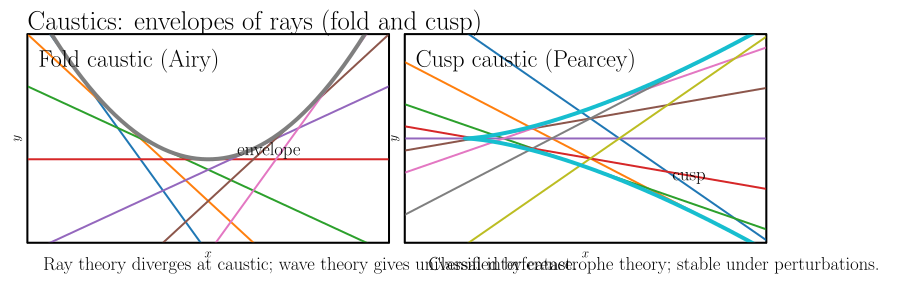
Figure F.1: Fold and cusp caustics as envelopes of ray families. Geometrical theory predicts divergences at the caustic; wave theory regularises them into universal interference patterns.

Figure F.2: Ocean-wave light caustics. Inset: a vertical – slice showing Snell-law refraction by a rippled air–water interface focusing onto a screen. Main panel: the corresponding 2D observation-plane intensity near a cusp, described by the universal Pearcey form.