Conventional Superconductivity
[…] something unexpected occurred. The disappearance did not take place gradually but abruptly. […] Thus the mercury at has entered a new state, which, owing to its particular electrical properties, can be called the state of superconductivity.
This chapter reviews the conventional theory of superconductivity used in the later discussion of time-reversal-symmetry breaking (TRSB), internal winding, and loop-supercurrent states. The focus is selective: dissipative metallic transport, magnetic screening, Ginzburg–Landau (GL) order-parameter language, vortices and flux quantisation, the minimal microscopic pairing picture, and the gauge structure of a charged condensate.
The thesis question is how unusual quantum states become physically selected rather than only symmetry-allowed. The results approach this question in three steps. First, a soft-wall SSH model asks whether topological boundary states survive realistic internal boundaries. Second, an internally antisymmetric nonunitary triplet proposal shows that an attractive superconducting channel can have the right algebra but still fail a self-consistency selection test. Third, the loop-supercurrent construction turns that obstruction into a design principle by separating superconducting amplitude support from the selection of a time-reversal-odd phase/current winding coordinate.
The hierarchy of effective descriptions is standard but still structurally important. Drude theory describes ordinary dissipative transport. London theory captures equilibrium magnetic screening. GL theory introduces the complex order parameter, the coherence length , and the penetration depth . Microscopic pairing theory explains superconductivity as a Fermi-surface instability of the normal metal. These descriptions are valid in different regimes and will later be generalised to multicomponent condensates with internal phase structure. [2, 3, 4, 5]
Conductors and low-energy electronic structure
Classical transport and the relaxation-time picture
A minimal starting point is the Drude model. Let denote the applied electric field, the carrier momentum, the carrier velocity, the effective carrier mass, the carrier charge including its sign, the carrier density, and the relaxation time. In the relaxation-time approximation, acceleration by the field and momentum loss by scattering are written
where the overdot denotes a time derivative. The current density is
Differentiating this relation gives
In steady state,
The Drude model is quantitatively incomplete, but its role here is simple: it defines the ordinary dissipative regime that superconductivity departs from. [2]
Fermi surface as the low-energy organising principle
In a metal, low-energy excitations are concentrated near the Fermi energy. States deep below the Fermi surface are Pauli-blocked and do not participate in low-energy rearrangements. Superconductivity is therefore not a generic two-body bound-state problem in vacuum. It is an instability of a filled Fermi sea, controlled by the low-energy structure near .
This viewpoint will remain important later. Even when the order parameter acquires nontrivial internal structure, the instability is still organised by the same low-energy electronic manifold.
Phase transitions and symmetry: Landau’s framework
Landau theory describes a continuous phase transition in terms of an order parameter whose equilibrium value changes at a critical point:
For superconductivity, the ordered phase is described by a new macroscopic variable absent in the normal metal. GL theory is Landau’s phase-transition framework adapted to a charged condensate. [6]
Later chapters use symmetry in two related ways. First, symmetry classifies superconducting phases through the BdG time-reversal, particle-hole, and chiral algebra. Second, crystal symmetry determines which spin-orbital terms are allowed in multiorbital effective Hamiltonians. The technical machinery for both uses is introduced in the symmetry and topology chapter; here, the important point is simply that superconductivity is an ordered state whose possible order parameters and low-energy Hamiltonians are constrained by symmetry.
Conventional superconducting phenomenology
Discovery and definition: Onnes and Meissner
At the start of the twentieth century it was unclear what should happen to metallic resistance as . Onnes’ experiments showed that the resistance of mercury does not merely decrease smoothly, but drops abruptly near , signalling a new phase. [1]
The decisive magnetic result came later. Meissner and Ochsenfeld showed that superconductors expel magnetic flux from their bulk below the critical temperature. [7] Superconductivity is therefore not simply perfect conduction. It is a distinct equilibrium phase characterised by both vanishing DC resistance and the Meissner effect.
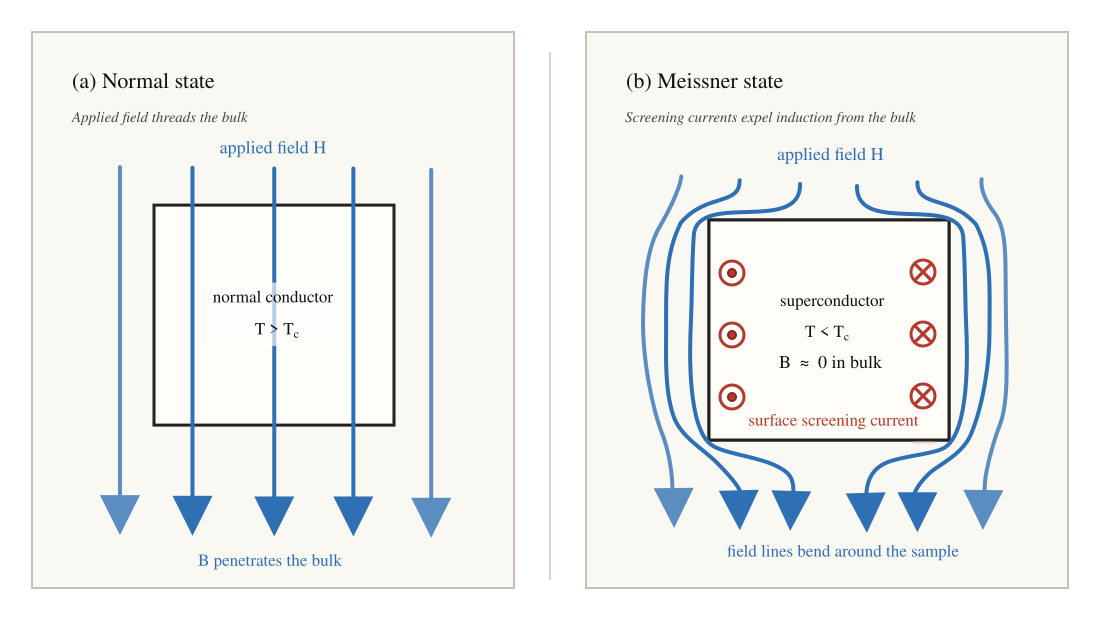
Figure 1.1: Ideal Meissner expulsion in a simply connected sample, for a Type-I superconductor with or a Type-II superconductor with . Above the applied field threads the normal conductor. Below , equilibrium surface currents confined to a London penetration layer of thickness expel the magnetic induction from the bulk, leaving away from the surface.
London theory of the Meissner effect
The London equations provide the first successful phenomenology of superconducting electrodynamics. [3] Their importance is clearest when a superconductor is compared with a perfect conductor.
In the collisionless Drude limit ,
Taking the curl and using Faraday’s law,
gives
This permits frozen-in magnetic flux. It does not force flux expulsion, because the integration constant is set by the magnetic history of the sample.
The London generalisation is to replace this history-dependent perfect-conductor behaviour by an equilibrium constitutive relation for the superconducting state:
Equivalently, the superconducting current is tied directly to the gauge field in a phase-rigid condensate, so that the equilibrium state screens the magnetic induction rather than merely preserving its initial value. Combining this with Ampère’s law,
and taking another curl gives
Magnetic field therefore decays exponentially into the sample over the penetration depth . London theory captures the Meissner effect and introduces the first intrinsic superconducting length scale. [8, 9]
Ginzburg—Landau theory
Ginzburg and Landau introduced a phenomenological theory of superconductivity in terms of a complex order parameter
[4] Above the transition , while below it . The symbol is a coarse-grained condensate field, not a single-particle wavefunction; is proportional to the superfluid density in the simplest normalisation, and is the macroscopic superconducting phase.
A minimal GL free-energy functional is
where is the normal-state reference free energy, changes sign at the transition, stabilises the ordered state, and are the effective mass and charge of the condensate degree of freedom, is the electromagnetic vector potential, and is the magnetic induction. The quadratic and quartic terms set the local condensation energy, the covariant-gradient term penalises spatial phase or amplitude variations and couples the condensate to electromagnetism, and is the magnetic-field energy. The amplitude encodes condensate strength, while the phase controls currents and gauge coupling.
Varying with respect to and gives
and
GL theory introduces two characteristic lengths:
The first controls magnetic screening; the second controls how rapidly the order parameter heals after a perturbation. Later chapters reuse exactly this phase-amplitude language, but for multicomponent condensates rather than a single complex scalar.
Gor’kov later derived GL theory from BCS theory near , placing the phenomenology on a microscopic footing. [10]
Type I and Type II superconductors
The ratio
determines the magnetic character of the superconductor.
For the material is Type I: It remains in the Meissner state up to a critical field. For the material is Type II: Magnetic flux penetrates above a lower critical field in the form of vortices while superconductivity survives up to an upper critical field.
Around a vortex the condensate phase winds by , the order parameter is suppressed in the core, and the defect carries quantised magnetic flux. Abrikosov showed that these vortices form regular lattices. [11, 12]
The Type I/Type II distinction is the first place where the phase stiffness, magnetic screening, and topological defects of the condensate appear together in a single framework.
Flux quantisation
Single-valuedness of the complex order parameter produces a global quantisation condition. Around a closed loop ,
In equilibrium away from singularities,
Using Stokes’ theorem,
Experiments by Doll–Näbauer and Deaver–Fairbank found , giving direct evidence that the superconducting carriers have charge . [13, 14] The theoretical interpretation is not limited to those early low-temperature samples. Byers and Yang showed that the flux response of a superconducting cylinder is fixed by gauge invariance and the global phase of the many-body state, while later measurements in high- materials found the same flux quantum . [15, 16] This universality is why flux quantisation is treated as evidence for a coherent charge- condensate rather than as a material-specific detail.
Flux quantisation is not an incidental effect. It is the global expression of condensate phase coherence and will later reappear when relative phases and loop variables are introduced inside a unit cell.
Microscopic pairing theory
The microscopic theory of conventional superconductivity was established in three steps:
- Cooper showed that an arbitrarily weak attractive interaction produces pairing near the Fermi surface.
- Bardeen, Cooper, and Schrieffer extended this to a coherent many-electron ground state.
- The resulting BCS theory explained the gap, thermodynamics, and electromagnetic response of conventional superconductors. [5, 12]
The detailed algebra is deferred to the appendices. Only the structural results are needed here.
Effective attraction and the Cooper instability
Electrons repel through the Coulomb interaction, but in a metal that interaction is screened. In addition, lattice vibrations can mediate an effective attraction in a narrow shell near the Fermi surface, typically set by a phonon scale such as . Pairing is therefore a low-energy effective interaction rather than a bare microscopic attraction.
Consider two electrons above a filled Fermi sea with opposite momenta and energies
Suppose the interaction is attractive only in a thin shell near the Fermi surface,
for
and vanishes outside that shell. Solving the two-body problem in the presence of the Fermi sea gives a bound state with binding energy
in the weak-coupling limit.
The qualitative conclusion is the important one: any arbitrarily weak attraction in the Cooper channel destabilises the Fermi sea. Superconductivity is therefore a Fermi-surface instability. [12]
Bardeen—Cooper—Schrieffer theory
BCS theory describes the superconducting state as a coherent many-body state of paired electrons. [5] The standard variational ground state is
with
The theory yields a gapped quasiparticle spectrum and a collective condensate phase. Superconductivity is therefore not a gas of independent bound pairs, but a coherent many-body state with long-range phase order.
At the mean-field level, the same four-fermion interaction can be reorganised into distinct contraction channels. For the present chapter the important contrast is between direct density renormalisation (Hartree), exchange renormalisation (Fock), ordinary Cooper pairing in the BCS channel, and the anomalous Gor’kov structure that appears once particle number is not fixed term-by-term in the paired description.

Empirical anchors
BCS theory is supported by several standard observations. The excitation gap appears in tunnelling spectroscopy and in activated low-temperature thermodynamics. [17] Coherence effects appear in phenomena such as the proximity effect and the Hebel–Slichter peak. [18, 19, 20] The isotope effect shows that lattice dynamics enter the pairing interaction in conventional superconductors. [21, 22]
These results matter here only as the minimal microscopic theory needed for what follows. Later chapters will keep the condensate language but generalise the internal structure of the order parameter.
Gauge structure and phase rigidity
The supercurrent is controlled by the gauge-invariant phase gradient,
A stationary supercurrent therefore does not require an electric field in the same way as normal-state transport. This is the low-energy expression of phase rigidity.
The same structure explains magnetic screening. The GL kinetic term
implies that once the condensate amplitude is nonzero, the electromagnetic field becomes massive within the medium and magnetic field decays over the scale . In condensed-matter language this is the Anderson mechanism. [23, 24, 25]
Writing
identifies as the phase fluctuation and as the amplitude fluctuation. For a global broken symmetry the phase mode would be gapless. With dynamical electromagnetism included, that mode is absorbed into the gauge sector, while the amplitude mode remains gapped. [26, 27, 24, 25]
Josephson relations and internal relative-phase dynamics are deferred to Chapter 4, where they are needed in the multicomponent setting relevant to the thesis mechanism.
Conclusion
This chapter has set the conventional baseline for the thesis. The central lesson is that superconductivity is not just a metal with infinite conductivity: it is an equilibrium condensate with phase rigidity, gauge coupling, magnetic screening, and quantised circulation. The Meissner effect, London penetration depth, GL order parameter, vortices, and flux quantum are different expressions of this same charged coherent state.
The microscopic BCS picture supplies the complementary low-energy view. Pairing is organised by the Fermi surface, and the superconducting order parameter is a collective field built from electronic pair correlations. In the simplest single-component case, the phase mostly controls electromagnetic response and supercurrent. In the multicomponent systems studied later, however, relative phases, orbital structure, spin structure, and internal winding can become independent variables in the free energy. That is the point of carrying the conventional framework forward: it provides the reference language against which time-reversal-symmetry breaking, loop-supercurrent order, and internally structured pairing can be identified.
Supporting derivations of the Cooper instability, the BCS variational state, Anderson pseudospins, and the geometric form of GL theory are collected in the appendix chapter on conventional superconductivity derivations.
References
- H. Onnes,
Further experiments with liquid helium. D. On the change of electric resistance of pure metals at very low temperatures, etc. IV. The resistance of pure mercury at helium temperatures,
Communications from the Physical Laboratory of the University of Leiden, vol. 120b, 1911. (↩︎) - S. Simon, The oxford solid state basics. Oxford: Oxford University Press, 2013. [Online]. Available: https://cds.cern.ch/record/1581455 [Accessed: Jul. 6, 2023]. (↩︎)
- F. London, H. London, and F. Lindemann,
The electromagnetic equations of the supraconductor,
Proceedings of the Royal Society of London. Series A - Mathematical and Physical Sciences, vol. 149, no. 866, pp. 71–88, 1997. doi:10.1098/rspa.1935.0048 (↩︎) - V. Ginzburg and L. Landau,
On the theory of superconductivity,
Zh. Eksp. Teor. Fiz., vol. 20, pp. 1064–1082, 1950. doi:10.1016/B978-0-08-010586-4.50035-3 (↩︎) - J. Bardeen, L. Cooper, and J. Schrieffer,
Theory of superconductivity,
Phys. Rev., vol. 108, no. 5, pp. 1175–1204, 1957. doi:10.1103/PhysRev.108.1175 (↩︎) - L. Landau and E. Lifshitz,
CHAPTER XIV - PHASE TRANSITIONS OF THE SECOND KIND AND CRITICAL PHENOMENA,
in Statistical Physics (Third Edition), L. Landau and E. Lifshitz, Eds. Oxford: Butterworth-Heinemann, 1980, pp. 446–516.doi:10.1016/B978-0-08-057046-4.50021-X (↩︎) - W. Meissner and R. Ochsenfeld,
Ein neuer Effekt bei Eintritt der Supraleitfähigkeit,
Naturwissenschaften, vol. 21, no. 44, pp. 787–788, 1933. doi:10.1007/BF01504252 (↩︎) - C. Kittel, Introduction to solid state physics. Wiley, 1976. [Online]. Available: https://books.google.com?id=iwFRAAAAMAAJ (↩︎)
- N. Ashcroft, N. Mermin, and S. Rodriguez,
Solid state physics,
American Journal of Physics, vol. 46, no. 1, pp. 116–117, 1978. doi:10.1119/1.11117 (↩︎) - L. Gor’kov,
Microscopic derivation of the ginzburg–landau equations in the theory of superconductivity,
Soviet Physics JETP, vol. 9, no. 6, pp. 1364–1367, 1959. (↩︎) - A. Abrikosov,
On the magnetic properties of superconductors of the second group,
Soviet Physics JETP, vol. 5, no. 6, pp. 1174–1182, 1957. (↩︎) - M. Tinkham, Introduction to superconductivity. Mineola, NY: Dover Publications, 2004. (↩︎)
- R. Doll and M. Näbauer,
Experimental proof of magnetic flux quantization in a superconducting ring,
Physical Review Letters, vol. 7, pp. 51–52, 1961. doi:10.1103/physrevlett.7.51 (↩︎) - B. Deaver and W. Fairbank,
Experimental evidence for quantized flux in superconducting cylinders,
Physical Review Letters, vol. 7, pp. 43–46, 1961. doi:10.1103/physrevlett.7.43 (↩︎) - N. Byers and C. Yang,
Theoretical Considerations Concerning Quantized Magnetic Flux in Superconducting Cylinders,
Physical Review Letters, vol. 7, pp. 46–49, 1961. doi:10.1103/PhysRevLett.7.46 (↩︎) - C. Gough, M. Colclough, E. Forgan, R. Jordan, M. Keene, C. Muirhead, A. Rae, N. Thomas, J. Abell, and S. Sutton,
Flux Quantization in a High-Tc Superconductor,
Nature, vol. 326, p. 855, 1987. doi:10.1038/326855a0 (↩︎) - I. Giaever,
Energy gap in superconductors measured by electron tunneling,
Physical Review Letters, vol. 5, pp. 147–148, 1960. doi:10.1103/physrevlett.5.147 (↩︎) - P. Gennes, Superconductivity of metals and alloys. Boca Raton: CRC Press, 2019. doi:10.1201/9780429497032 (↩︎)
- A. Andreev,
The thermal conductivity of the intermediate state in superconductors,
Soviet Physics JETP, vol. 19, no. 5, pp. 1228–1231, 1964. (↩︎) - L. Hebel and C. Slichter,
Nuclear spin relaxation in normal and superconducting aluminum,
Physical Review, vol. 113, pp. 1504–1519, 1959. doi:10.1103/physrev.113.1504 (↩︎) - E. Maxwell,
Isotope effect in the superconductivity of mercury,
Physical Review, vol. 78, pp. 477–477, 1950. doi:10.1103/physrev.78.477 (↩︎) - C. Reynolds, B. Serin, W. Wright, and L. Nesbitt,
Superconductivity of isotopes of mercury,
Physical Review, vol. 78, pp. 487–487, 1950. doi:10.1103/physrev.78.487 (↩︎) - P. Anderson,
Random-phase approximation in the theory of superconductivity,
Physical Review, vol. 112, pp. 1900–1916, 1958. doi:10.1103/physrev.112.1900 (↩︎) - P. Anderson,
Plasmons, gauge invariance, and mass,
Physical Review, vol. 130, pp. 439–442, 1963. doi:10.1103/physrev.130.439 (↩︎) - P. Higgs,
Broken symmetries and the masses of gauge bosons,
Physical Review Letters, vol. 13, pp. 508–509, 1964. doi:10.1103/physrevlett.13.508 (↩︎) - Y. Nambu,
Quasi-particles and gauge invariance in the theory of superconductivity,
Physical Review, vol. 117, pp. 648–663, 1960. doi:10.1103/physrev.117.648 (↩︎) - J. Goldstone,
Field theories with « superconductor » solutions,
Il Nuovo Cimento, vol. 19, pp. 154–164, 1961. doi:10.1007/bf02812722 (↩︎)