Josephson Effect and Relative-Phase Modes
This chapter fixes the low-energy phase-dynamics framework used later for weak links and multicomponent superconductors. Because the thesis studies TRSB states built from coupled internal superconducting phases, internal Josephson physics and relative-phase collective modes provide the natural low-energy dynamical language.
The treatment is effective rather than microscopic. Amplitude fluctuations and high-energy quasiparticles are assumed to have been integrated out unless explicitly stated otherwise. The result is a phase-only description in which the universal collective structure is manifest.
Notation and conventions
We take the electron charge magnitude to be and use for the reduced Planck constant. Cooper pairs therefore carry charge .
For condensate ,
The electromagnetic potentials are . Under a gauge transformation with scalar function ,
The gauge-invariant phase combinations are
For a two-component condensate it is convenient to define
Here is the common phase and is the relative phase. In a charged superconductor, hybridises with electromagnetism and becomes plasma-like. By contrast, is gauge-invariant and supports an internal collective mode.
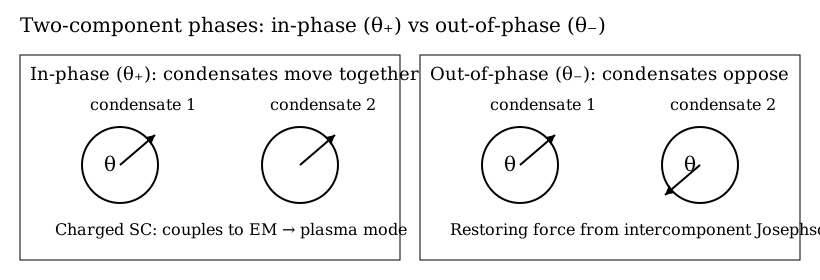
Figure 4.1: Two-component phases: in-phase () versus out-of-phase (). The in-phase motion is the charged total-phase mode and, in a charged superconductor, is pushed up to the plasma frequency by electromagnetic coupling. The out-of-phase motion is the relative-phase Leggett mode, which is an internal, approximately neutral oscillation between condensates. Intercomponent coupling provides its restoring force and opens the Leggett gap.
For the intercomponent Josephson coupling, take
Then favours , while favours .
Phase-only description
At energies well below the superconducting gap, amplitude fluctuations are usually heavier than phase fluctuations. A standard approximation is therefore to retain only the phase degrees of freedom. The resulting theory is hydrodynamic in form: microscopic details are encoded in stiffness and compressibility parameters, while the long-wavelength collective structure is retained.
For a neutral superfluid, the in-phase mode is the Goldstone mode of broken symmetry. In a charged superconductor, coupling to electromagnetism pushes this mode to the plasma scale by the Anderson mechanism. In a multicomponent condensate, the relative phase remains as an additional internal degree of freedom.
Josephson effect
Consider two superconductors separated by a weak link. At low energies the relevant variable is the phase difference
Josephson relations
The Josephson relations are
Thus a constant voltage produces oscillations at the Josephson frequency
These relations are the original Josephson effect written in the low-energy phase language used throughout the chapter. [1]
Josephson energy
The weak link is described by the Josephson energy
This cosine potential governs small oscillations, nonlinear phase dynamics, and phase-slip processes.
RCSJ dynamics
Including capacitance and shunt resistance gives the resistively and capacitively shunted junction equation
Linearising about a stable minimum yields the Josephson plasma frequency
Extended junctions
In a long junction the phase becomes a field . After the usual electromagnetic reduction one obtains a sine-Gordon-type equation,
This supports fluxons, plasma waves, and nonlinear propagating phase profiles. The extended-junction case is kept here only as a compact reference for later phase-texture arguments.
Internal Josephson coupling in multicomponent condensates
For a two-component condensate,
and the coupling
makes the relative phase
a natural low-energy variable.
This is internal Josephson physics: the phase coupling is not across a weak link between two bulk superconductors, but between two superconducting components of the same material. The common phase describes collective charge motion, while the relative phase describes internal oscillation between condensates.
For the present thesis this language is especially natural. Internally winding TRSB states are built from coupled site-, orbital-, or band-resolved superconducting phases, so their low-energy dynamics is naturally expressed in terms of internal Josephson couplings and relative-phase variables.
Leggett modes
Leggett modes are collective oscillations of the relative phase in multicomponent superconductors or superfluids. In the two-band language, they are out-of-phase oscillations of the condensates associated with different bands.
Physical interpretation
The common phase describes in-phase motion of all condensates together. In a charged system it couples to electromagnetism, carries net charge oscillation, and becomes the plasma mode. The relative phase instead describes out-of-phase motion between condensates and is, to leading order, an internal neutral mode rather than a total-charge mode. Because the intercomponent Josephson term prefers a particular relative phase, the Leggett mode is typically gapped even at long wavelength. Its small- dispersion is therefore optical-like,
with a finite Leggett gap at . This mode was first analysed in the two-band superconducting context by Leggett. [2]
Sharp and damped regimes
The mode is long-lived only when it lies below the pair-breaking continuum. A practical criterion is
where is the smaller gap scale. If
the mode overlaps the quasiparticle continuum and becomes strongly damped. [2, 3]
Experimental observation
Leggett modes are most directly identified in Raman scattering when the relevant symmetry channel couples to the relative-phase oscillation. A standard example is MgB, in which a Leggett-mode peak was reported near . [4] Optical and THz probes can also couple to the mode, although the strength and form of that coupling depend on the symmetry of the excitation and on the microscopic coupling mechanism. [3]
Phase-only derivation of the Leggett mode
A compact derivation starts from the quadratic phase-only Lagrangian
where is the phase stiffness and is a compressibility-like coefficient.
Expanding around a minimum by writing
gives
The constant term is irrelevant, and the quadratic term provides the restoring force.
Passing to the variables and and diagonalising the quadratic form separates the theory into a charged in-phase sector and a neutral relative-phase sector. At quadratic order the latter takes the form
with
The Euler–Lagrange equation is
For plane-wave solutions
one obtains
with
The Leggett mode is therefore a gapped relative-phase oscillation. The phase-only theory does not itself encode decay into quasiparticles; damping enters once the mode overlaps the pair-breaking continuum.
Relation to later semiclassical analysis
Any later semiclassical material on ray focusing or caustics is supplementary to the present phase-dynamics discussion and is kept outside the main background chapter. When that language is used, the natural conceptual reference is Berry’s catastrophe-theory treatment of structurally stable wave caustics, while O’Dell’s bosonic Josephson-junction analysis provides a concrete many-body example in which caustic structure appears directly in Josephson dynamics formulated in Fock space. [5, 6] The optional technical material is collected in the appendix on caustics and semiclassical focusing; it is not used as evidence for the static loop-supercurrent ground-state selection.
Summary
The later chapters need a phase-dynamics language in which the Josephson effect is understood as the effective low-energy dynamics of a superconducting phase difference. In multicomponent condensates, the relative phase then defines an internal Josephson degree of freedom. In a charged superconductor the in-phase mode becomes plasma-like, whereas the relative-phase mode survives as the Leggett mode. Intercomponent phase locking provides the restoring force for that mode and therefore its gap. This language is directly relevant to internally winding TRSB states, whose low-energy dynamics is organised by coupled internal superconducting phases.
References
- B. Josephson,
Possible new effects in superconductive tunnelling,
Physics Letters, vol. 1, pp. 251–253, 1962. doi:10.1016/0031-9163(62)91369-0 (↩︎) - A. Leggett,
Number-phase fluctuations in two-band superconductors,
Progress of Theoretical Physics, vol. 36, pp. 901–930, 1966. doi:10.1143/ptp.36.901 (↩︎) - T. Kamatani, S. Kitamura, N. Tsuji, R. Shimano, and T. Morimoto,
Optical response of the leggett mode in multiband superconductors in the linear response regime,
Physical Review B, vol. 105, p. 094520, 2022. doi:10.1103/physrevb.105.094520 (↩︎) - G. Blumberg, A. Mialitsin, B. Dennis, M. Klein, N. Zhigadlo, and J. Karpinski,
Observation of leggett’s collective mode in a multiband MgB2 superconductor,
Physical Review Letters, vol. 99, p. 227002, 2007. doi:10.1103/physrevlett.99.227002 (↩︎) - M. Berry,
Waves and thom’s theorem,
Advances in Physics, vol. 25, pp. 1–26, 1976. doi:10.1080/00018737600101342 (↩︎) - D. O’Dell,
Quantum catastrophes and ergodicity in the dynamics of bosonic josephson junctions,
Physical Review Letters, vol. 109, p. 150406, 2012. doi:10.1103/physrevlett.109.150406 (↩︎)