Signatures of Time-Reversal Symmetry Breaking Beyond Chiral Momentum-Space Pairing in LaNiX2 (X = C, Ga)
Having met the Meissner Effect in our previous chapter, that is, the total expulsion of magnetic fields inside superconductors, it may surprise the reader to discover there is an entire class of unconventional superconductors exhibiting intrinsic magnetic fields, spectacularly contradicting the Meissner Effect. Magnetism in materials have diverse microscopic origins, and time-reversal symmetry breaking (TRSB) superconductors are no exception, with different classes of them requiring different theories. These theories have a sense of momentum, which is a logical route to TRSB, because one need only have a system in which the electrons (or electron pairs, rather) circulate in one way, rather than the other, a classical picture of motion. This thesis is built around a more intrinsically quantum mechanical notation of time-reversal symmetry breaking, based on the orientation of the complex phase of the macroscopic superconducting state, called a Loop Supercurrent [1]; we also explore another route to TRSB through a multiorbital spin-triplet theory, which is known to exist in other materials.
Mathematically, time reversal is denoted by and is understood to be antiunitary, which means it is not a linear operator (one cannot achieve time-reversal (TR) in a continuous manner, it is intrinsically discontinuous). When a system is mathematically symmetric in time, we refer to it as time-reversal symmetric (TRS), and when such a system’s solutions break the TRS, we refer to such states as TRSB.
The standard textbook route to TRSB in a superconductor is a chiral momentum-space state such as or , usually described as a two-component order parameter selected from a two-dimensional irreducible representation. That route will be retained here because it is the canonical reference case. It is not, however, the primary organising principle of this thesis.
A central claim of the thesis is that TRSB need not be understood primarily through momentum-space chiral pairing states such as . Instead, TRSB can arise through internal winding of a multicomponent superconducting order parameter, with the broken-symmetry state selected by microscopic free-energy minimisation. The loop-supercurrent framework of Ghosh, Annett, and Quintanilla provides the main theoretical starting point for this alternative route. [1, 2]
This distinction is forced by the material motivation. LaNiC and LaNiGa both show TRSB signatures, yet the usual 2D-irrep route is not naturally available in their orthorhombic setting. The relevant multicomponent structure must therefore be internal, arising from spin, orbitals, bands, or symmetry-related sites within a unit cell. The chapter is organised around that problem.
The discussion proceeds from symmetry criteria to free-energy mechanisms. Conventional chiral states are introduced first as a contrast class. The emphasis then shifts to multicomponent GL theory, frustration, internal phase winding, and unit-cell loop supercurrents, with LaNiC and LaNiGa providing the main materials motivation throughout.
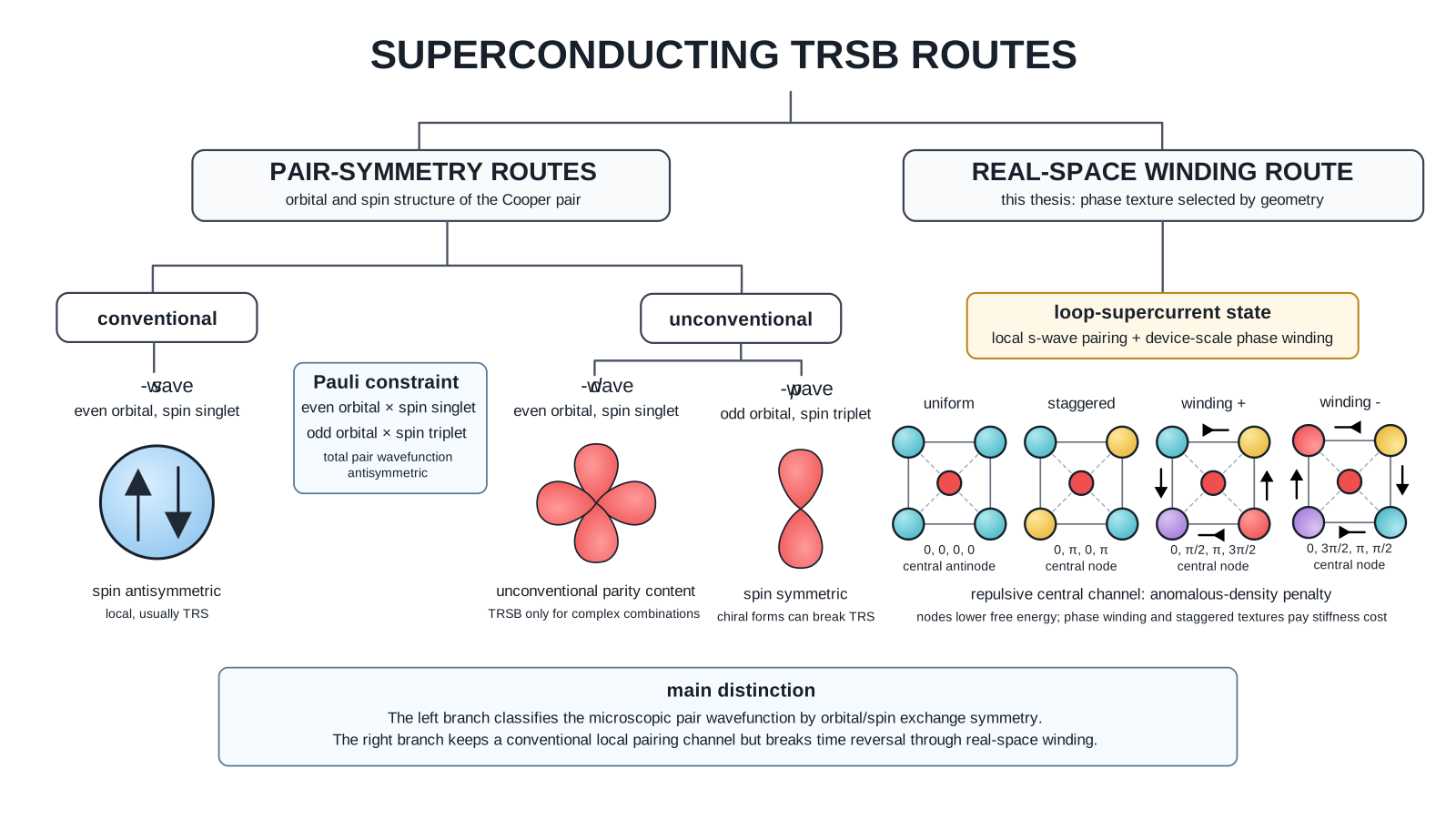
Figure 2.1: Pairing-route schematic. Conventional -wave pairing and established unconventional - and -wave references are organised by the orbital/spin exchange structure of the Cooper pair. The loop-supercurrent route developed in this thesis is shown separately: the local pairing channel can remain conventional, while TRSB is carried by real-space phase winding of the condensate texture. The right-hand selector sketches the repulsive central-channel penalty: a uniform state has an anomalous-density antinode at the centre, staggered and winding states cancel it in an ideal C4 toy-node rule, and the split/screw selector removes the staggered competitor while retaining the winding node. This C4 selector is a model geometry, not the crystal symmetry of LaNiC2 or LaNiGa2.
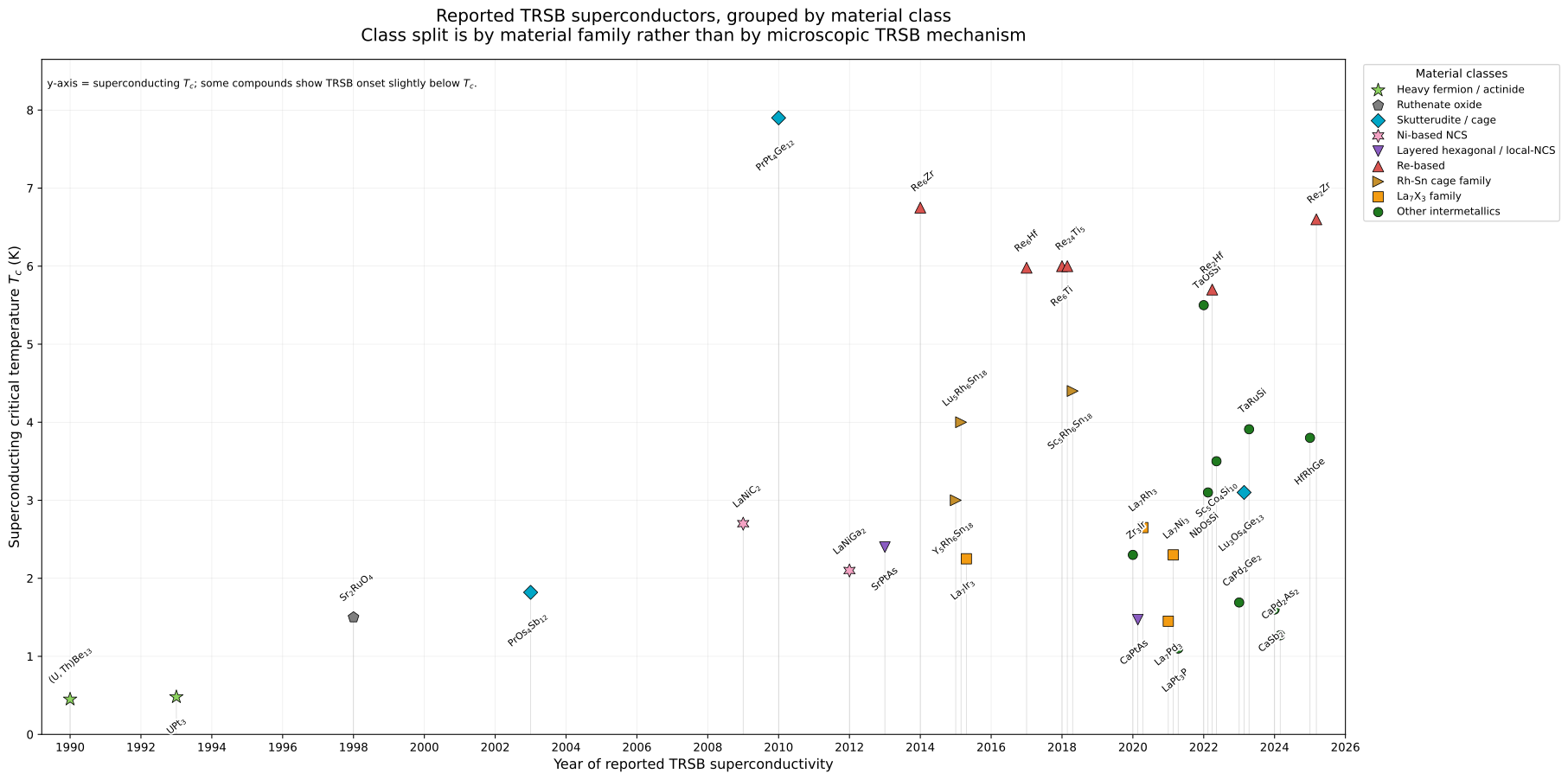
Figure 2.2: TRSB materials timeline. Reported TRSB superconductors are placed by discovery year and superconducting transition temperature , with colors and symbols indicating material class. In most materials, the microscopic mechanism underlying TRSB remains debated; only the earliest heavy-fermion examples, and , are longstanding canonical multicomponent candidates, whereas even remains under active debate.
Timeline context follows recent reviews and material surveys. [3, 4, 5]
LaNiC and LaNiGa as the motivating material pair
Two materials recur throughout this thesis because they provide a natural paired case in the TRSB literature. TRSB has been reported in both LaNiC and LaNiGa, but LaNiC is noncentrosymmetric whereas LaNiGa is centrosymmetric. This makes it difficult to explain both materials using only the standard noncentrosymmetric parity-mixing narrative without introducing additional internal structure. [6, 7, 8, 2]
In both materials the principal experimental signature is the same: in zero applied field, ZF-SR detects an additional relaxation or field distribution that appears at, or just below, , consistent with spontaneous internal fields generated by the superconducting state. [9, 7, 2]
At the same time, thermodynamic probes often look comparatively conventional. In LaNiGa, several analyses favour a fully gapped, two-gap-like superconducting state. In LaNiC, the extent of gap anisotropy or nodal structure remains more sample- and probe-dependent, and recent work argues for two-gap TRSB superconductivity in the same material family. [10, 11, 2]
That LaNiGa line of argument is especially useful here because it makes the tension explicit: TRSB points toward a nonunitary triplet interpretation, while thermodynamic data look fully gapped rather than nodal. The 2016 preprint version of the two-gap LaNiGa analysis, together with Quintanilla’s short research blog note, is a concise entry point to that puzzle and to the proposed same-spin, different-orbital pairing resolution. [10, 12]
More recently, normal-state NMR, NQR, magnetization, XPS, and DFT measurements on LaNiGa have argued against strong magnetic fluctuations or strong Stoner enhancement in the normal state. That does not by itself determine the superconducting order, but it does sharpen the motivation for mechanisms in which TRSB is selected by internal multicomponent structure rather than by a strongly correlated magnetic normal state. [13]
The LaNiC/LaNiGa pair is also not isolated. Recent SR and thermodynamic work on the noncentrosymmetric 111 family LaNiSi, LaPtSi, and LaPtGe reports the same broad combination of ingredients: a fully gapped superconducting state together with spontaneous TRSB at . In that case the normal state is argued to be a Weyl nodal-line semimetal, so the onset of TRSB superconductivity is expected to drive a topological transition as well. That broadens the significance of the present thesis: internal multicomponent TRSB is not only a puzzle for two orthorhombic intermetallics, but part of a wider material landscape where unconventional superconductivity coexists with nontrivial normal-state band topology. [14]
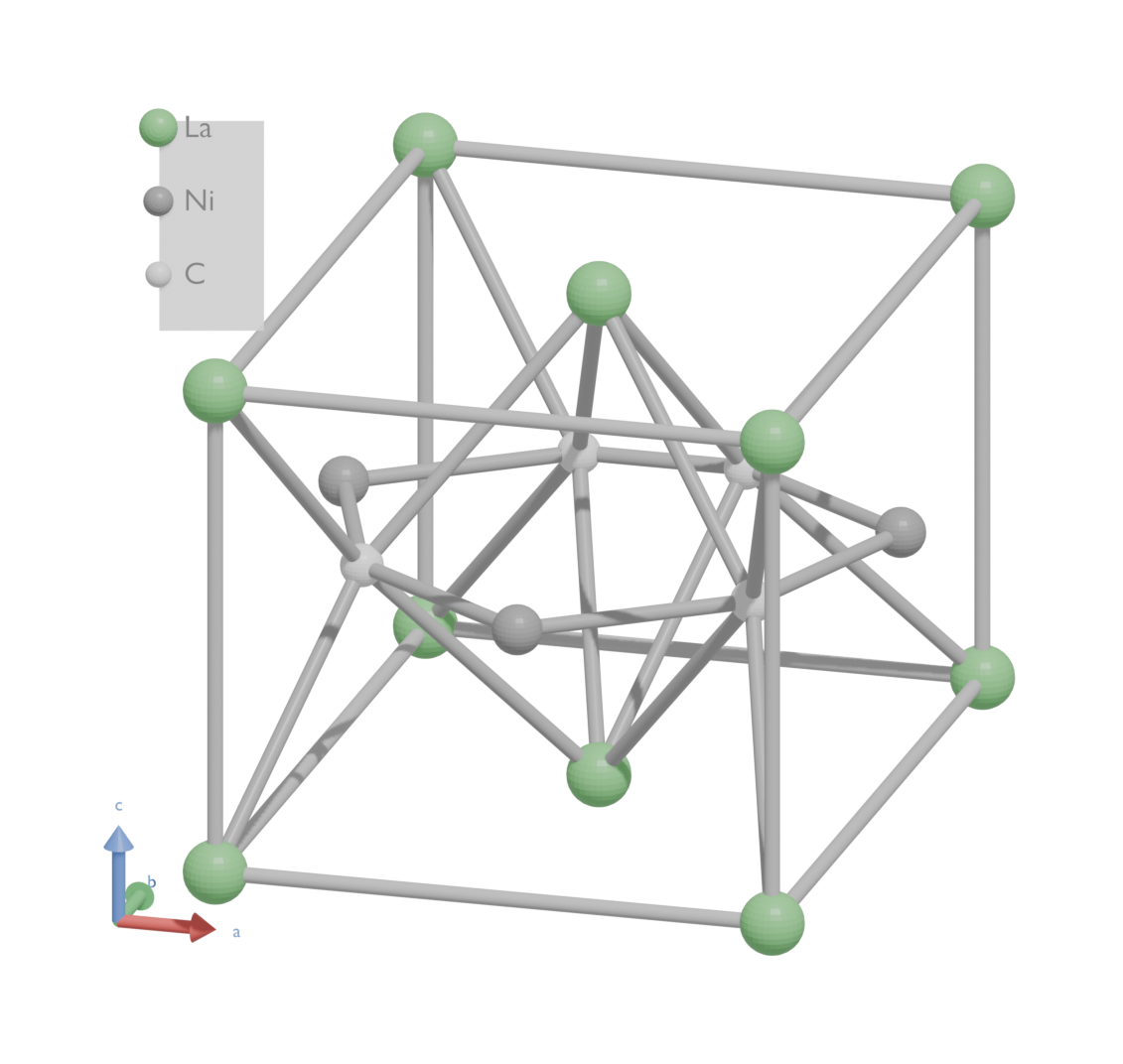
The crystallographic contrast between the pair is already informative. LaNiC crystallises in the orthorhombic noncentrosymmetric Amm2 setting, whereas LaNiGa is treated here as orthorhombic and centrosymmetric (Cmmm in the older crystallographic sources, with later nonsymmorphic electronic-structure discussions often phrased in a Cmcm setting). The structural figures below are included for one reason only: to make that internal contrast visible before the later electronic-structure discussion. [15, 16, 17, 18]
LaNiC2 overview
LaNiC2 local motif
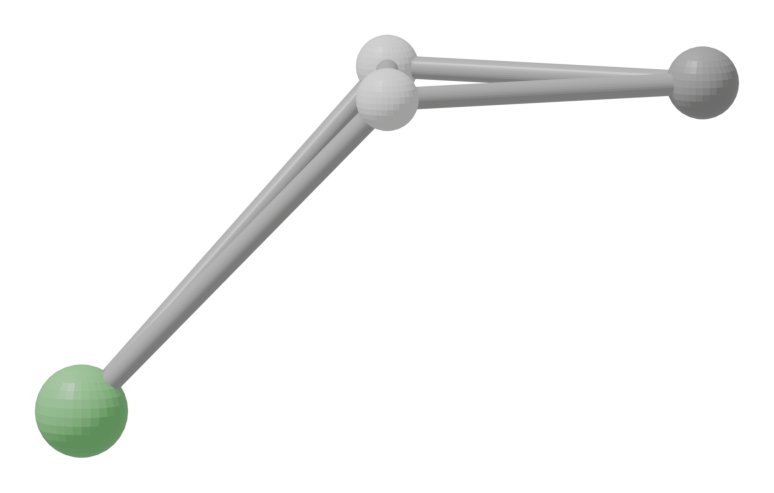
Native QTT views of the reported LaNiC crystal structure. The overview emphasises the noncentrosymmetric La-Ni-C chain network, while the local view highlights the short C motif together with its neighbouring Ni and La environment. The thesis-facing point is simply that a reduced Ni/C internal description is structurally plausible for later effective descendants. [15, 19]
LaNiGa2 overview
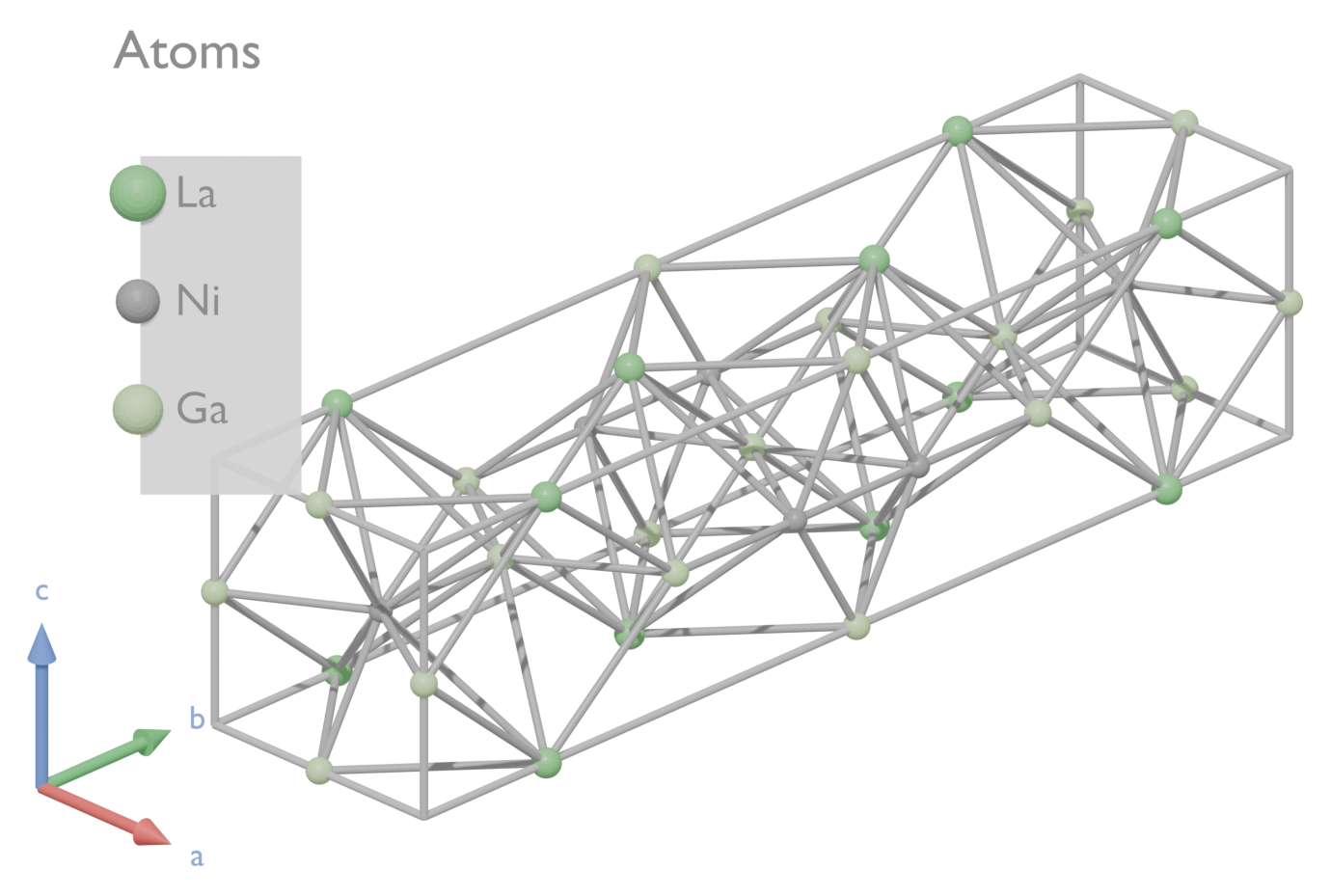
LaNiGa2 local coordination
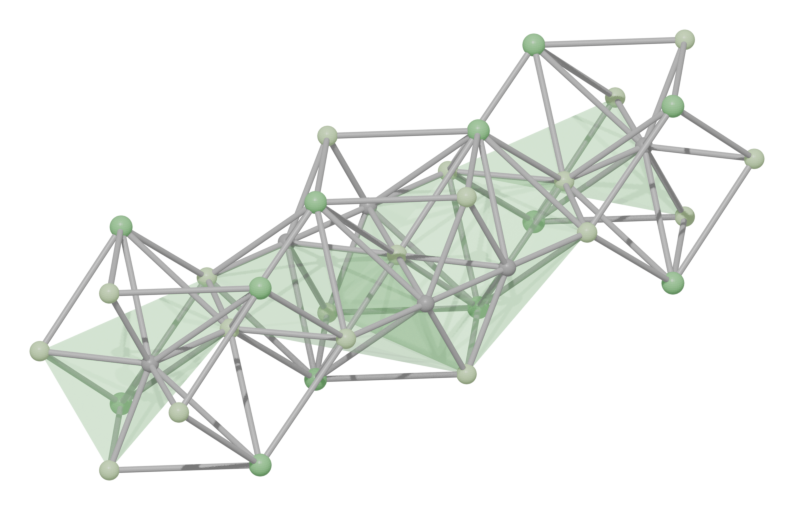
Native QTT views of the reported LaNiGa crystal structure. The overview and local motif make clear that the low-energy problem is multiorbital and internally structured even before superconductivity is introduced. But unlike LaNiC, the thesis does not treat local coordination as the decisive materials input here; the later normal-state symmetry and Wannier discussion must carry that burden. [16, 17]
The structural point of these figures is therefore modest. Local coordination pictures can make the unit cell legible, but they do not determine the superconducting mechanism. For LaNiC they suggest that an internal Ni/C reduction may be meaningful; for LaNiGa they mainly warn that the problem is too multiorbital and symmetry-constrained to be read off from a neighbour graph. The physics burden therefore passes quickly from structure to electronic structure: projected bands, spin-orbit splitting, Wannier reduction, and the symmetry of the low-energy manifold. [20, 19, 18]
First-principles superconductivity literature
It is also useful to separate the existing microscopic literature on this material pair into three layers. First, there are conventional first-principles electronic-structure and electron-phonon studies, such as the Subedi-Singh calculation for LaNiC, Zhang et al.’s DFT and de Haas–van Alphen simulation paper for LaNiC, Singh’s fermiology study of LaNiGa, and the later DFPT analysis of LaNiGa by Tütüncü and Srivastava. Second, there are DFT-informed superconductivity papers that solve a semiphenomenological BdG- or KKR-based model on top of the ab initio electronic structure. Third, there are the later symmetry- and topology-focused papers, especially for LaNiGa, which establish the nonsymmorphic Dirac-line / Dirac-loop normal-state setting that any serious low-energy theory must preserve. [21, 22, 23, 24, 25, 18]
Within the literature surveyed for this thesis, no standard parameter-free superconducting density-functional calculation in the Oliveira-Gross-Kohn sense was identified for either LaNiC or LaNiGa. The nearest published microscopic results instead sit on the DFT-informed BdG side. That distinction matters for the later modelling chapters, because it means the existing literature already points toward a materials-faithful multiorbital BdG programme, but not yet to a settled ab initio SCDFT explanation of the pairing interaction.
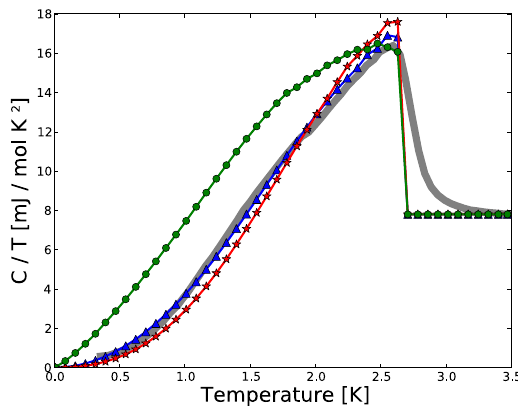
For LaNiC, the clearest example is the 2018 paper by Csire, Újfalussy, and Annett, who describe a first-principles-based semiphenomenological Dirac-BdG treatment of nonunitary triplet pairing. Their central thermodynamic comparison is reproduced below. The thesis-facing point is not merely that a nonunitary triplet state can be written down, but that the nodal candidate is disfavoured while fully gapped interorbital equal-spin states remain viable. In their fit, the pairing strengths are fixed by requiring the self-consistent calculation to reproduce the experimental , so the paper remains DFT-informed BdG rather than parameter-free SCDFT. [26]
For LaNiGa, the closest existing quantitative superconductivity paper is the 2020 work of Ghosh, Annett, Gradhand, and Quintanilla. It starts from ab initio electronic structure and magnetic information, then introduces a phenomenological interorbital equal-spin pairing interaction on the Ni sector. The paper again uses a single adjustable interaction, fixed by the experimental , and the supplementary material explicitly formulates the technical implementation in KKR / Kohn-Sham-Dirac-BdG language. The figure reproduced below is therefore especially useful for this thesis: it ties together three quantities that any later microscopic model should try to reproduce simultaneously, namely the specific heat, the spontaneous internal moment below , and the two-gap spin-resolved quasiparticle density of states. [25, 27]
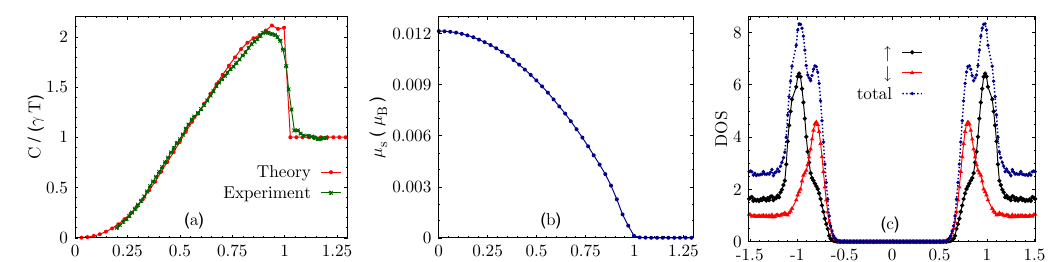
Taken together, these papers set the immediate target for the later modelling chapters. They do not yet provide a standard SCDFT account of superconductivity in LaNiC or LaNiGa, but they do show that DFT-informed multiorbital BdG theory can already reach experimentally meaningful observables. The next step for the present thesis is therefore not to start from a neighbour graph or a hand-drawn bond model, but to build low-energy models faithful to the orthorhombic material inputs that can test whether the observed TRSB is better understood through nonunitary interorbital pairing, internally winding orbital order, or a combination of both. For LaNiGa, that programme must in particular remain compatible with the later nonsymmorphic normal-state literature, where the low-energy Dirac-line / Dirac-loop structure constrains the admissible superconducting models from the outset. [18, 13]
These materials therefore motivate two broad microscopic routes:
- spin TRSB, usually in the form of nonunitary triplet or equal-spin pairing;
- orbital TRSB, in the form of internal phase winding and loop supercurrents inside a unit cell.
The thesis focus is the second route. The reason is not that the first route is excluded, but that LaNiC and LaNiGa demand a framework in which TRSB can emerge from internal multicomponent structure even when the familiar chiral-momentum-space explanation is not naturally enforced.
That is the narrative handoff to the later materials chapter. The background task is to explain why LaNiC and LaNiGa force the problem beyond the standard two-dimensional-irrep story. The materials task is then narrower and harder: determine what orthorhombic-material low-energy basis and what candidate pairing structures remain viable once the actual normal-state electronic structure is respected.
| Material | Inversion | Symmetry setting | (typ.) | Main TRSB evidence | Gap phenomenology | Thesis-facing significance |
|---|---|---|---|---|---|---|
| LaNiC | absent | orthorhombic, noncentrosymmetric | ZF-SR onset of spontaneous internal fields at or near | broadly conventional thermodynamics; nodal or anisotropic structure debated | motivates TRSB without a natural 2D-irrep explanation | |
| LaNiGa | present | orthorhombic, centrosymmetric | ZF-SR onset of spontaneous internal fields at or near | often described as fully gapped with two-gap phenomenology | shows that the mechanism cannot be reduced to noncentrosymmetric parity mixing |
Mechanism map
Terminology. “Two-component TRSB” here means a (nearly) degenerate two-component order parameter (often a 2D irrep) whose relative phase is complex, e.g. . [28] This is not the same as “multiorbital spin-triplet”, where internal orbital/band structure supplies the relevant multicomponent degree of freedom even if the crystal irrep is 1D. [2] “Nonunitary triplet” is a distinct TRSB route: can occur already for 1D irreps, with TRSB residing in internal spin structure rather than a chiral basis function. [7, 8] “Two-gap superconductivity” is spectral phenomenology: it means two distinct gap scales are inferred from low-energy quasiparticles (often associated with different Fermi-surface sheets) and does not, by itself, specify singlet vs triplet, unitary vs nonunitary, or orbital-diagonal vs interorbital pairing. In LaNiGa a prominent proposal is precisely that an interorbital equal-spin, nonunitary triplet state produces a fully gapped two-gap spectrum [10], but the reverse implication is not generally valid: two-gap behaviour can also occur in multiband singlet superconductors, including TRSB multiband singlet states such as [29]. A multiband example where the broken-symmetry state is often described as rather than a symmetry-protected 2D-irrep chiral state is BaKFeAs. [29] This is why LaNiC/LaNiGa are not clean textbook 2D-irrep chiral examples: the likely multicomponent structure is internal (spin/orbitals/bands) within an orthorhombic setting. [2, 10]
The mechanism classes used in this thesis are summarised in Table 2.1. Standard chiral momentum-space states are included mainly as a reference class against which the internally winding mechanisms of interest are contrasted.
| Mechanism class | Source of multicomponent structure | TRSB variable | Typical field phenomenology | Role in this thesis |
|---|---|---|---|---|
| Chiral state from 2D irrep | crystal symmetry, two-dimensional irrep | relative phase , e.g. | often edge-, defect-, or domain-wall-dominated | standard reference case, not the main mechanism here |
| Nonunitary triplet | internal spin structure, often with SOC | local and strongly screened spontaneous fields | major alternative mechanism for LaNiC/LaNiGa | |
| Unit-cell loop supercurrents | inequivalent sites or orbitals within a unit cell | internal phase winding and loop chirality | intra-cell currents; fields concentrated near disorder and domains | central microscopic mechanism of the thesis |
| Complex mixing of two 1D channels | near-degenerate pairing channels | relative phase between two scalar order parameters | weak bulk fields with strong domain dependence | useful bridge beyond the 2D-irrep route |
| Multiband or multi-orbital frustration | three or more coupled internal phases | phase structure | defect- and domain-wall-dominated fields | generic precursor to internally winding TRSB states |
Symmetry classification and the gauge-aware criterion for TRSB
Order parameters as representations of crystal symmetry
A superconducting order parameter is not merely a scalar gap amplitude. In a weak-coupling description the gap matrix transforms under the symmetry group of the normal state, and the allowed superconducting states are classified by irreducible representations of the crystal point group. In GL language, the order-parameter components are coordinates in the irrep space. Standard symmetry-based treatments are given in [28].
For a one-dimensional irrep, the primary order parameter is usually a single complex scalar. For a multidimensional irrep, several complex components condense and relative phases become physical low-energy degrees of freedom. This is the usual symmetry route to TRSB at the superconducting transition.
That route is important as a reference point, but it is not sufficient for the present thesis. In LaNiC and LaNiGa, the relevant orthorhombic point groups do not provide the natural two-dimensional irrep structure that would make the standard chiral explanation automatic. The multicomponent degree of freedom must instead be internal.
Time reversal and the gauge-aware criterion for TRSB
Time reversal is antiunitary. It complex-conjugates amplitudes and reverses momenta and spins. A superconducting state preserves TRS only if the order parameter is invariant under up to global gauge redundancy and, when relevant, up to basis changes inside a degenerate internal subspace.
This is the key point used repeatedly later: every superconductor is described by a complex order parameter, but TRSB does not mean merely that the order parameter is complex. It means that the complex structure cannot be removed by gauge choice.
At the many-body or mean-field level, a superconducting state preserves TRS if there exists a global phase such that
TRSB means that no such exists.
At the level of the pairing kernel, for spin- electrons with unitary spin part ,
must hold for some global phase . Failure of this condition is a practical TRSB criterion.
At the Bogoliubov–de Gennes (BdG) level, TRS means the existence of an antiunitary operator such that
Experimentally, TRSB is inferred through observables odd under , such as spontaneous internal fields, Kerr rotation, or anomalous interference.
A practical consequence is that spontaneous TRSB produces a discrete degeneracy: if is a TRSB state, then is distinct and degenerate in zero field. Domain formation is therefore generic, and weak-field probes are often dominated by domain walls, disorder, or boundaries rather than by a uniform bulk moment.
Ginzburg—Landau routes to TRSB
For a multicomponent order parameter , the GL free energy has the schematic form
where the terms encode the allowed symmetry couplings between components. Minimisation determines whether the ordered state preserves or breaks TRS.
Standard reference case: two-component irrep order
For a two-component order parameter transforming as a two-dimensional irrep, a standard quartic free-energy density is
Write
and define the relative phase
If , the minimum is typically realised by a real configuration and TRS is preserved. If , minimisation favours
which is realised by
These states break TRS because time reversal maps to and the two are not gauge-equivalent.
This is the standard textbook route to chiral momentum-space states such as or . It is included here as the reference case, but it is not the primary organising principle for the material systems studied in this thesis.
Complex mixing of two one-dimensional channels
TRSB does not require a multidimensional crystal irrep. It can also arise when two distinct one-dimensional pairing channels are nearly degenerate. Let and be complex scalar order parameters associated with two one-dimensional irreducible representations. The quartic coupling
locks the relative phase through .
If , the minimum occurs at or and the coexistence state preserves TRS. If , the minimum occurs at
so the coexistence state takes the form and breaks TRS.
This mechanism is already closer to the thesis viewpoint, because the decisive issue is not momentum-space chirality by itself but free-energy selection among multiple internal order-parameter components.
From multicomponent GL theory to internal phase winding
Later chapters work with explicit mean-field and BdG Hamiltonians. The phase-locking terms that appear in GL theory arise microscopically by introducing multiple pairing fields, integrating out the fermions, and expanding the resulting effective action in powers of those fields:
When amplitudes are relatively stiff, the long-wavelength reduction is a phase theory,
with generated by intercomponent pair scattering.
This phase-only form is the natural bridge to internally winding TRSB states. The relevant components need not correspond to distinct Fermi pockets. They can be orbitals or inequivalent sites inside one unit cell. Once that happens, phase frustration becomes an internal free-energy problem rather than a momentum-space chirality problem.
Frustrated internal phases as a route to TRSB
TRSB frequently appears as the resolution of phase frustration. Several couplings try to lock relative phases to incompatible values, and the system lowers its free energy by choosing intermediate phase differences that are neither nor . The resulting complex structure is physical and cannot be removed by a global gauge transformation.
This mechanism is important for two reasons. First, it gives a general route to TRSB in multiband and multi-orbital superconductors without requiring a chiral spatial basis function. Second, it maps directly onto loop-supercurrent constructions in which the relevant phases live within a single unit cell.
Multiband and multi-orbital phase locking
In a minimal description one introduces
and writes
For there is no frustration: the single preferred phase difference can always be satisfied. For , competing signs and magnitudes of the couplings can produce incompatible constraints.
The canonical frustrated pattern is
together with its time-reversed partner
The order-parameter manifold then has a structure: the usual overall superconducting phase and a discrete chirality selecting one of two time-reversed minima.
Internal components within a unit cell
The components need not label different bands. In a Wannier or orbital basis they can label inequivalent internal degrees of freedom within one unit cell. Pair-hopping terms again reduce to phase-locking terms between the corresponding phases.
If the internal coupling graph contains loops, the minimal case being a triangle, frustrated couplings can stabilise circulating bond supercurrents,
Two opposite circulation patterns are then related by time reversal and define a loop chirality. This is the microscopic content of the internal-winding mechanism used later in the thesis.
Domains and weak spontaneous fields
A frustration-driven TRSB state forms domains in zero field because the two time-reversed minima are degenerate. Domain walls support spatial variation of the relative phases and can carry supercurrents and local magnetic fields even when the uniform bulk magnetisation is negligible.
This is why TRSB signatures are often experimentally subtle. The symmetry breaking is robust, but the observable fields may be concentrated near defects, disorder, or domain boundaries and further reduced by Meissner screening. [30, 31]
Experimental probes and their interpretive limits
TRSB is inferred through responses that are odd under time reversal. No single experiment measures the order parameter directly.
Zero-field SR
ZF-SR detects changes in the local magnetic-field distribution below through enhanced muon-spin depolarisation or relaxation. It is highly sensitive to small internal fields and is therefore central to the LaNiC/LaNiGa discussion. Its interpretation nevertheless requires care: SR detects local fields, not order-parameter phase directly, and the measured signal can be dominated by domain structure or inhomogeneous field localisation. [32, 33, 2]
Instrument view
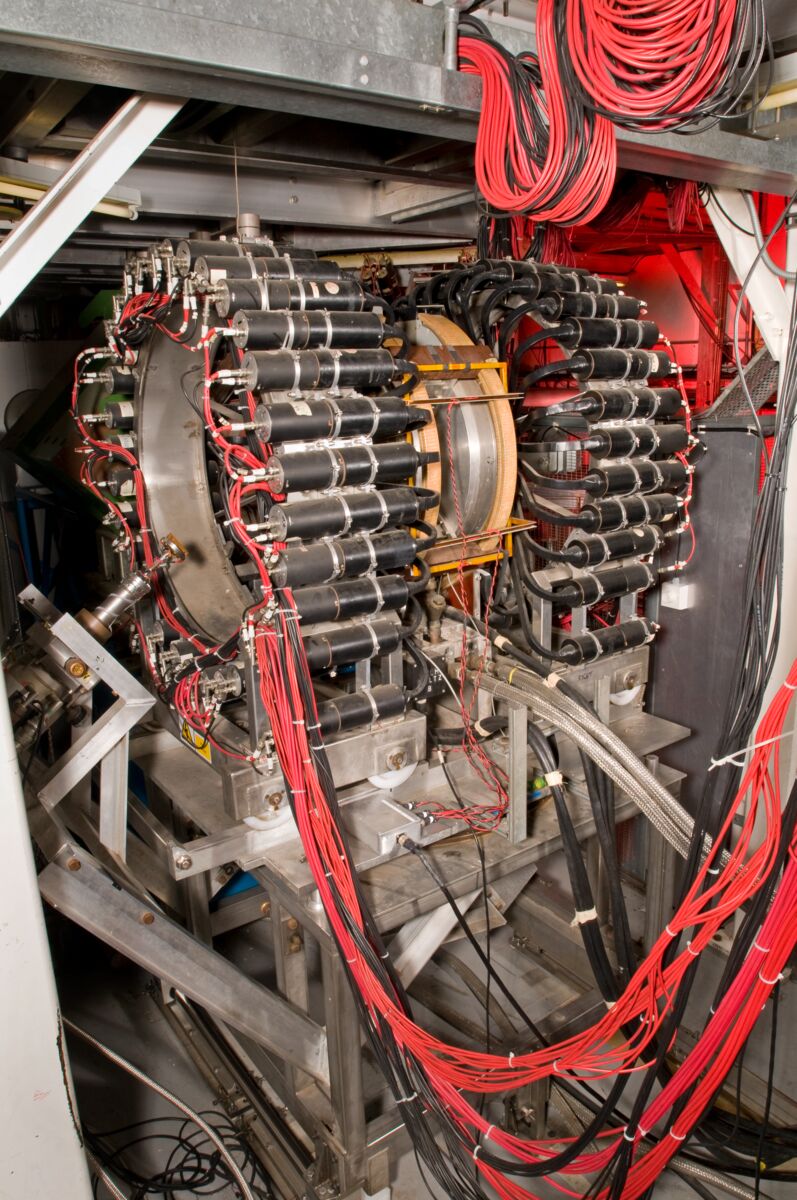
ZF-μSR schematic
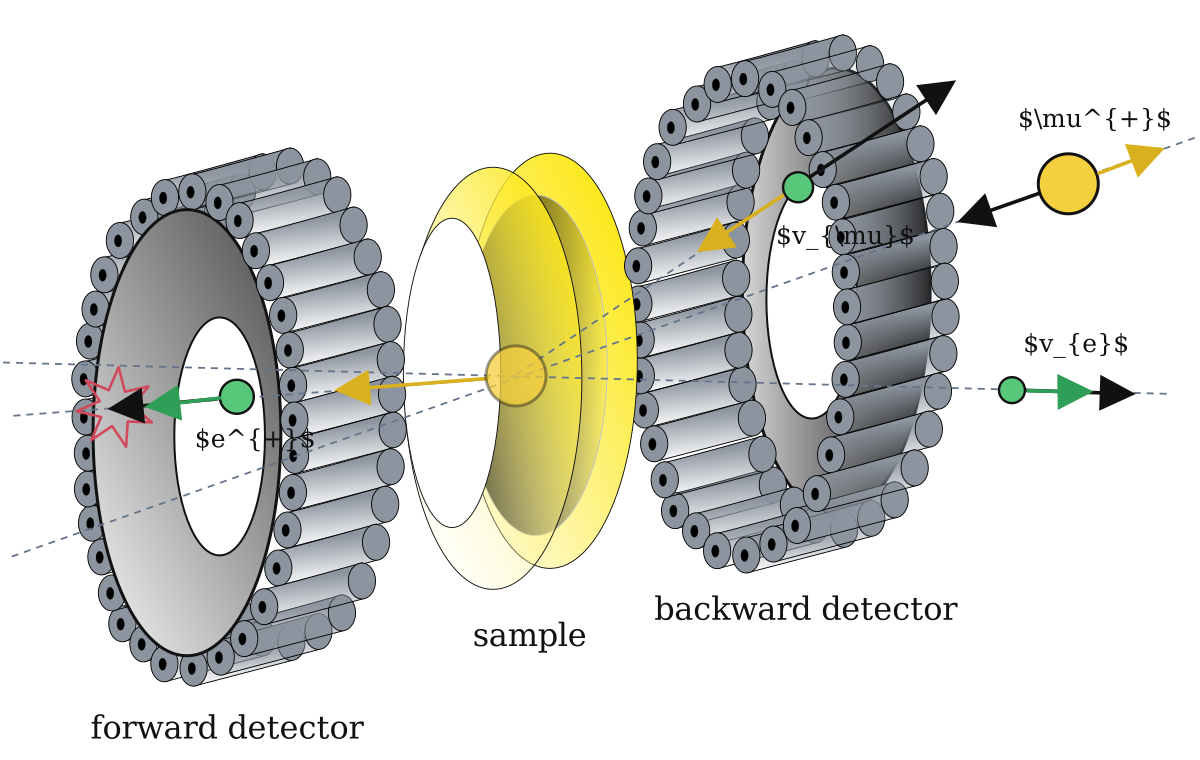
SR probe overview. The instrument photograph shows the detector environment, while the schematic summarizes the zero-field measurement logic: implanted spin-polarised muons precess in the local internal-field distribution and decay anisotropically into positrons, whose angular asymmetry is recorded by forward and backward detectors. In TRSB superconductors, spontaneous fields appearing below broaden that field distribution and generate an additional relaxation channel even when the underlying fields are weak, spatially nonuniform, and affected by domains or screening.
Kerr, Josephson, and local magnetic probes
Polar Kerr rotation probes TRS-breaking optical response and therefore complements SR. Phase-sensitive Josephson interferometry probes superconducting phase structure more directly. Scanning SQUID or Hall imaging constrains whether spontaneous fields are edge-like, defect-bound, or associated with domain walls. These distinctions matter because internally winding and loop-current states are naturally expected to produce highly nonuniform local fields. [34, 35, 36, 37]
LaNiC and LaNiGa: TRSB beyond the 2D-irrep route
The key symmetry constraint is simple. In many canonical TRSB superconductors, including the usual chiral reference cases, TRSB at the primary transition is naturally explained by a multidimensional irrep: two order-parameter components condense together and a relative phase such as is selected. In LaNiC and LaNiGa, the relevant orthorhombic point groups have only one-dimensional irreducible representations, so the simplest chiral-irrep mechanism is not naturally available.
The two materials nevertheless differ in a way that matters for the later SOC discussion. LaNiC is noncentrosymmetric with point group (C_{2v}) (mm2), so antisymmetric spin-orbit coupling and parity mixing are symmetry-allowed ingredients of a material Hamiltonian. LaNiGa is centrosymmetric with point group (D_{2h}) (mmm), so it does not reduce to the same antisymmetric-SOC story even though it shares the orthorhombic one-dimensional-irrep constraint. This is why the thesis treats spin-orbit texture as a material-specific projection problem rather than as a generic SOC/no-SOC switch.
This is why these materials are central here. They force the multicomponent structure to be internal rather than inherited directly from crystal representation theory. Historical reference systems such as SrRuO or UPt remain useful contrasts, but they are not the organising centre of the present thesis. [38, 34, 39, 35]
Coupled-magnetisation mechanism for TRSB in LaNiC/LaNiGa
A GL mechanism emphasised in this material family is that a superconducting instability in a triplet channel can couple linearly to a subdominant magnetisation and thereby lower the free energy of a nonunitary TRSB state. [7, 25, 2]
Within the LaNiGa discussion, the crucial microscopic claim is not merely that the state is triplet, but that pairing can occur between electrons of the same spin on different orbitals. That preserves overall fermionic antisymmetry while allowing an even-parity, fully gapped, two-gap superconducting state that still breaks time-reversal symmetry. This was the central interpretation advanced in the 2016 LaNiGa penetration-depth / heat-capacity / upper-critical-field analysis and highlighted in the accompanying commentary. [10, 12]
A useful earlier notebook calculation makes the practical ambiguity of this proposal concrete. In a two-orbital impurity model, the spin-resolved local spectrum distinguishes the multiorbital-singlet and nonunitary-triplet cases rather clearly at low broadening, but the total local DOS becomes much harder to tell apart once the phenomenological broadening is increased to the scale of the orbital splitting. That is precisely why the earlier notebook work treated QPI and other structured probes as more discriminating than a broadened tunnelling spectrum by itself.
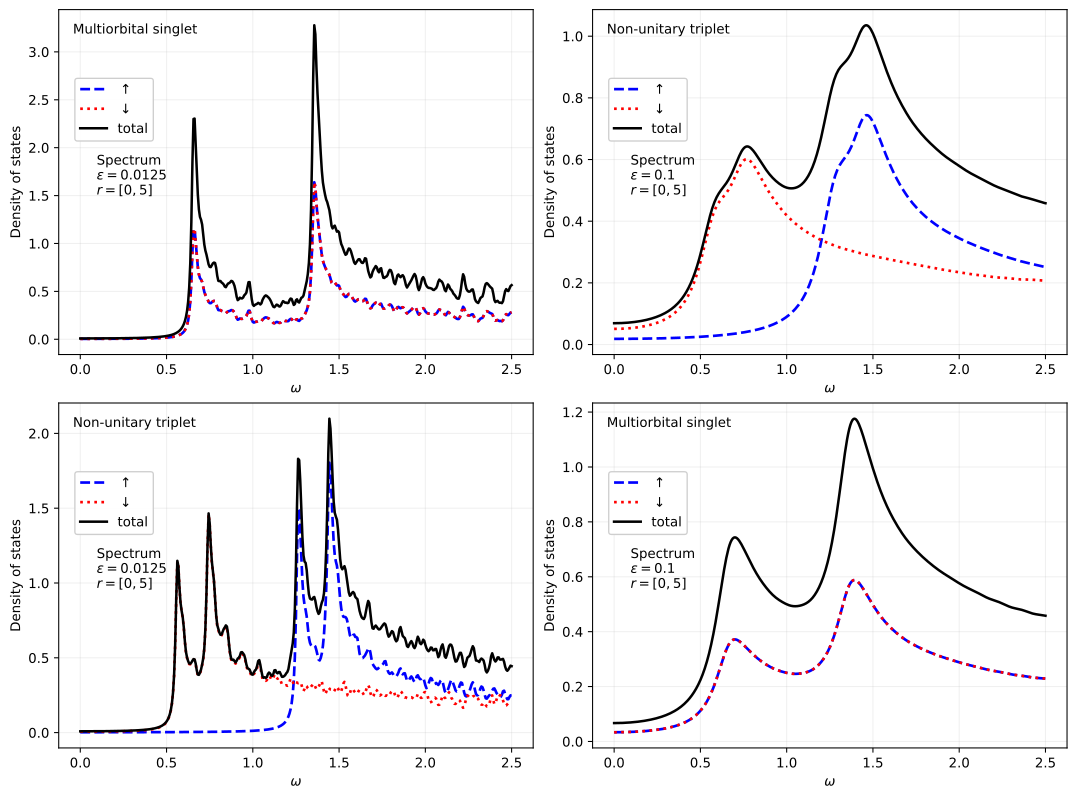
Figure 2.3: Author calculation from the earlier two-orbital impurity-model notebook. Left: the low-broadening case (\epsilon=0.0125) resolves the spin/orbital structure cleanly. Right: at (\epsilon=0.1) the same spin-resolved spectra are visibly smeared, although the nonunitary-triplet branch still retains an internal asymmetry between the spin channels. The model uses (43\times 43) sites, an impurity at the origin with (V/t=1.21), and the original parameter sets used in the earlier notebook comparison.
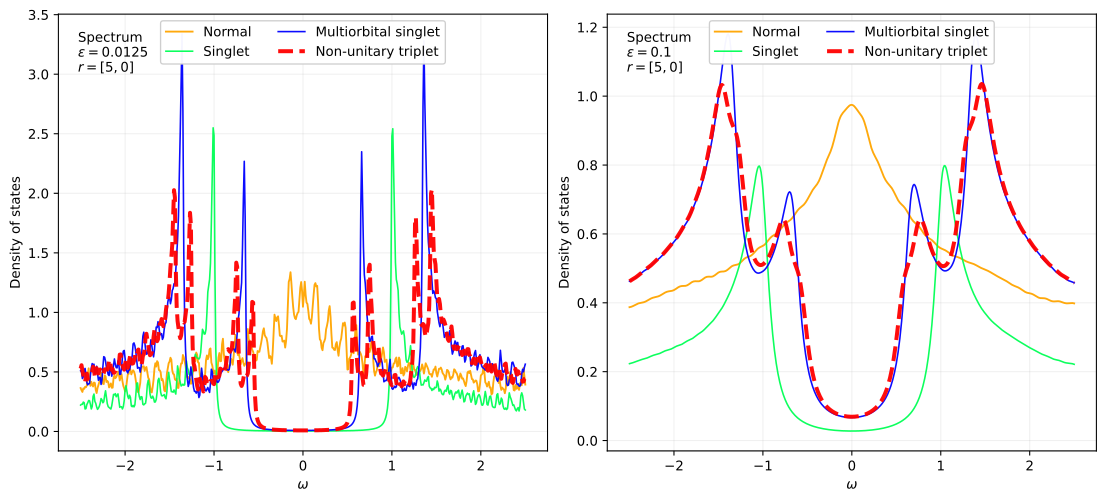
Figure 2.1: Author calculation from the same two-orbital impurity-model notebook. Left: at low broadening (\epsilon=0.0125), the multiorbital-singlet and nonunitary-triplet spectra can still be separated in the total local DOS. Right: at larger broadening (\epsilon=0.1), the two become much less distinguishable. The comparison uses (43\times 43) sites, (\mu=0), rigid orbital splitting (s/t=0.05), interorbital hybridisation (\delta/t=0.075), pairing scale (\Delta/t=1), interorbital shift (\varsigma/t=0.35), and an impurity at the origin with (V/t=1.21), sampled at (\mathbf r=[5,0]).
The newer normal-state study is useful here as a counterweight. If LaNiGa lacks strong precursor magnetic fluctuations in the normal state, then any successful TRSB mechanism has to work without leaning too heavily on the usual strongly correlated narrative. That makes internally structured order parameters, multiorbital pairing, and unit-cell-scale phase structure even more relevant to the thesis viewpoint. [13]
The 111-family result is useful for a different reason. There the argument is not built around LaNiGa-style same-spin different-orbital pairing, but around a minimal spin-triplet description of superconductivity emerging from a Weyl nodal-line normal state. That provides a second route by which TRSB, full gaps, and nontrivial normal-state topology can coexist, and it is therefore an important wider backdrop for the thesis emphasis on internal superconducting structure beyond the simplest chiral-irrep story. [14]
Nonunitary triplet order
For a spin-triplet superconductor the order parameter may be encoded by a complex vector. In a reduced GL description one may use a complex vector order parameter . A standard TRSB diagnostic is the nonunitarity vector
If , the state is unitary. If , the state is nonunitary and breaks TRS.
Importantly, can be nonzero even when the crystal irrep is one-dimensional. The TRSB then resides in the internal spin structure of the condensate rather than in a chiral momentum-space basis function.
GL free energy with magnetisation coupling
Introduce a subdominant magnetisation and write
with .
If is subdominant, minimisation at quadratic order gives
Substituting back yields
The negative sign is the key result. Any configuration with nonzero is favoured by this coupling. A nonunitary TRSB state can therefore be stabilised already at even though the crystal point group has only one-dimensional irreducible representations. [7, 8, 10, 25]
For illustration, take
Then
so the state is nonunitary, TRSB, and induces .
Loop supercurrents and internally winding states
The loop-supercurrent framework is the culmination of the present chapter. Its central claim is that TRSB can be selected by free-energy minimisation in an internal Josephson network formed by superconducting phases attached to inequivalent sites or orbitals within one unit cell. The broken symmetry is then carried by internal phase winding rather than by a conventional momentum-space chiral basis function.
This is the route that most directly matches the thesis. It naturally produces small, local spontaneous fields, it accommodates orthorhombic materials in which a 2D-irrep explanation is not available, and it makes the relevant degree of freedom a loop chirality rather than a macroscopic edge-current pattern. [1, 2]
Internal Josephson networks and loop chirality
Suppose several superconducting components associated with inequivalent internal degrees of freedom are coupled in a frustrated way. The unit cell then acts as an internal Josephson network. If the coupling graph contains loops and the preferred phase differences are incompatible, the minimum is a compromise phase pattern with circulating bond supercurrents.
The two opposite circulation patterns are related by time reversal and form a pair. TRSB is therefore tied to a discrete choice of loop chirality. This is the internally winding alternative to standard chiral momentum-space pairing.
Gauge-invariant loop variables
On a lattice or network the gauge-invariant phase difference on a bond is
The corresponding bond current is proportional to . Summing link phases around a closed path gives a loop holonomy. In the present setting that holonomy is not a formal gauge-theory detour; it is the natural collective coordinate for internally frustrated superconducting phases on a fixed microscopic network.
GL reduction in the loop-chirality subspace
The effective two-component order parameter relevant for loop supercurrents is not a two-component crystal-irrep order parameter. It arises instead from a doubly degenerate superconducting instability at quadratic order in a subspace spanned by two time-reversed loop-current basis states and . [1]
Expand
so that the order parameter is
Time reversal exchanges the basis states and implies
Write
and define the relative phase
The quartic free energy in this instability subspace reduces to
with
Minimising over the amplitude gives
For , so that , the ground state is found by minimising .
The minima occur in time-reversed pairs:
which exchange and and therefore correspond to opposite loop-supercurrent circulation. In a special regime there is a continuous ring of degenerate minima satisfying
The relevant structural point is that the effective two-component space here is internal. It is generated microscopically from orbitals, sites, or bands and then resolved by quartic free-energy minimisation into a pair of internally winding TRSB states.
Summary
This chapter has established the main conceptual framework used throughout the thesis for discussing TRSB in superconductors. Standard chiral momentum-space pairing from a two-dimensional irrep remains the canonical textbook route to TRSB, but it serves here mainly as a contrast class. The central emphasis is that TRSB can also arise from internal multicomponent structure, with the broken-symmetry state selected by microscopic free-energy minimisation. When phase locking among internal superconducting components is frustrated, the resulting state acquires a structure, forms domains, and generates weak but symmetry-diagnostic spontaneous fields.
LaNiC and LaNiGa are important because they motivate TRSB mechanisms that are not naturally explained by the standard 2D-irrep route. Within this material family, nonunitary triplet order coupled to a subdominant magnetisation provides one symmetry-consistent mechanism. The central thesis mechanism, however, is that loop supercurrents can carry TRSB through internal phase winding and a discrete loop chirality inside the unit cell.
Later chapters construct microscopic representatives of this internally winding TRSB mechanism and study their symmetry and boundary consequences.
Internal Maintainer Notes (Not Thesis Content)
This directory is a thesis content tree; keep workflow notes here for maintainers/agents only.
To attach a missing PDF to an existing Papis entry (library papers), use:
1papis -l papers addto --doc-folder /home/henry/Resources/Papers/<papis_id> -f /path/to/file.pdf --file-name '{doc[ref]}.pdf'Replace <papis_id> with the entry folder id and /path/to/file.pdf with the downloaded file path.
References
- S. Ghosh, J. Annett, and J. Quintanilla,
Time-reversal symmetry breaking in superconductors through loop supercurrent order,
New Journal of Physics, vol. 23, no. 8, p. 083018, 2021. doi:10.1088/1367-2630/ac17ba (↩︎) - S. Ghosh, M. Smidman, T. Shang, J. Annett, A. Hillier, J. Quintanilla, and H. Yuan,
Recent progress on superconductors with time-reversal symmetry breaking,
J. Phys.: Condens. Matter 33 033001 (2020), 2020. doi:10.1088/1361-648X/abaa06 (↩︎) - [missing reference] (↩︎)
- [missing reference] (↩︎)
- [missing reference] (↩︎)
- [missing reference] (↩︎)
- A. Hillier, J. Quintanilla, B. Mazidian, J. Annett, and R. Cywinski,
Non-unitary triplet pairing in the centrosymmetric superconductor LaNiGa,
2012. doi:10.1103/PhysRevLett.109.097001 (↩︎) - J. Quintanilla, A. Hillier, J. Annett, and R. Cywinski,
Relativistic analysis of the pairing symmetry of the noncentrosymmetric superconductor LaNiC,
Phys. Rev. B 82, 174511 (2010), 2010. doi:10.1103/PhysRevB.82.174511 (↩︎) - A. Hillier, J. Quintanilla, and R. Cywinski,
Evidence for time-reversal symmetry breaking in the noncentrosymmetric superconductor LaNiC 2,
Phys. Rev. Lett., vol. 102, no. 11, p. 117007, 2009. doi:10.1103/PhysRevLett.102.117007 (↩︎) - Z. Weng, J. Zhang, M. Smidman, T. Shang, J. Quintanilla, J. Annett, M. Nicklas, G. Pang, L. Jiao, W. Jiang, Y. Chen, F. Steglich, and H. Yuan,
Two-gap superconductivity in LaNiGa with non-unitary triplet pairing and even parity gap symmetry,
Phys. Rev. Lett. 117, 027001 (2016), 2016. doi:10.1103/PhysRevLett.117.027001 (↩︎) - S. Sundar, S. Dunsiger, S. Gheidi, K. Akella, A. Côté, H. Özdemir, N. Lee-Hone, D. Broun, E. Mun, F. Honda, Y. Sato, T. Koizumi, R. Settai, Y. Hirose, I. Bonalde, and J. Sonier,
Two-gap time reversal symmetry breaking superconductivity in non-centrosymmetric LaNiC2,
Phys. Rev. B, vol. 103, no. 1, p. 014511, 2021. doi:10.1103/PhysRevB.103.014511 (↩︎) - J. Quintanilla,
Two-gap superconductivity in LaNiGa_2 with non-unitary triplet pairing and even parity gap symmetry,
2016. [Online]. Available: https://blogs.kent.ac.uk/strongcorrelations/2016/06/16/laniga2-prl-2016/ (↩︎) - P. Sherpa, I. Vinograd, Y. Shi, S. Sreedhar, C. Chaffey, T. Kissikov, M. Jung, A. Botana, A. Dioguardi, R. Yamamoto, M. Hirata, G. Conti, S. Nemsak, J. Badger, P. Klavins, I. Vishik, V. Taufour, and N. Curro,
Absence of strong magnetic fluctuations or interactions in the normal state of LaNiGa2,
Physical Review B, vol. 109, p. 125113, 2024. doi:10.1103/physrevb.109.125113 (↩︎) - T. Shang, S. Ghosh, M. Smidman, D. Gawryluk, C. Baines, A. Wang, W. Xie, Y. Chen, M. Ajeesh, M. Nicklas, E. Pomjakushina, M. Medarde, M. Shi, J. Annett, H. Yuan, J. Quintanilla, and T. Shiroka,
Spin-triplet superconductivity in weyl nodal-line semimetals,
npj Quantum Materials, vol. 7, 2022. doi:10.1038/s41535-022-00442-w (↩︎) - Materials Project,
Materials data on LaNiC by materials project,
OSTI Data Explorer, 2017. doi:10.17188/1350127 (↩︎) - Y. Grin’ and Y. Yarmolyuk,
Crystal structures of the RGani compounds (r = la, ce, pr, nd, sm, gd),
Dopovidi Akademii Nauk Ukrains’koi RSR, Seriya A: Fiziko-Matematichni ta Tekhnichni Nauki, vol. 3, pp. 69–72, 1982. (↩︎) - V. Romaka, Y. Grin, Y. Yarmolyuk, R. Skolozdra, and A. Yartys’,
Magnetic and crystallographic characteristics of compounds RNiGa (r = rare-earth metal),
Ukrainskii Fizicheskii Zhurnal, vol. 28, pp. 227–230, 1983. (↩︎) - J. Badger, Y. Quan, M. Staab, S. Sumita, A. Rossi, K. Devlin, K. Neubauer, D. Shulman, J. Fettinger, P. Klavins, S. Kauzlarich, D. Aoki, I. Vishik, W. Pickett, and V. Taufour,
Dirac lines and loop at the fermi level in the time-reversal symmetry breaking superconductor LaNiGa2,
Communications Physics, vol. 5, 2022. doi:10.1038/s42005-021-00771-5 (↩︎) - H. Pan, A. Ganose, M. Horton, M. Aykol, K. Persson, N. Zimmermann, and A. Jain,
Benchmarking coordination number prediction algorithms on inorganic crystal structures,
Inorganic Chemistry, vol. 60, pp. 1590–1603, 2021. doi:10.1021/acs.inorgchem.0c02996 (↩︎) Pymatgen.analysis namespace documentation,
2025. [Online]. Available: https://pymatgen.org/pymatgen.analysis.html (↩︎)- G. Mikitik and E. Brandt,
Flux-line pinning by point defects in anisotropic biaxial type-II superconductors,
Physical Review B, vol. 79, p. 020506, 2009. doi:10.1103/physrevb.79.020506 (↩︎) - [missing reference] (↩︎)
- D. Singh,
Electronic structure and fermiology of superconducting LaNiGa2,
Physical Review B, vol. 86, p. 174507, 2012. doi:10.1103/physrevb.86.174507 (↩︎) - H. Tütüncü and G. Srivastava,
Origin of superconductivity in layered centrosymmetric LaNiGa2,
Applied Physics Letters, vol. 104, 2014. doi:10.1063/1.4862329 (↩︎) - S. Ghosh, G. Csire, P. Whittlesea, J. Annett, M. Gradhand, B. Újfalussy, and J. Quintanilla,
Quantitative theory of triplet pairing in the unconventional superconductor LaNiGa 2,
Phys. Rev. B, vol. 101, no. 10, p. 100506, 2020. doi:10.1103/PhysRevB.101.100506 (↩︎) - G. Csire, B. Újfalussy, and J. Annett,
Nonunitary triplet pairing in the noncentrosymmetric superconductor LaNiC2,
The European Physical Journal B, vol. 91, 2018. doi:10.1140/epjb/e2018-90095-7 (↩︎) - S. Ghosh, J. Annett, M. Gradhand, and J. Quintanilla,
Supplemental material to quantitative theory of triplet pairing in the unconventional superconductor LaNiGa2,
2020. [Online]. Available: https://journals.aps.org/prb/supplemental/10.1103/PhysRevB.101.100506/SM_LaNiGa2_ESP_version04.pdf (↩︎) - M. Sigrist and K. Ueda,
Phenomenological theory of unconventional superconductivity,
Reviews of Modern Physics, vol. 63, pp. 239–311, 1991. doi:10.1103/revmodphys.63.239 (↩︎) - [missing reference] (↩︎)
- J. Garaud, M. Silaev, and E. Babaev,
Thermoelectric signatures of time-reversal symmetry breaking states in multiband superconductors,
Physical Review Letters, vol. 116, p. 097002, 2016. doi:10.1103/physrevlett.116.097002 (↩︎) - T. Bojesen, E. Babaev, and A. Sudbø,
Time reversal symmetry breakdown in normal and superconducting states in frustrated three-band systems,
Physical Review B, vol. 88, p. 220511, 2013. doi:10.1103/physrevb.88.220511 (↩︎) - J. Sonier, J. Brewer, and R. Kiefl,
μSR studies of the vortex state in type-II superconductors,
Reviews of Modern Physics, vol. 72, pp. 769–811, 2000. doi:10.1103/revmodphys.72.769 (↩︎) - A. Yaouanc and P. Dalmas de Réotier, Muon spin rotation, relaxation, and resonance: Applications to condensed matter. Oxford University Press, 2011. (↩︎)
- J. Xia, Y. Maeno, P. Beyersdorf, M. Fejer, and A. Kapitulnik,
High resolution polar kerr effect measurements of Sr2RuO4: Evidence for broken time-reversal symmetry in the superconducting state,
Physical Review Letters, vol. 97, p. 167002, 2006. doi:10.1103/physrevlett.97.167002 (↩︎) - A. Hollowed and S. Sundby,
Change is coming to the northern oceans,
Science, vol. 344, pp. 1084–1085, 2014. doi:10.1126/science.1251166 (↩︎) - M. Tinkham, Introduction to superconductivity. Mineola, NY: Dover Publications, 2004. (↩︎)
- J. Clarke and F. Wilhelm,
Superconducting quantum bits,
Nature, vol. 453, pp. 1031–1042, 2008. doi:10.1038/nature07128 (↩︎) - G. Luke, Y. Fudamoto, K. Kojima, M. Larkin, J. Merrin, B. Nachumi, Y. Uemura, Y. Maeno, Z. Mao, Y. Mori, H. Nakamura, and M. Sigrist,
Time-reversal symmetry-breaking superconductivity in Sr2RuO4,
Nature, vol. 394, pp. 558–561, 1998. doi:10.1038/29038 (↩︎) - R. Joynt and L. Taillefer,
The superconducting phases of UPt3,
Reviews of Modern Physics, vol. 74, pp. 235–294, 2002. doi:10.1103/revmodphys.74.235 (↩︎)