Methodology
1. Microscopic modelling of conductors
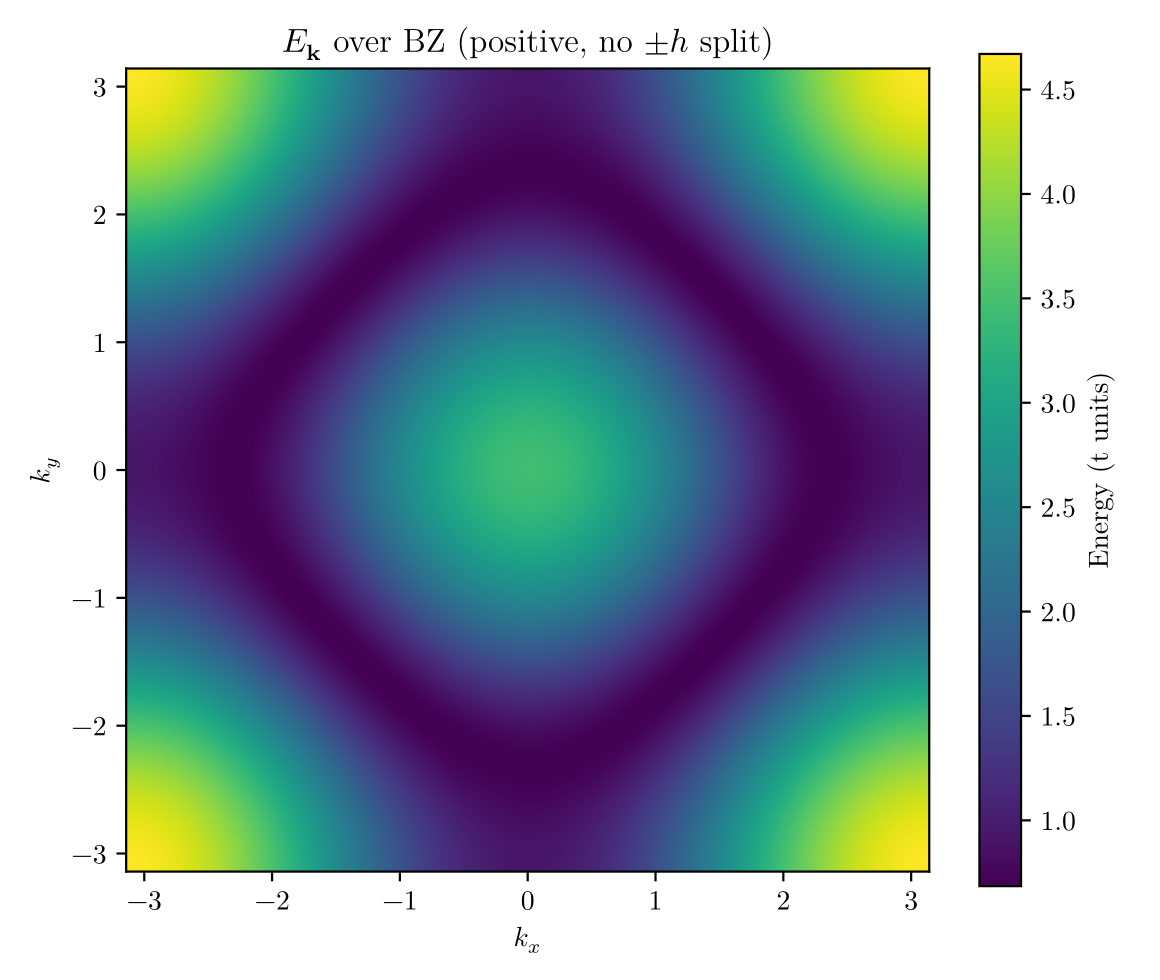
This chapter presents a general framework for building the most general quadratic Hamiltonian consistent with the physical structure of the problem. That structure includes lattice translations, boundaries, inhomogeneous geometries, and defects; optional particle-hole (Nambu) doubling; internal structure such as sublattices, orbitals, and intra-cell positions; spin; and whatever set of symmetry generators is imposed for the model under consideration.
2. General framework for electron-electron interactions
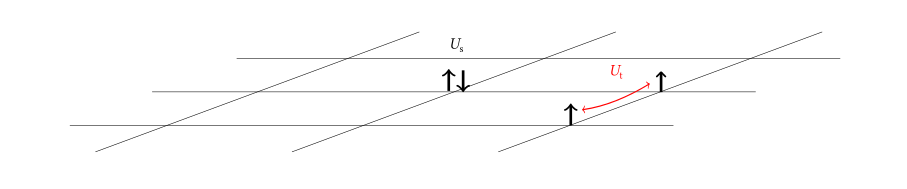
This chapter extends the same symmetry and tensor-product structure used for quadratic, free-fermion, and BdG models to quartic, two-body lattice Hamiltonians. The aim is to write the most general interacting Hamiltonian consistent with the physical structure of the problem: lattice translations, boundaries, inhomogeneous geometries, and defects implemented through masks; Nambu doubling when it is useful for pairing-channel bookkeeping and later mean-field decouplings; internal structure such as sublattices, orbitals, and intra-cell positions; spin; and the chosen set of symmetry generators.
3. Mean-field Theories for Electronic Order
Mean-field theory replaces an interacting fermion Hamiltonian by a quadratic (Gaussian) variational Hamiltonian whose parameters are fixed by self-consistency:
4. Experimental Observables in Electronic Systems
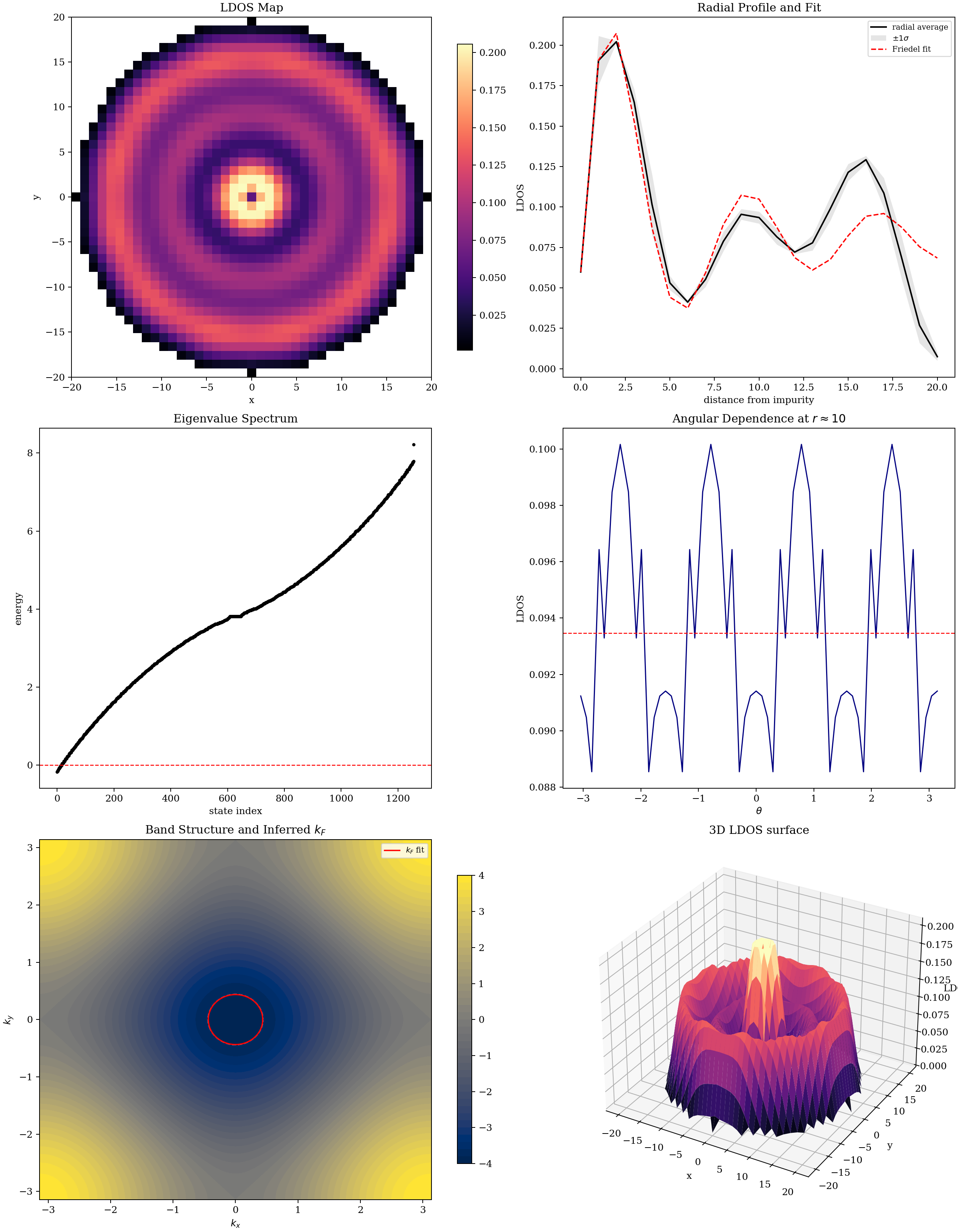
Gerd Binnig and Heinrich Rohrer, Nobel Lecture, December 8, 1986 [@binnigScanningTunnelingMicroscopy1987]
5. Numerical solution of self-consistency equations
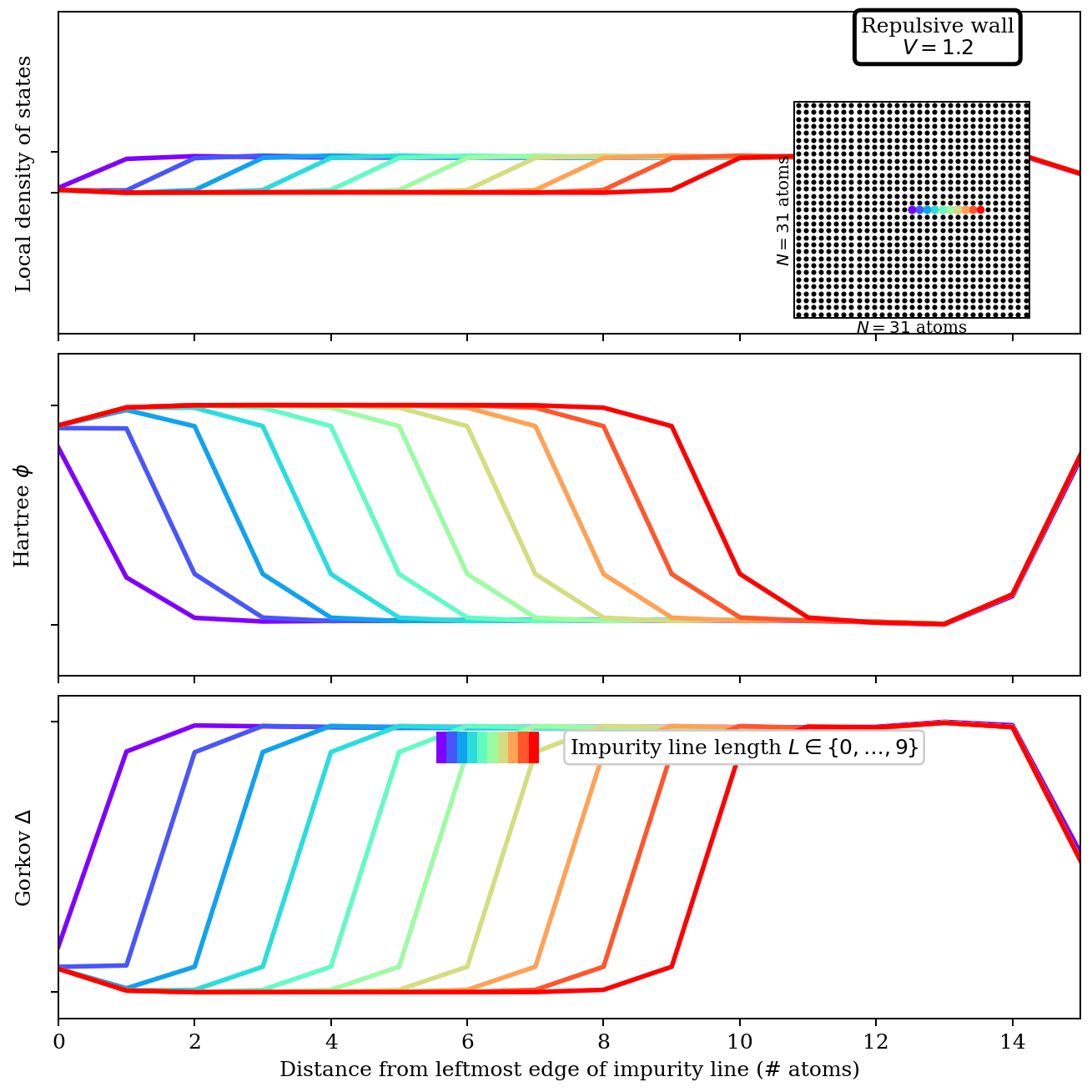
This chapter turns from model construction to the numerical solution of self-consistency equations on finite lattices. The central practical issue is convergence: straightforward fixed-point iteration is often unstable, or converges too slowly to be useful, so some degree of damping is required in order to obtain reliable solutions. We begin with the simplest lattice BCS setting, and then move on to impurity problems and inhomogeneous mean-field states.
6. Quantum Tensor Tree Simulation Framework
Quantum Tensor Tree is introduced here not as a tensor-network ansatz in the MPS or TTN sense, but as a modelling language for quantum matter with visible internal structure. The central problem is simple to state. In the systems studied in this thesis, the physically relevant degrees of freedom are rarely well described by one flat integer index. One must keep track of site, orbital, spin, Nambu sector, unit-cell position, finite geometry, and in some cases larger mesoscopic aggregates such as superconducting islands. If that structure is erased too early, the notation may become numerically convenient, but the physics becomes harder to read and harder to control.