General Framework for Electron-Electron Interactions
This chapter extends the same symmetry and tensor-product structure used for quadratic, free-fermion, and BdG models to quartic, two-body lattice Hamiltonians. The aim is to write the most general interacting Hamiltonian consistent with the physical structure of the problem: lattice translations, boundaries, inhomogeneous geometries, and defects implemented through masks; Nambu doubling when it is useful for pairing-channel bookkeeping and later mean-field decouplings; internal structure such as sublattices, orbitals, and intra-cell positions; spin; and the chosen set of symmetry generators.
The organising principle is that quartic Hamiltonians may be constructed systematically as symmetry-constrained combinations of products of bilinears, where each bilinear is the second-quantized lift of a single-particle operator written in the same tensor-product order as in the quadratic chapter. In this way, the interacting theory remains compatible with later mean-field reductions: once an interaction has been specified, the admissible quadratic orders are precisely the symmetry-allowed bilinears that can appear as decoupling channels.
From the condensed-matter side, this is the natural language in which on-site Hubbard interactions, extended density-density couplings, and multiorbital local interactions are usually formulated before one chooses a particular approximation scheme or pairing channel. [1, 2, 3, 4]
Unified structure: lattice ⊗ Nambu ⊗ internal ⊗ spin
We keep the same single-particle tensor-product order
When Nambu space is absent, that factor is omitted.
Define a composite internal index
and write fermion operators as
with the same intra-cell position-phase convention as in the quadratic chapter if desired.
From single-particle operators to many-body operators
Second-quantized lift of a single-particle operator
Given any single-particle operator (X) acting on (\mathcal H) (in the fixed tensor order), define its many-body (second-quantized) lift
where (m,n) range over the full one-particle basis (site ⊗ internal ⊗ spin, and Nambu if used).
This construction provides the bridge between the quadratic and quartic theories. Quadratic Hamiltonians are sums of operators of the form (\widehat X), whereas quartic Hamiltonians are built from products of such operators, typically in normal-ordered form.
Normal ordering and a canonical quartic container
A symmetry-compatible and nonredundant container for many interactions is
with Hermitian (X_\mu) and a real symmetric coupling matrix (g_{\mu\nu}=g_{\nu\mu}) (after choosing a Hermitian operator basis). Normal ordering removes the quadratic “Hartree” pieces from the algebraic definition, so that quadratic terms are handled in the quadratic chapter and quartic terms remain genuinely interacting.
Accordingly, the operators (X_\mu) should already respect the lattice structure, including shifts, masks, and boundaries, while symmetry acts on the remaining tensor factors.
Real-space parametrization using shifts and masks
Masked shifts and local projectors
Retain the mask ( \mathbb M ) on (\mathcal H_{\text{lat}}) and the masked shift
For interactions it is often convenient to also use site projectors on lattice space:
These give a clean “operator density at (\mathbf R)” construction.
Local bilinears as building blocks
Let (\Gamma) be any Hermitian matrix acting on (\mathcal H_{\text{(Nambu)}}\otimes\mathcal H_{\text{int}}\otimes\mathcal H_{\text{spin}}). Define the local bilinear (operator density) at (\mathbf R)
Equivalently, (\widehat O_\Gamma(\mathbf R)=\widehat X) with
Common choices of (\Gamma) include the charge-density channel (\Gamma=\mathbb 1), the spin-density channels (\Gamma=\sigma_j), the orbital-density channels (\Gamma=\lambda_i), and, when Nambu space is retained, combined channels of the form (\Gamma=\tau_\ell\otimes\lambda_i\otimes\sigma_j).
Two-site (finite-range) quartic terms via displacements
A large class of lattice interactions can be written as sums over displacements (\boldsymbol\delta\in\mathcal D):
This is the interacting analogue of restricting a quadratic model to a finite displacement set (\mathcal D).
Masking is implemented by restricting (\mathbf R) to active sites (or inserting (m_{\mathbf R}m_{\mathbf R+\boldsymbol\delta}) in the sum).
Special cases include the on-site Hubbard interaction, obtained with (\boldsymbol\delta=\mathbf 0) and (\Gamma) chosen to resolve the spin densities, or directly as (Un_{\uparrow}n_{\downarrow}); nearest-neighbour density interactions, for which (\Gamma=\mathbb 1) and (|\boldsymbol\delta|=a); spin-exchange terms with (\Gamma=\sigma_j) and (|\boldsymbol\delta|=a); and orbital-exchange or Kugel-Khomskii-type structures involving (\Gamma=\lambda_i) and (\Gamma=\lambda_i\otimes\sigma_j).
In this formulation, the lattice geometry is encoded in (\mathcal D) and (\mathbb M), while the (\Gamma)-structure is treated as internal, spin, and, when present, Nambu algebra subject to symmetry.
Examples relevant to later chapters
The interaction classes most relevant to the present thesis are those that lead naturally to superconducting, bond-resolved, and multiorbital mean-field channels. The general quartic framework becomes concrete in the following examples.
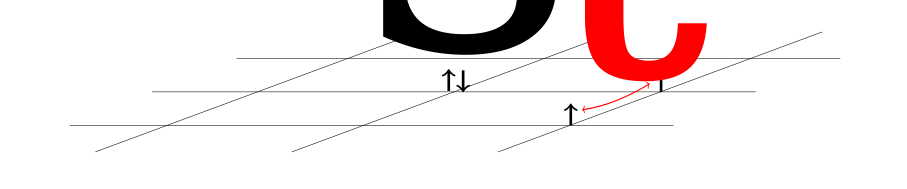
Schematic interaction channels on a lattice. The central local process represents an on-site interaction between opposite-spin electrons occupying the same orbital, as in the attractive or repulsive Hubbard term; the label marks this local singlet channel. The right-hand process indicates a finite-range bond-resolved channel, where interactions couple neighboring sites; the label marks a nonlocal triplet channel that can naturally generate exchange, bond-order, current, or nonlocal pairing decouplings in the mean-field reduction.
On-site attractive Hubbard interaction and singlet pairing
The simplest superconducting example is the on-site attractive Hubbard interaction [1, 2]
In the present formalism this is an on-site quartic term, corresponding to (\boldsymbol\delta=\mathbf 0), and it is the natural starting point for on-site spin-singlet pairing. Decoupling in the anomalous channel gives
so that the resulting quadratic theory contains terms of the form
together with the corresponding Hartree shifts. This is the minimal interaction underlying the lattice BdG constructions used later in the thesis and the standard microscopic bridge to the BCS/Gor’kov mean-field description. [5, 6]
Nearest-neighbour density interactions and bond-resolved channels
A second important class consists of finite-range density interactions such as
This is the simplest example with a nontrivial displacement set (\mathcal D), and therefore makes explicit contact with the harmonic structure discussed above. In the superconductivity literature this is the standard extension beyond the on-site Hubbard term when one wants nonlocal charge, bond, or pairing channels. [2, 7, 8] On the square lattice one obtains
so the interaction already carries the lattice harmonics that later distinguish different ordering patterns. Decoupling in the particle-hole sector can favour charge order, whereas decoupling in the bond-singlet pairing sector gives
The symmetry of the bond pattern then distinguishes extended (s)-wave from (d_{x^2-y^2})-type pairing. This example is therefore the direct interacting analogue of the finite-displacement quadratic models discussed in the preceding chapter.
Bond-current interactions and loop-supercurrent channels
The loop-supercurrent chapters are naturally connected to interactions written in terms of bond-current operators. For an oriented bond (b=(\mathbf R,\mathbf R’)), define
A quartic current-channel interaction may then be written as
In the bilinear-product language, this is simply a coupling between bond bilinears rather than on-site densities. A mean-field decoupling introduces bond fields
which enter the quadratic Hamiltonian as directed bond terms, or equivalently as self-consistent imaginary hopping amplitudes. It is in this sense that current-channel interactions provide a microscopic route to time-reversal-breaking loop-current or loop-supercurrent states, including the loop-supercurrent constructions discussed later in the thesis. [9]
Multiorbital local interactions
When several orbitals or sublattices are retained inside the same unit cell, local interactions acquire a richer internal structure. The standard local multiorbital parametrization goes back to Kanamori, while the corresponding spin-orbital exchange descendants are often summarized as Kugel-Khomskii-type interactions. [3, 4] A standard multiorbital form is
written here for a single site or unit cell with orbital labels (a,b). Such terms are naturally expanded in the (\lambda_i\otimes\sigma_j) basis introduced above. They can generate orbital polarisation, spin exchange, interorbital singlet pairing, or more specialised multicomponent pairing penalties and couplings. This is precisely the class of interaction structure needed once internal degrees of freedom inside a unit cell become central to the later microscopic superconducting models.
Canonical interaction-vertex form and fermionic constraints
Vertex tensor form (most general quartic interaction)
In a general basis label (p=(\mathbf R,\alpha)) (or ((\mathbf k,\alpha)) in momentum space),
Fermion statistics and Hermiticity impose antisymmetry in the incoming legs,
antisymmetry in the outgoing legs,
and Hermiticity,
The bilinear-product container ( \sum g_{\mu\nu}:\widehat X_\mu\widehat X_\nu: ) is a structured way to parameterize such (V) while keeping symmetry constraints tractable.
Translation-invariant case: momentum conservation and lattice harmonics
Assume periodic boundaries and (\mathbb M=\mathbb 1). Translation invariance implies momentum conservation (up to a reciprocal lattice vector (\mathbf G)):
A common reduced parametrization uses transfer momentum (\mathbf q):
Finite-range interactions become trigonometric polynomials
If in real space you kept a finite displacement set (\mathcal D), then the (\mathbf q)-dependence is a finite harmonic expansion:
where each (V_{\boldsymbol\delta}) is a matrix in the internal/spin (and possibly Nambu-channel) indices.
This is the interaction analogue of the quadratic “Bloch polynomial” in (\mathbf k).
Generator-based symmetry constraints for quartic Hamiltonians
Symmetry action on fermion fields
Let a unitary spatial symmetry (g) act on the one-particle Hilbert space by
with (U_g(\mathbf k)) constructed exactly as in the quadratic chapter:
When Nambu space is absent, the factor (U_g^{(\text{Nambu})}) is omitted.
Time reversal (\mathsf T) (antiunitary) acts as
i.e. complex conjugation in coefficients plus the unitary matrix (U_{\mathsf T}) on internal/spin (and possibly Nambu) indices.
Constraint on the interaction vertex
In momentum space, invariance under a unitary symmetry (g) imposes
together with momentum conservation.
For time reversal (\mathsf T),
These are the direct interacting analogues of the quadratic constraints (U_g,\mathcal H(\mathbf k),U_g^\dagger=\mathcal H(g\mathbf k)) and (U_{\mathsf T},\mathcal H(\mathbf k)^*,U_{\mathsf T}^\dagger=\mathcal H(-\mathbf k)), but now acting on a rank-4 vertex.
Constraint in the bilinear-product container
If the interaction is written as
and the symmetry maps the basis by
then invariance is the matrix condition
For antiunitary symmetries, include complex conjugation of coefficients; with a Hermitian basis one typically works with real (g) after enforcing constraints.
In practice, one computes (R_g) by acting with (U_g) on the single-particle operators (X_\mu), and then enforces (g=R_g g R_g^T) as a system of linear constraints.
Basis expansions for interacting channels
Operator basis on internal, spin, and Nambu space
As in the quadratic chapter, one chooses Hermitian bases ({\tau_\ell}) for Nambu space when it is present, ({\lambda_i}) for the internal sector, and ({\sigma_j}) for spin.
Define channel matrices
Then local bilinears are
and finite-range interactions can be expanded as
Symmetry constraints act only on the index structure ((\ell,i,j)) and on the displacement classes (\boldsymbol\delta) (or their orbits under the point group), exactly mirroring the quadratic form-factor selection.
Mean-field bridge: recovering symmetry-allowed quadratic orders from quartic interactions
A quartic term written as a product of bilinears provides an immediate mean-field/Hubbard–Stratonovich entry point:
with an analogous construction for pairing-type decouplings when Nambu space is retained.
Two consequences follow. First, the allowed order parameters are precisely the symmetry-allowed bilinears: the generator constraints of the quadratic chapter determine which (\widehat O_\mu) may acquire expectation values without explicitly breaking the imposed symmetries. Second, the question of competition or coexistence among candidate orders is inherited from the symmetry-allowed invariants. Once a set of channels ({\widehat O_\mu}) has been selected, the Landau-type couplings among the associated mean fields are constrained by the same generator logic, with coefficients determined in principle by the microscopic couplings (g_{\mu\nu}).
Mean-field terms should therefore not be introduced independently, but obtained by decoupling a symmetry-allowed quartic Hamiltonian in symmetry-identified channels. This is the same logic that underlies standard superconducting mean-field theory, microscopic derivations of Ginzburg-Landau theory, and symmetry-based Landau expansions of unconventional order parameters. [10, 6, 11, 12]
Symmetry-first construction of quartic Hamiltonians
The construction proceeds in a natural sequence. One first fixes the lattice structure by specifying the lattice shape (\mathbf N), the boundary conditions, the mask (\mathbb M), and a finite displacement set (\mathcal D). One then chooses a bilinear operator basis of the form
with (\Gamma_\mu) drawn from (\tau\otimes\lambda\otimes\sigma), or from (\lambda\otimes\sigma) when Nambu space is absent. The quartic Hamiltonian is then written in the container
or, equivalently, in a displacement-resolved form with couplings (g^{(\boldsymbol\delta)}).
At that stage one imposes the intrinsic fermionic constraints, namely antisymmetry and Hermiticity, either directly on the vertex (V) or implicitly through the use of Hermitian bilinear bases and symmetric coupling matrices (g). The next step is to construct the generator representations (U_g(\mathbf k)) exactly as in the quadratic chapter, including the intra-cell phase conventions, and from these obtain the induced action (R_g) on the basis (X_\mu). Solving the resulting linear constraints, (g=R_g g R_g^T) together with the antiunitary variants, yields the most general symmetry-allowed coupling space.
If desired, this space may then be organised further by projection into irreducible representations of the point group or spin-rotation group, and may subsequently be reduced by controlled approximations such as mean-field decoupling, random-phase approximation, or functional-renormalization-group truncations.
General form of the quartic Hamiltonian
A symmetry-compatible quartic model can be written as
with generator constraints implemented as
and with translation invariance giving momentum conservation plus finite-harmonic (\mathbf q)-dependence when the interaction range is finite.
References
- J. Hubbard,
Electron correlations in narrow energy bands,
Proceedings of the Royal Society of London. Series A. Mathematical and Physical Sciences, vol. 276, pp. 238–257, 1963. doi:10.1098/rspa.1963.0204 (↩︎) - R. Micnas, J. Ranninger, and S. Robaszkiewicz,
Superconductivity in narrow-band systems with local nonretarded attractive interactions,
Reviews of Modern Physics, vol. 62, pp. 113–171, 1990. doi:10.1103/revmodphys.62.113 (↩︎) - J. Kanamori,
Electron correlation and ferromagnetism of transition metals,
Progress of Theoretical Physics, vol. 30, pp. 275–289, 1963. doi:10.1143/ptp.30.275 (↩︎) - K. Kugel’ and D. Khomskii,
The jahn-teller effect and magnetism: Transition metal compounds,
Uspekhi Fizicheskih Nauk, vol. 136, p. 621, 1982. doi:10.3367/ufnr.0136.198204c.0621 (↩︎) - J. Bardeen, L. Cooper, and J. Schrieffer,
Theory of superconductivity,
Phys. Rev., vol. 108, no. 5, pp. 1175–1204, 1957. doi:10.1103/PhysRev.108.1175 (↩︎) - L. Gor’kov,
Microscopic derivation of the ginzburg–landau equations in the theory of superconductivity,
Soviet Physics JETP, vol. 9, no. 6, pp. 1364–1367, 1959. (↩︎) - J. Quintanilla and B. Gyorffy,
Finite range model interaction potential for d-wave superconductors: Tc vs. Doping in the cuprates,
Physica B: Condensed Matter, vol. 284–288, pp. 421–422, 2000. doi:10.1016/S0921-4526(99)01991-2 (↩︎) - J. Quintanilla and B. Gyorffy,
Cooper pairing with finite angular momentum: BCS vs bose limits,
J. Phys. A: Math. Gen. 36, 9379-9390 (2003), 2003. doi:10.1088/0305-4470/36/35/322 (↩︎) - S. Ghosh, J. Annett, and J. Quintanilla,
Time-reversal symmetry breaking in superconductors through loop supercurrent order,
New Journal of Physics, vol. 23, no. 8, p. 083018, 2021. doi:10.1088/1367-2630/ac17ba (↩︎) - P. Anderson,
Random-phase approximation in the theory of superconductivity,
Physical Review, vol. 112, pp. 1900–1916, 1958. doi:10.1103/physrev.112.1900 (↩︎) - L. Landau and E. Lifshitz,
CHAPTER XIV - PHASE TRANSITIONS OF THE SECOND KIND AND CRITICAL PHENOMENA,
in Statistical Physics (Third Edition), L. Landau and E. Lifshitz, Eds. Oxford: Butterworth-Heinemann, 1980, pp. 446–516.doi:10.1016/B978-0-08-057046-4.50021-X (↩︎) - M. Sigrist and K. Ueda,
Phenomenological theory of unconventional superconductivity,
Reviews of Modern Physics, vol. 63, pp. 239–311, 1991. doi:10.1103/revmodphys.63.239 (↩︎)