Microscopic Modelling of Conductors
This chapter presents a general framework for building the most general quadratic Hamiltonian consistent with the physical structure of the problem. That structure includes lattice translations, boundaries, inhomogeneous geometries, and defects; optional particle-hole (Nambu) doubling; internal structure such as sublattices, orbitals, and intra-cell positions; spin; and whatever set of symmetry generators is imposed for the model under consideration.
The same formalism is intended to cover both single-order and multi-order settings, including spatial textures, flux- or current-like phases, and regimes in which different orders either compete or coexist. In that sense, the aim of the chapter is not only to write down particular Hamiltonians, but to establish a general construction that can be applied across the later microscopic models in the thesis.
We also explain how this microscopic framework connects to, and generalises, the more macroscopic symmetry-based approach associated with Ginzburg and Landau.
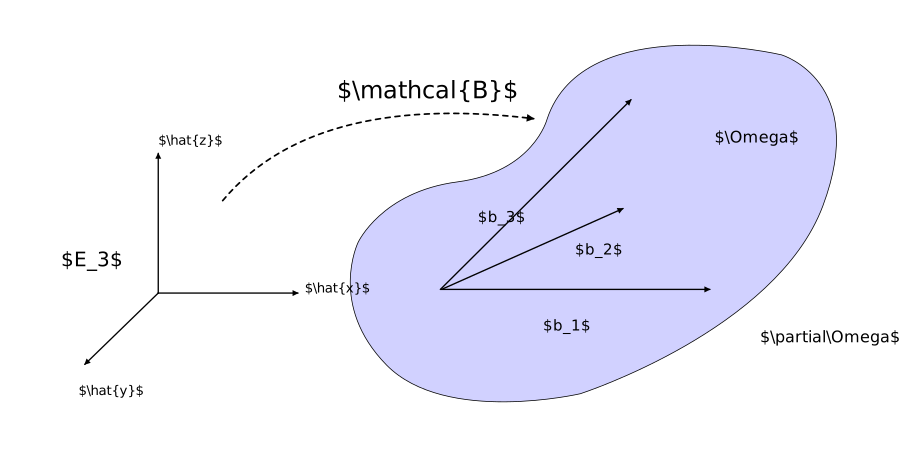
Geometric input for the microscopic construction: a finite sample region with boundary , embedded in the ambient space and spanned by primitive lattice directions , , and . In the formalism below, this geometric data is encoded by the lattice Hilbert space together with the boundary conditions and mask operator.
Minimal tight-binding picture of a conductor. A local orbital energy sits on each site, while a hopping amplitude connects neighbouring sites. The quadratic Hamiltonians developed in this chapter promote this local on-site plus inter-site structure to the full lattice Nambu internal spin tensor product.
Unified structure: lattice shifts ⊗ Nambu ⊗ internal ⊗ spin
Hilbert-space factorization and index order
We fix the tensor-product order
All operators are written to respect this order. When Nambu space is absent, the factor is simply omitted and the formulas are interpreted in the normal, non-doubled space.
Shift operators as the lattice backbone (real space)
Definition of the shift symbol and the “/𝕄” convention
Fix a finite lattice with shape and boundary-condition label . Let 𝕄 be a defect/mask operator acting on .
Start from the “pure translation” shift 𝕊 defined by its action on site kets :
where specifies how is interpreted at the boundary.
To model inhomogeneous geometry, impurities, vacancies, or any other spatial inhomogeneity, let 𝕄 be a fixed site mask: a diagonal operator in the site basis with eigenvalues , selecting the active lattice degrees of freedom.
This equation defines the slash notation “”: the shift only connects active sites. Equivalently, one may work directly in the restricted active-site subspace. The same masking can be written compactly as:
Embedding into the full Hilbert space
Embed the masked shift into the full Hilbert space using the fixed order:
Accordingly, any quadratic term may be written as a sum of objects of the form (shift on ) ⊗ (matrix on ).
When translation is a good quantum number: 𝕊 becomes the unitary phase
If the lattice is translation-invariant (typically periodic and no defects so ), define Bloch plane-wave kets via the discrete Fourier transform 𝓕:
Then each shift is diagonal in the basis:
So any translation-invariant lattice Hamiltonian written in the shift notation,
where is a chosen (typically finite) set of lattice displacement vectors connecting sites/unit cells (e.g. n.n., n.n.n., etc.). For normal (number-conserving) hopping terms, is understood to act trivially on Nambu space, i.e. with acting on ; spin dependence can encode spin-orbit coupling, whereas spin-independent hopping corresponds to . All coefficients are independent of for a translation-invariant model, becomes block-diagonal in :
so the lattice part has reduced to the unitary phase factors (the lattice representation of translations, i.e. Bloch’s theorem) [1, 2].
In 1D with lattice spacing and nearest-neighbour shifts , the basic unitaries are . Restricting to nearest neighbours (n.n.), next-nearest neighbours (n.n.n.), etc. amounts to retaining a finite set of displacement vectors , and therefore produces a trigonometric polynomial in momentum. For example, a single-band 1D tight-binding model with hopping amplitudes to the th neighbour has
On a square lattice with spacing , keeping only n.n. hopping gives the familiar cosine dispersion
while adding an n.n.n. hopping contributes additional harmonics, e.g. .
In multi-orbital models the same structure holds, but and are replaced by matrices acting on (and possibly spin/Nambu). The resulting Bloch Hamiltonian is a matrix-valued trigonometric polynomial; in particular,
so cosine terms typically appear in Hermitian (even) hopping channels, whereas sine terms commonly appear in antisymmetric or purely imaginary (odd) inter-orbital couplings (e.g. hybridization terms). For example, an inter-orbital hopping channel along with produces an off-diagonal Bloch matrix element proportional to .
Intra-cell position phases and a clean Bloch convention
The discussion above accounts for the Bravais-lattice (unit-cell translation) part of Bloch’s theorem, where shifts contribute factors . For multi-orbital/unit-cell models there is an additional, purely conventional choice: whether intra-cell orbital positions are included explicitly in the Bloch basis. The following gauge transformation implements that convention, converting a “naive” built only from into the corresponding cell-periodic (orbital-position-aware) Bloch Hamiltonian.
When orbitals sit at different intra-cell positions , define the diagonal phase operator on internal space
Concretely, let denote the real-space orbital basis (and, if present, include spin as an additional tensor factor ). A standard orbital Bloch basis at fixed is
with the number of unit cells. The “position-phase” (cell-periodic) convention instead attaches the intra-cell phase,
In this notation, is precisely the internal-space unitary that maps between the two orbital Bloch conventions. At the level of operators, let annihilate an electron in orbital of unit cell . The corresponding orbital Bloch operators are
If is built ignoring intra-cell positions, the “cell-periodic gauge” convention is
This is a change of basis within the orbital/sublattice Bloch basis (a -dependent gauge choice), not a change of momentum. The band basis is obtained separately by diagonalizing at each , i.e. by a unitary such that
and defining band states (with the same construction for the corresponding field operators). Equivalently, the band annihilation operators are , i.e. .
In particular, each band eigenstate at fixed is a superposition of the orbital basis states in the same sector, with coefficients given by the eigenvectors of . For example, if the internal space consists of four sites arranged in a ring within the unit cell and only intra-cell hopping is present, then can be chosen -independent and reduces to a discrete Fourier transform on the ring, so the band index may be identified with a discrete internal (cluster) momentum with (i.e. ).
More generally, whenever the orbitals within a unit cell carry an internal discrete translation symmetry (e.g. a cyclic ordering of orbitals), one can define an internal translation operator acting on by its action on the orbital basis,
Its eigenstates are internal Bloch modes with eigenvalues , where and . If the internal couplings respect this symmetry (i.e. for each ), then can be block-diagonalized in , and the band label can be taken as a pair (internal momentum plus residual band index within each sector).
This “position-phase” correction underlies consistent symmetry actions for multi-sublattice/orbital Bloch bases [3, 4].
Quadratic Hamiltonians in normal and Nambu form
General normal-state quadratic form
In the absence of Nambu doubling,
with valued in .
Multiple normal orders, such as density waves, orbital order, and loop-current-like hopping patterns, enter additively:
Nambu-doubled quadratic form
If you include pairing, introduce a Nambu spinor valued in and write
A standard block structure is
with and acting on .
Multiple pairing orders are additive:
Particle–hole symmetry in BdG systems is intrinsic and constrains accordingly [5].
Encoding textures, currents, and frustration
Loop/current/flux phenomena are encoded as phases attached to internal and/or link-resolved structures.
Site/orbital phase texture operator
Define a diagonal phase field on (acts on ):
Normal bilinears are dressed by conjugation:
Pairing-type bilinears are dressed by the transpose on the right:
Link-based phases
For bond-resolved terms
Loop currents correspond to nontrivial gauge-invariant loop products of these phases around cycles.
Competition vs coexistence from symmetry-allowed invariants
Given multiple order components (normal or pairing), symmetry decides which invariants can appear in
and whether phase-sensitive terms that lock relative phases are allowed [6, 7].
Accordingly, the couplings are not introduced independently, but are derived from the generator constraints discussed below.
Generator-based construction of the most general symmetry-allowed quadratic Hamiltonian
The construction may be written in a form that will be used throughout the later models in the thesis.
Basis expansion
Let be a Pauli basis on , a Hermitian basis on , and a Pauli basis on .
In Nambu-doubled form
In the normal (non-Nambu) case
The scalar form factors are lattice harmonics selected by symmetry.
Generator representations
For each generator , construct acting on as
When Nambu space is absent, the factor and the expansion are omitted.
Constraints
For unitary spatial symmetries
or in the normal case.
Time reversal (antiunitary), if imposed
and similarly for .
In BdG form, the intrinsic particle–hole constraint is
which is the basis for the standard symmetry classification of gapped free-fermion phases [5, 8, 9].
General form of the quadratic Hamiltonian
Quadratic model
or, when Nambu doubling is included,
Example: Friedel oscillations
A natural benchmark of the normal-state implementation is the response of a conductor to a single local impurity. In a clean metal the density is uniform, but a defect mixes states across the Fermi surface and produces oscillations with characteristic wavevector . It provides a natural introductory benchmark because it tests several parts of the framework at once: real-space masking, boundary conditions, impurity insertion, diagonalisation, and local observables such as the local density of states.
Friedel oscillations therefore serve as an early benchmark of Quantum Tensor Tree before we turn to self-consistent mean-field calculations. The calculation below is performed for a 2D square lattice with nearest-neighbour hopping, an open circular mask, and a single impurity at the origin. The oscillatory rings in the LDOS are the Friedel oscillations themselves, while the radial line cut shows that the observed period agrees with the expected value . This allows the analytical derivation to be compared directly with the numerical results. The same figure also exposes the weak lattice anisotropy that survives beyond the isotropic continuum approximation.
The canonical chapter-local Python benchmark driver for this example is friedel_qpi_native_figures.py. It is a thin wrapper over qttree benchmark construction and plotting, replacing the earlier Julia draft while still emitting the simple LDOS and QPI figures reused later in the methodology. The older tightbinding_lattice.py name is kept only as a compatibility alias while the thesis scripts are being consolidated.
The microscopic Hamiltonian used in the simulation is the normal-state tight-binding model
where the sum runs over nearest-neighbour pairs of active sites retained by the circular mask , so that the boundary is open, and the impurity is represented by a local onsite potential at the origin. The LDOS shown below is then
evaluated at . In the present low-filling benchmark, this energy is identified with the Fermi level used in the analytical estimate. For the numerical example shown here, we take , radius , , , , and .

Analytical Derivation in dimensions
Take an isotropic normal state with quadratic dispersion
and a point impurity
The retarded Green’s function of the clean system is
For an isotropic continuum band this has the Hankel-function form
and therefore, for ,
To first order in the impurity strength,
so the correction to the LDOS is
At fixed energy, then, the impurity produces oscillations with wavelength and envelope .
If instead one integrates over occupied states to obtain the density modulation,
the extra oscillatory integral contributes one further power of , so asymptotically
This is the general -dimensional Friedel law for the integrated density. The often-quoted decay therefore refers to the density integrated to the Fermi level, whereas the LDOS measured at fixed energy decays one power more slowly.
In particular,
Specialisation to the low-filling square lattice
Near the bottom of the square-lattice band,
so the lattice model reduces to the continuum form above with effective mass . In two dimensions one may therefore write
which at large distance reduces to
For the benchmark shown above, places the Fermi level close to the band bottom, so the continuum estimate is already accurate:
The observed ring spacing agrees with this prediction, so the example provides a compact validation of the real-space geometry, impurity implementation, and LDOS evaluation that are used throughout the later numerical work.
References
- F. Bloch,
�Ber die quantenmechanik der elektronen in kristallgittern,
Zeitschrift f�r Physik, vol. 52, pp. 555–600, 1929. doi:10.1007/bf01339455 (↩︎) - C. Kittel, Introduction to solid state physics. Wiley, 2005. [Online]. Available: https://openlibrary.org/books/OL22152400M/Introduction_to_solid_state_physics (↩︎)
- B. Bradlyn, L. Elcoro, J. Cano, M. Vergniory, Z. Wang, C. Felser, M. Aroyo, and B. Bernevig,
Topological quantum chemistry,
Nature, vol. 547, pp. 298–305, 2017. doi:10.1038/nature23268 (↩︎) - J. Cano, B. Bradlyn, Z. Wang, L. Elcoro, M. Vergniory, C. Felser, M. Aroyo, and B. Bernevig,
Building blocks of topological quantum chemistry: Elementary band representations,
Physical Review B, vol. 97, p. 035139, 2018. doi:10.1103/physrevb.97.035139 (↩︎) - A. Altland and M. Zirnbauer,
Nonstandard symmetry classes in mesoscopic normal-superconducting hybrid structures,
Physical Review B, vol. 55, no. 2, pp. 1142–1161, 1997. doi:10.1103/PhysRevB.55.1142 (↩︎) - L. LANDAU,
The theory of phase transitions,
Nature, vol. 138, pp. 840–841, 1936. doi:10.1038/138840a0 (↩︎) - P. Chaikin and T. Lubensky, Principles of condensed matter physics. Cambridge University Press, 1995. doi:10.1017/cbo9780511813467 (↩︎)
- A. Kitaev, V. Lebedev, and M. Feigel’man,
Periodic table for topological insulators and superconductors,
In Proc. ADVANCES IN THEORETICAL PHYSICS: Landau memorial conference, 2009, pp. 22–30. doi:10.1063/1.3149495 (↩︎) - S. Ryu, A. Schnyder, A. Furusaki, and A. Ludwig,
Topological insulators and superconductors: Tenfold way and dimensional hierarchy,
New Journal of Physics, vol. 12, p. 065010, 2010. doi:10.1088/1367-2630/12/6/065010 (↩︎)