Self-consistent lattice calculations
This chapter turns from model construction to the numerical solution of self-consistency equations on finite lattices. The central practical issue is convergence: straightforward fixed-point iteration is often unstable, or converges too slowly to be useful, so some degree of damping is required in order to obtain reliable solutions. We begin with the simplest lattice BCS setting, and then move on to impurity problems and inhomogeneous mean-field states.
The canonical chapter-local native driver for the convergence example in this
chapter is self_consistency_native_figures.py.
It is a thin chapter wrapper over qttree benchmark construction plus local
matplotlib rendering, while the older standalone Python and Julia drafts remain
only as lift-sources or archival provenance. The checked-in chapter assets
below are now generated by the native wrapper as convergence-example.svg,
with PDF sidecars and runlogs written alongside them.
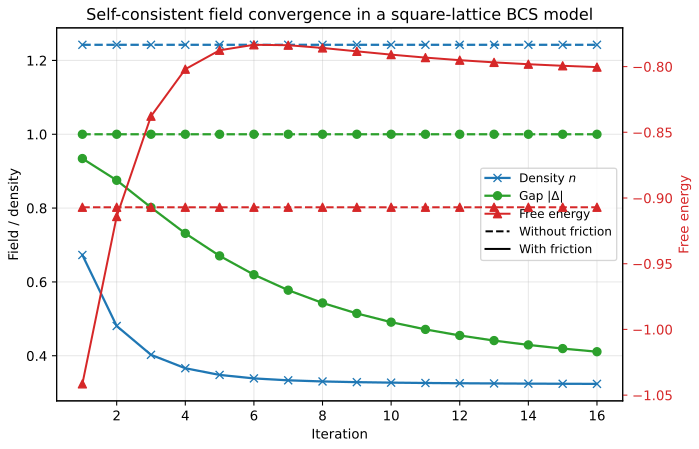
Convergence of a damped self-consistency iteration in the lattice BCS model.: Square lattice with sites, nearest-neighbour hopping , chemical potential , interaction strength , and initial self-consistent fields and . The convergence threshold is ; the undamped and damped iterations use friction coefficients and , respectively.
Friedel oscillations
The analytical derivation and introductory benchmark for Friedel oscillations are given in the chapter on microscopic modelling of conductors, where they are used to validate the normal-state implementation before any self-consistency is introduced. In the present chapter we retain only the numerical results that connect directly to later impurity and mean-field calculations.
Normal-state benchmark
The weak-coupling normal state provides the bridge between that analytical discussion and the self-consistent inhomogeneous calculations below. In this regime the numerical LDOS recovers the expected oscillation wavelength , thereby validating the impurity calculations before interactions are turned on.
Impurities modulate the local density of states (Friedel oscillations)
The corresponding normal-state Friedel and quasiparticle-interference benchmarks are collected in the experimental-observables chapter, where they are introduced together with the STM and FT-STS measurement dictionary. This chapter keeps the focus on the self-consistent iteration itself.
Inhomogeneous mean-field theory with impurities
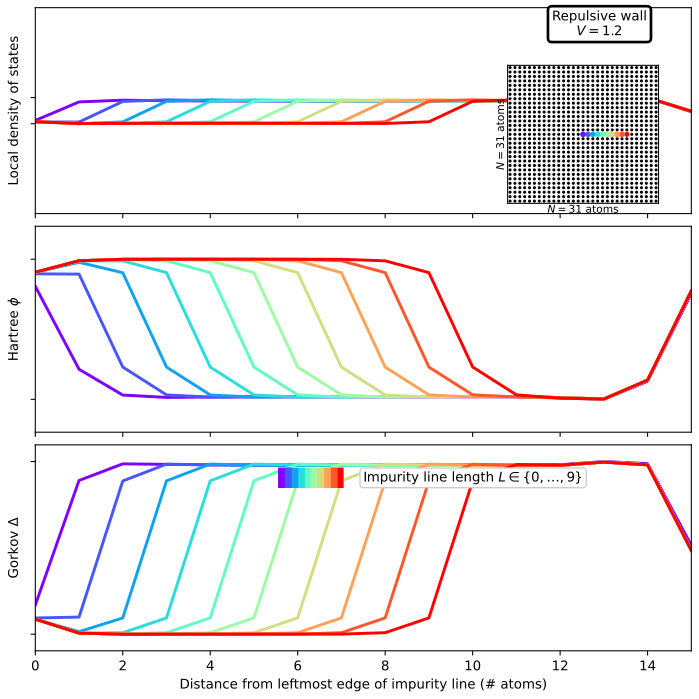
Figure 9.2: Self-consistent mean-field results for the renormalisation of the chemical potential (Hartree term) and the anomalous term for a line of impurities on a lattice, with attractive , chemical potential , and impurity coupling strength .
Once the normal-state impurity response has been established, the next step is to restore self-consistency and examine how the order parameters themselves adjust in the presence of inhomogeneity. The same finite-lattice framework then yields not only the LDOS, but also the spatial structure of the pairing fields and related mean-field quantities.