Results
1. Soft Impurity Walls and Hard-Wall Branch Promotion in a Superconducting Two-Dimensional SSH Model
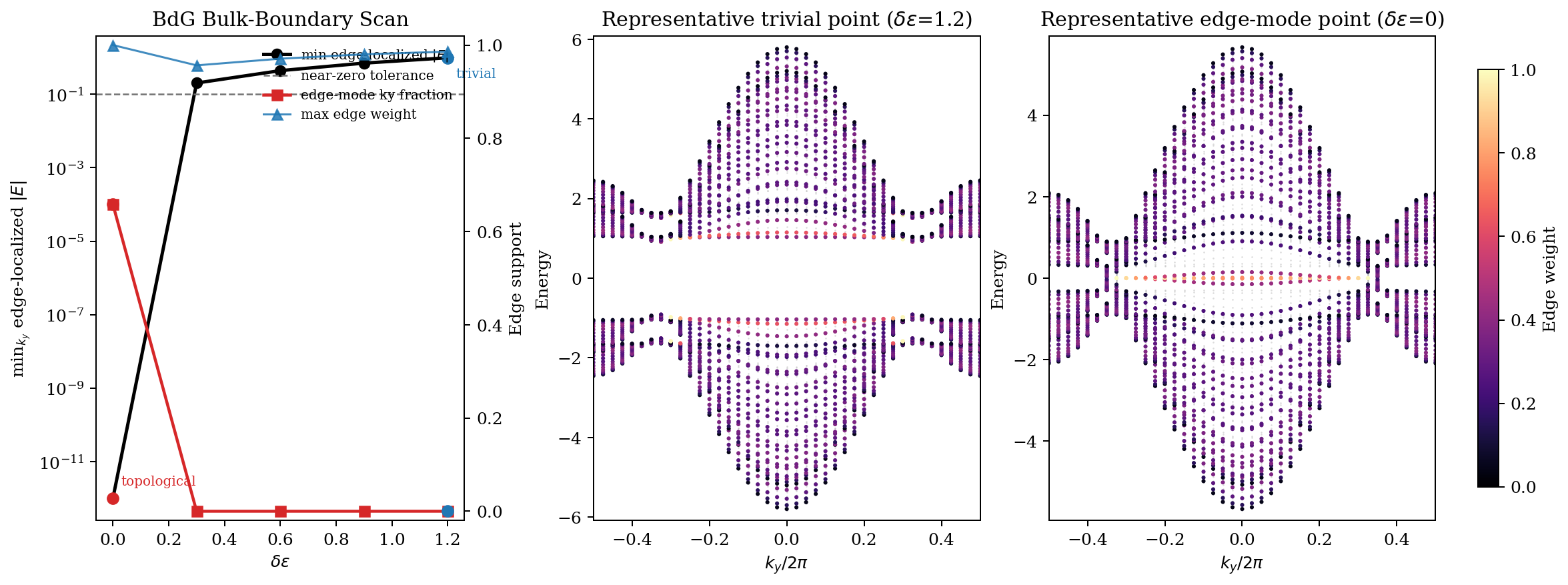
This chapter studies a superconducting two-dimensional extension of the Su–Schrieffer–Heeger model in which a finite impurity wall is used as a tunable internal boundary. The clean model is a stack of momentum-resolved SSH chains; after imposing an inter-sublattice pairing field it supports Majorana-arc boundary modes in the same symmetry setting as the Weyl-SSH construction. In the imposed-pairing problem, tracking the same wall-projected Bogoliubov-de Gennes branch by eigenvector overlap shows that the lowest positive bulk-like excitation at (k_y=0) is continuously promoted into a wall-local hard-wall-descendant branch as the scalar wall becomes strong. Self-consistent mean-field theory changes the wall from a pure quasiparticle scatterer into a local depression of the anomalous field: the wall suppresses (|\Delta_{AB}|) on the impurity support while the off-wall condensate remains finite.
2. A Self-Consistency Obstruction to Internally Antisymmetric Nonunitary Triplet Pairing
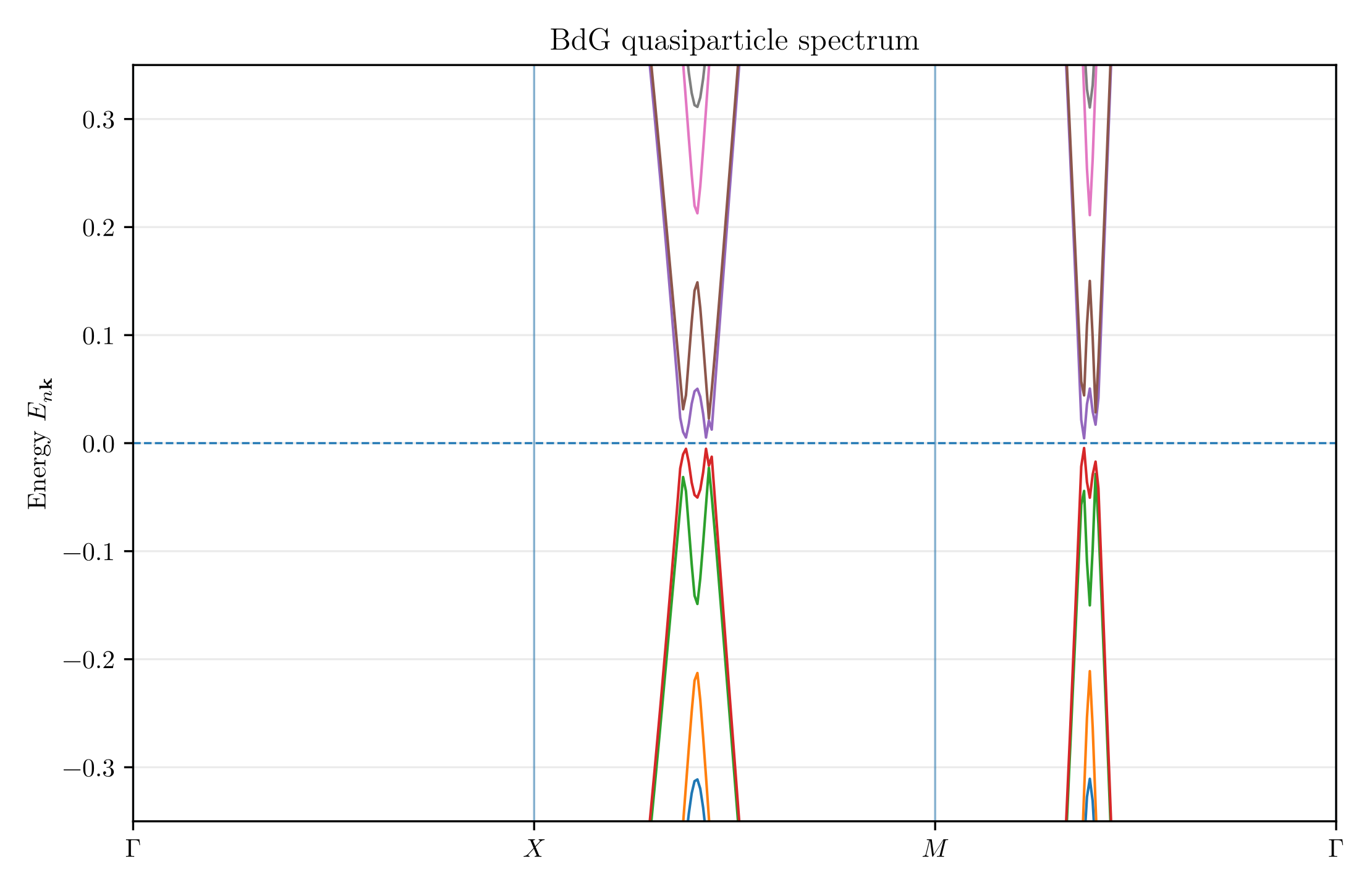
This chapter tests internally antisymmetric nonunitary triplet pairing as a proposed explanation of time-reversal-symmetry breaking in LaNiC2 and LaNiGa2-inspired models. The mechanism is coherent: an equal-spin triplet can be local and even parity when the orbital part is antisymmetric, and an imposed imbalance between the two equal-spin components produces the expected nonunitary BdG diagnostics. The central microscopic result is a self-consistency obstruction. Scalar INT attraction can support finite triplet amplitude, but it does not by itself select the nonunitary pair-spin imbalance between equal-spin components. The material-derived LaNiC2 and LaNiGa2 calculations are therefore treated as survey checks and provenance, not as the burden of the chapter. LaNiC2 now has an improved full-window Wannier candidate; checkpointed reduced/full-basis reruns through (n_k=3) still relax to numerical-zero order parameter rather than selecting nonunitary INT. LaNiGa2 remains additionally blocked by normal-state validation in the tested QE/Wannier workflows: repeated SCF/cell/eigensolver variants retain c_bands warnings, and the alternate PAW-SOC route fails before SCF on the current QE stack. This is the thesis scope boundary: the chapter is a mechanism audit and survey-level negative test, while a production material-realistic LaNiX2 theory is future work.
3. Microscopic Theories of Time-Reversal Symmetry Breaking in Superconductors through Loop Supercurrent Ordering
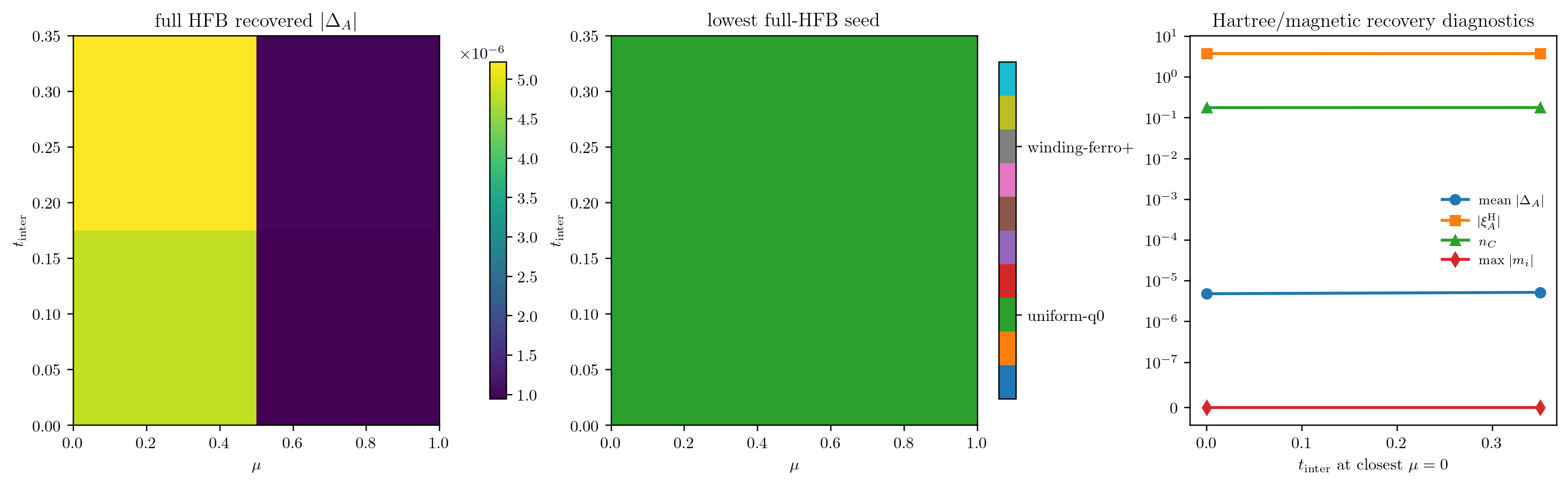
This chapter consolidates the loop-supercurrent results into one thesis story. Frustrated multicomponent superconductors can form time-reversal-related winding branches with finite hopping currents, orbital moment, and relative-phase soft modes. The microscopic calculations supply both the caveat and the constructive route: compact onsite-Hubbard spacer and molecule routes do not robustly select the winding branch once full self-consistency and competing uniform or staggered branches are enforced, while amplitude-reservoir constructions, including the promoted Josephson-island model and signed onsite crystal-bath smokes, give strict tuned HFG evidence in controlled settings.