Soft Impurity Walls and Hard-Wall Branch Promotion in a Superconducting Two-Dimensional SSH Model
This chapter is the topology-led boundary result of the thesis. It asks whether a local impurity wall inside a periodic superconducting SSH system can be tuned into an effective internal boundary carrying the arc physics of the clean open model.
The answer is deliberately finite-device and model-based. The clean parent is a two-dimensional Weyl-SSH construction in which fixed (k_y) slices behave as SSH chains [1, 2, 3]. The wall calculation does not claim a materials-faithful model of LaNiX2, and it does not identify a thermodynamic quantum critical point. It shows how a finite wall continuously promotes the lowest positive bulk-like (k_y=0) excitation into a wall-local hard-wall-descendant branch, and how self-consistency turns the same wall into a suppression of the local anomalous field.
A journal-style version of this work is archived with this chapter: soft impurity walls PRB manuscript, with supplemental numerical methods. The full thesis-local manuscript PDFs are also collected in the final appendix on publication manuscripts. An early version was presented at ExoSup 2022, the Cargese Summer School on Exotic Superconductivity.
Clean Weyl-SSH Parent
The normal-state model has two sublattices, intra- and intercell SSH hoppings (v) and (w), and a diagonal interchain hopping (t_d). For the translation-invariant parent, each (k_y) slice is an SSH chain along (x) with effective hoppings
For (\delta\epsilon=0), the slice winding is
so (\nu(k_y)=1) when (|w_1(k_y)|>|v_1(k_y)|) and zero otherwise. The stacked SSH model therefore supplies a (k_y)-dependent one-dimensional winding number. Inter-sublattice spinless pairing becomes an effective (p)-wave gap after projection onto the winding Weyl bands; forced zeros of that gap intersect the Fermi pockets to create Bogoliubov-Weyl/Majorana nodes; and the change of the fixed-(k_y) one-dimensional BdG invariant across those nodes produces Majorana arcs on an edge.
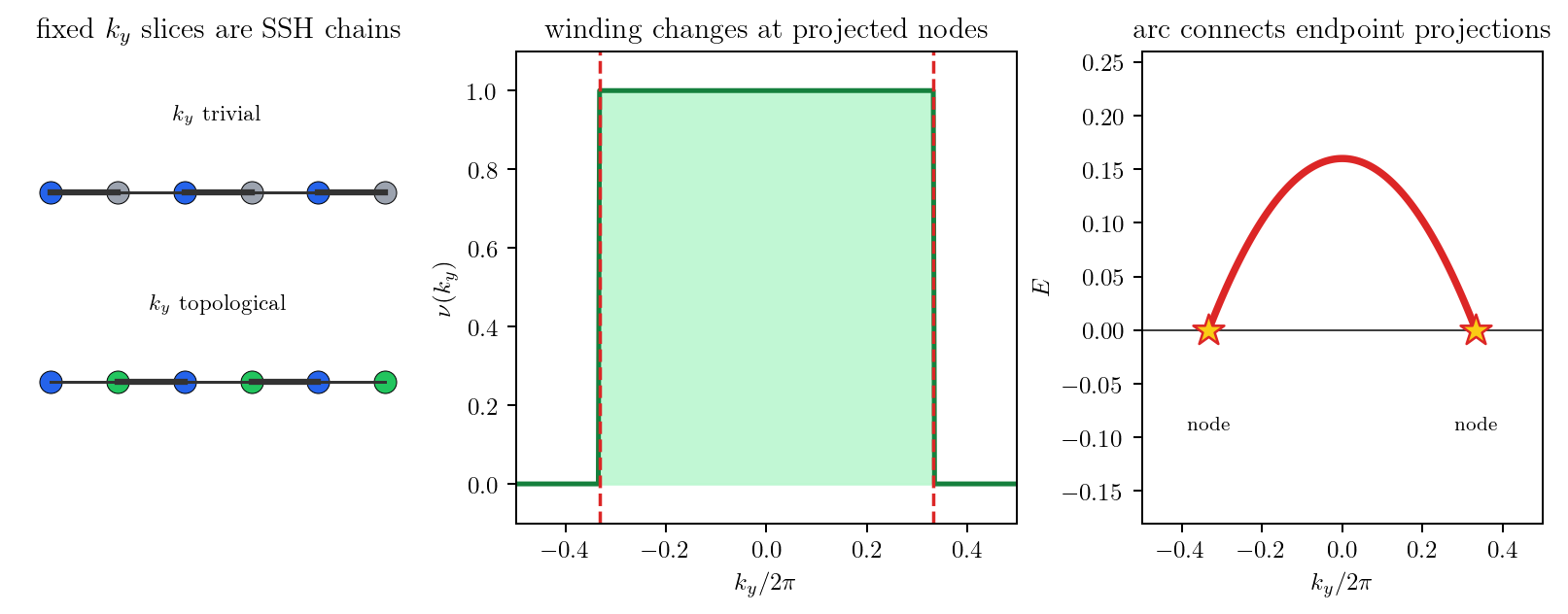
Figure 11.1: Cartoon of the Weyl/Majorana arc mechanism. Fixed (k_y) slices are SSH chains along (x). The winding changes across the projected Weyl nodes, and the paired boundary spectrum carries an arc connecting the endpoint projections.
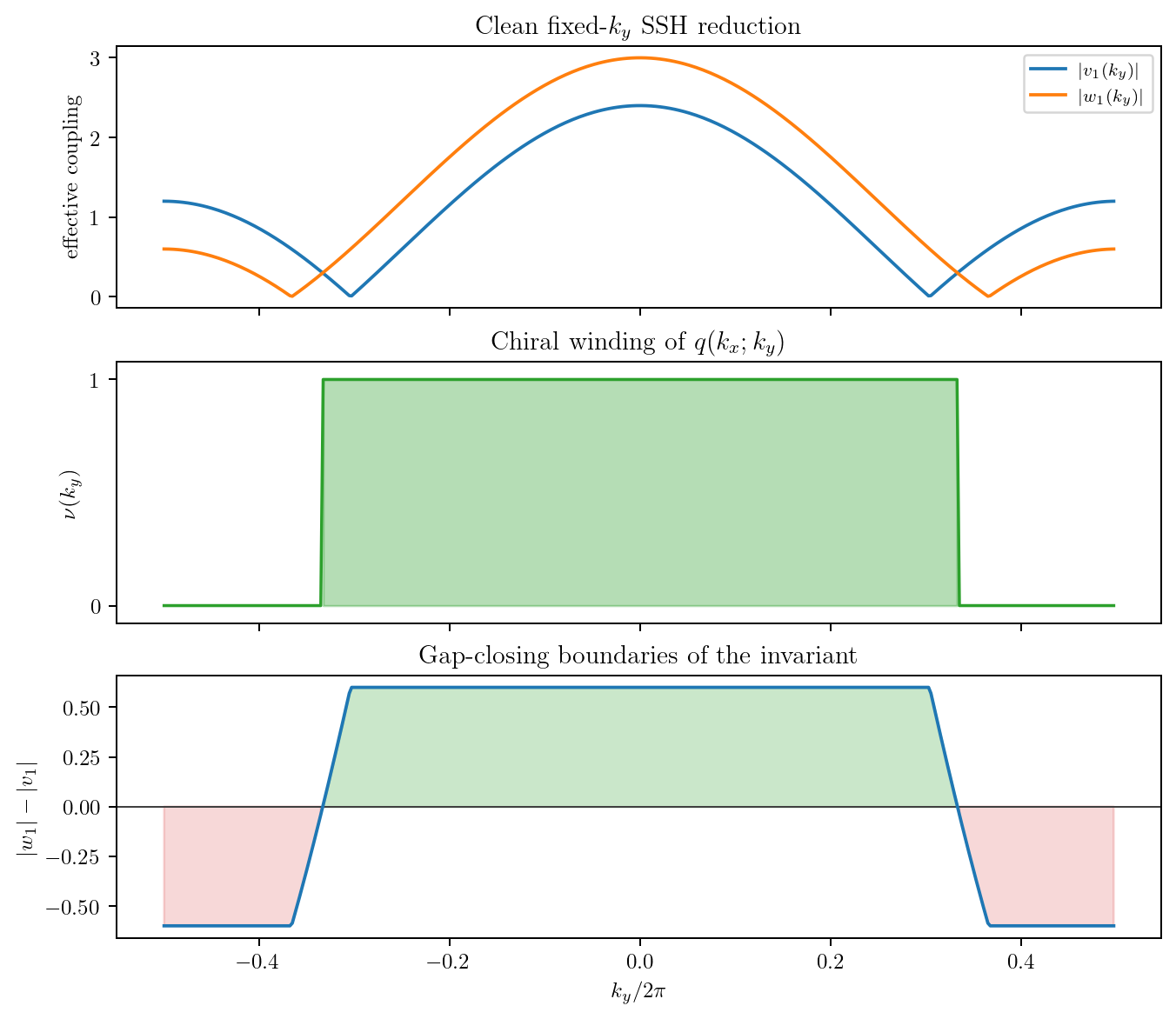
Figure 11.2: Clean bulk topology. For (\delta\epsilon=0), each (k_y) slice reduces to a chiral SSH chain along (x). The winding changes when the effective intracell and intercell hoppings exchange magnitude, predicting where the open-boundary Majorana arc should begin and end.
Internal Wall Geometry
The imposed-pairing BdG problem uses an inter-sublattice cell pairing (\Delta_{AB}=\Delta_0), usually (\Delta_0=0.3), in the Nambu basis ((c_A,c_B,c_A^\dagger,c_B^\dagger)^T). The wall is a scalar onsite potential
where (W_\ell) is a one-cell-thick support of length (\ell). The wall is inside a periodic torus, not an imposed open boundary. The real-space plots use centered unit-cell coordinates, so the plotted wall is at (x=0). Unless stated otherwise, real-space densities are cell-resolved sums over the (A) and (B) sites in each unit cell.
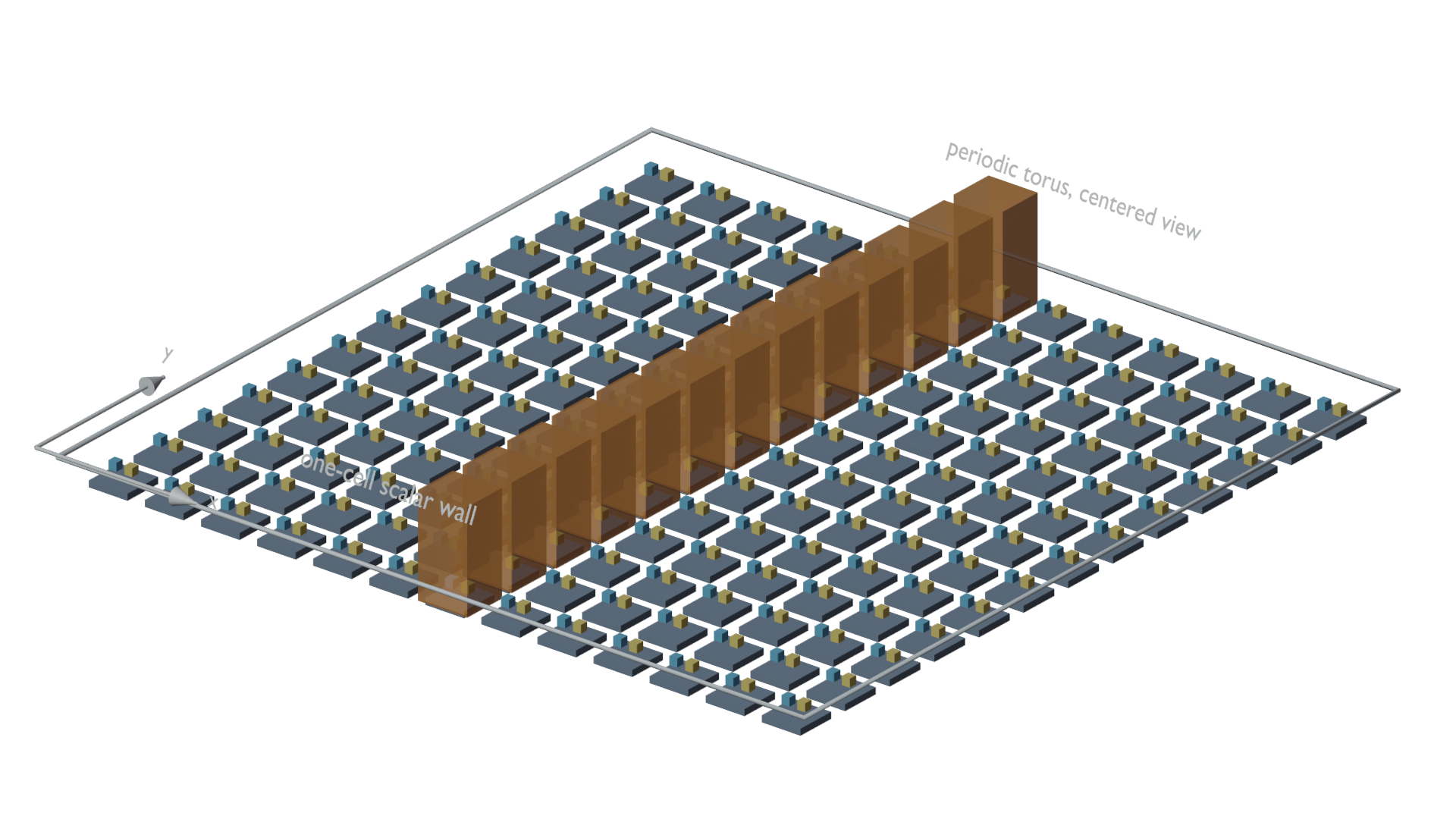
Figure 11.3: Three-dimensional view of the periodic wall setup. The orange cells mark the one-cell-thick scalar wall, the small blue and gold blocks show the two sublattice sites in each unit cell, and the compact axes indicate centered real-space coordinates. The render uses a (13\times13) representative lattice for clarity; the main fixed-pairing spectra and real-space diagnostics use (41\times41) unit cells unless stated otherwise.
Fixed-(\Delta_0) Branch Promotion
The imposed-(\Delta_0) calculation isolates the quasiparticle boundary problem. For representative wall strengths, the wall-projected spectral function (A(k_y,E)) shows the lowest positive bulk-like (k_y=0) excitation acquire wall weight and approach the near-zero hard-wall arc.
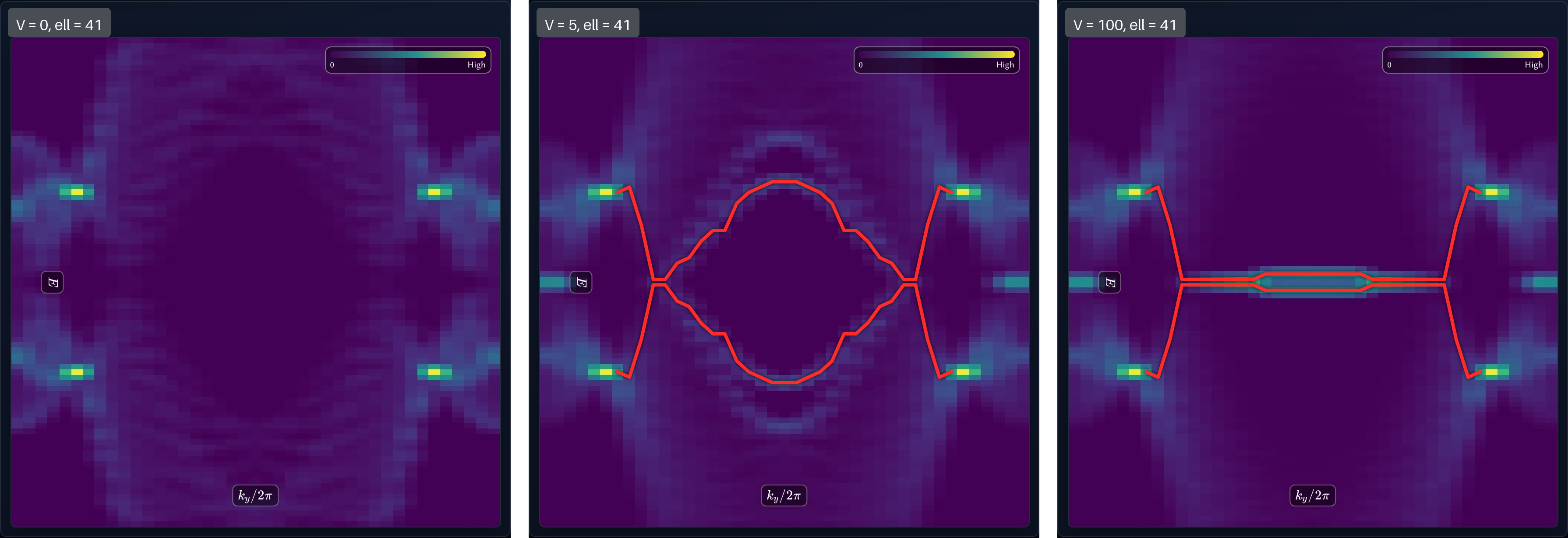
Figure 11.4: Viewer-exported wall-strength spectra for the imposed-pairing model on (41\times41) unit cells. The panels show (A(k_y,E)) at (\Delta_0=0.3), (\mu=\delta\epsilon=0), (\ell=41), and (V=0,5,100). The red curve follows the visible ADOS ridge and is clipped to the projected Weyl-node interval (|k_y|/2\pi\le 1/3).
To quantify the promotion, the calculation labels the branch by hard-wall ancestry rather than selecting a new local minimum at each parameter point. For each sampled (k_y), the tracker seeds the wall-weighted positive-energy mode at the largest simulated wall strength and continues that state downward in (V) by eigenvector overlap. When nearby eigenvalues have comparable single-vector overlaps, a small nearby-state subspace is used; ambiguous steps are logged and can be marked in the viewer. This makes the tracked branch a reproducible object, distinct from a purely visual ridge fit to (A(k_y,E)).
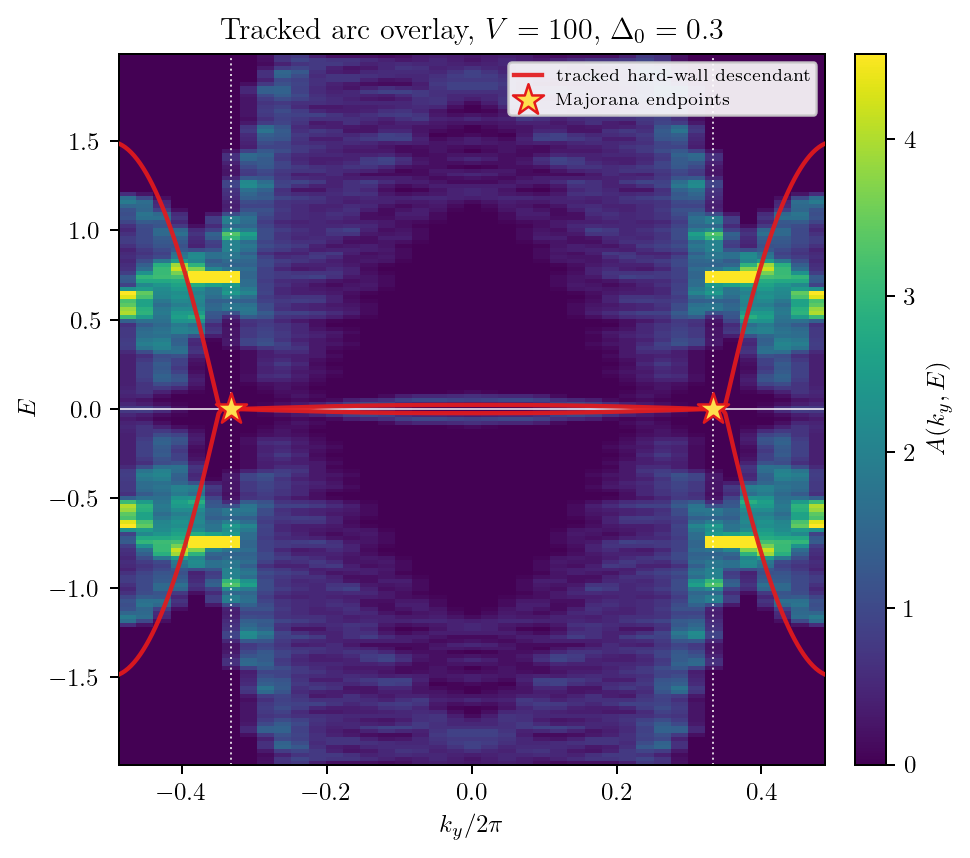
Figure 11.5: Tracked Weyl arc on top of the wall-projected spectrum. The background is (A(k_y,E)). The red curve is the hard-wall-descendant BdG branch selected by eigenvector and nearby-subspace overlap, and the yellow stars mark the clean Majorana endpoints at (k_y/2\pi=\pm 1/3).
The (k_y=0) point of the tracked branch provides a finite-size order diagnostic for the wall-driven branch promotion. Let (\epsilon_{\mathrm{arc}}(0;V)) be the wall-projected ADOS branch energy at (k_y=0), i.e. the distance from (E=0) to the selected positive-energy peak. The normalized branch-promotion diagnostic is
In practice the hard-wall reference is represented by the largest simulated wall strength. The (41\times41) full-wall data show a sharp finite-device onset between (V=2.5) and (V=3). This is physically useful: it marks the wall strength where the lowest positive bulk-like excitation at (k_y=0) is promoted into a wall-local hard-wall-descendant branch. It is not reported as a critical point. Window scans of the Landau-style form
do not give a stable (V_c) or (\beta): fits that include the jump pin (V_c) to the first fitted point, while fits beginning after the jump drive (V_c) to an unphysical lower bound. A thermodynamic quantum-critical interpretation would require a size-scaling collapse of (\eta_{\mathrm{hw}}(V,L)) and a consistent gap-closing diagnostic, neither of which is obtained from the present data.
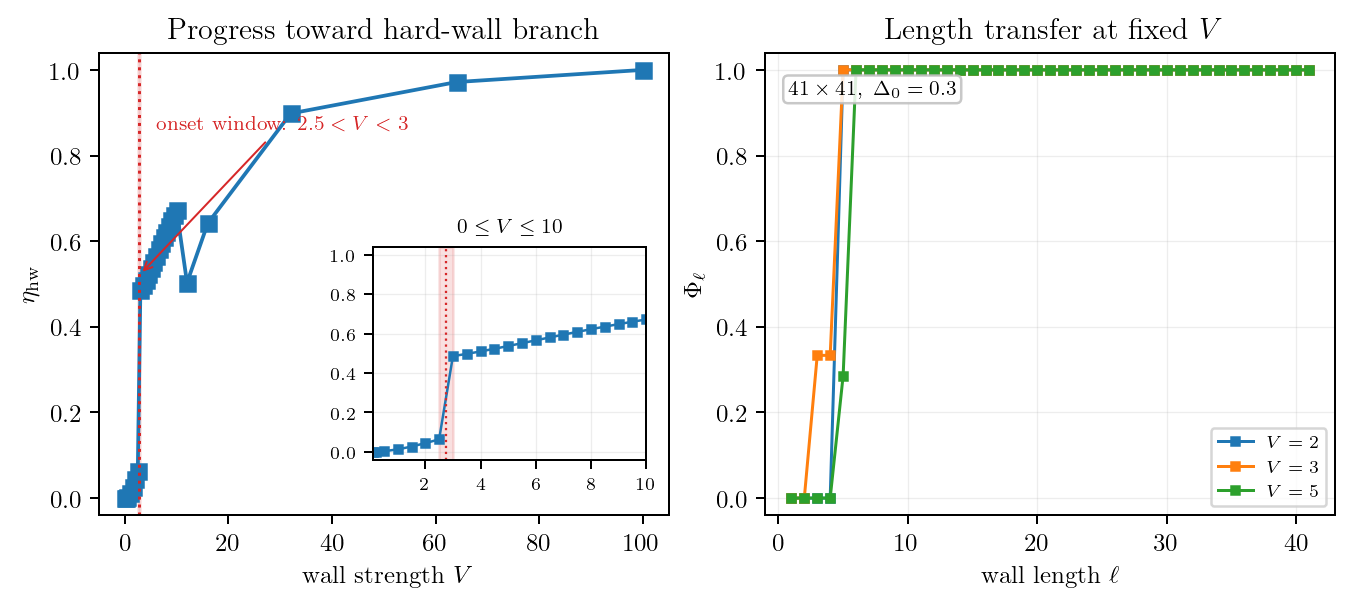
Figure 11.6: Fixed-(\Delta_0) branch-promotion diagnostic. The left panel shows the tracked (k_y=0) branch energy as (V) is increased. The tracked state is the lowest positive bulk-like excitation at weak wall strength and is promoted into a wall-local hard-wall descendant as the scalar wall becomes strong. The right panel shows (\eta_{\mathrm{hw}}(V)). The data points use a full wall on a (41\times41) unit-cell device with (\Delta_0=0.3). The shaded band marks the finite-size onset window (2.5<V<3), not a fitted critical point.
Localization And Majorana Character
The same branch promotion is visible in real space. The LDOS profiles below show wall-normal localization of selected spectral contributions at fixed (k_y) and energy. The component-resolved wavefunction shows the corresponding signed BdG amplitudes for the strong-wall near-zero mode. Together these diagnostics check that the tracked spectral branch is not merely a relabelled bulk eigenvalue.
In the BdG basis (\Psi=(c_A,c_B,c_A^\dagger,c_B^\dagger)^T), a wall eigenstate has spinor (\psi=(u_A,u_B,v_A,v_B)^T). Particle-hole symmetry pairs the state at energy (E) with a partner at (-E). At an exact Majorana zero mode the spinor can be gauge-fixed so that (v_\alpha=e^{i\phi}u_\alpha^\ast). The strong-wall state is therefore read as Majorana-like when the tracked branch approaches this particle-hole self-conjugate limit while remaining on the arc connecting the projected Weyl-node endpoints.
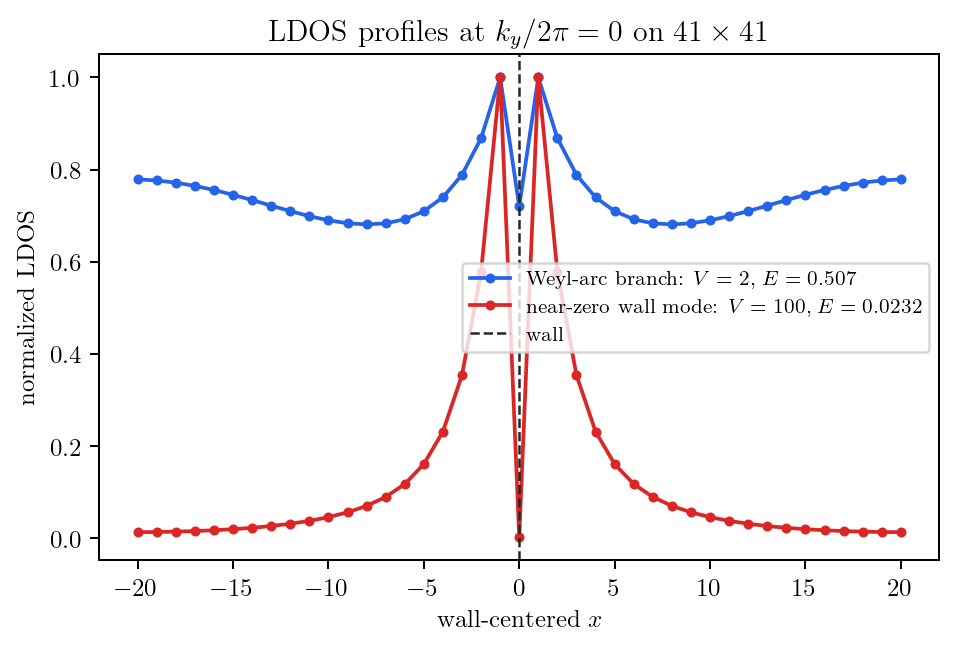
Figure 11.7: Wall-normal LDOS profiles on (41\times41) unit cells. The curves are evaluated at (k_y/2\pi=0): the Weyl-arc branch uses (V=2) and (E=0.507), while the near-zero wall mode uses (V=100) and (E=0.0232). Each curve is normalized by its own maximum, and the wall is marked at (x=0).
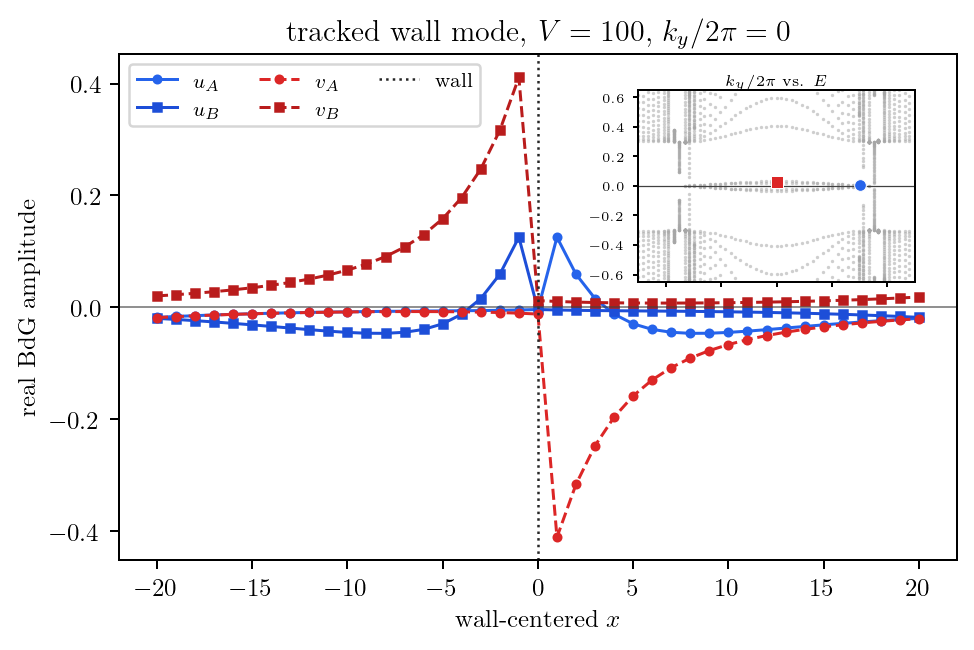
Figure 11.8: Component-resolved BdG wavefunction of the tracked strong-wall mode on (41\times41) unit cells. The curves show the real amplitudes ((u_A,u_B,v_A,v_B)) versus wall-centered (x) at (V=100), (k_y/2\pi=0), and (E=0.0232). The global phase is fixed by making the largest component real and positive.
Self-Consistent Wall Feedback
The imposed calculation treats the wall as a scatterer in a fixed BdG background. The self-consistent calculation asks a stronger question: how does the anomalous field respond to the wall?
The interaction is decoupled through the local Gor’kov field
with the local mean-field pairing field
Here (\kappa_{AB}(r)) and (\Delta_{AB}(r)) are local inter-sublattice cell fields. The plots show (|\Delta_{AB}(r)|), or averages of this magnitude over wall and off-wall cell sets, so the displayed quantity is insensitive to the global sign convention for the real pairing gauge used in the calculation. This self-consistent field is distinct from the imposed constant (\Delta_0) used in the fixed-pairing BdG problem.
The self-consistent result is the main physical correction to the fixed-pairing picture. The wall is not only a scattering potential for quasiparticles. It also creates a local depression of the anomalous field: (|\Delta_{AB}(r)|) is strongly suppressed on the wall support while the off-wall condensate remains finite. Attempts to fit the wall mean to the same finite-(V_c) ansatz as the fixed-(\Delta_0) arc are unstable. The safer interpretation is wall-local depletion with an empirical algebraic tail over the simulated interval, with an exponent of order unity rather than a claimed critical exponent.
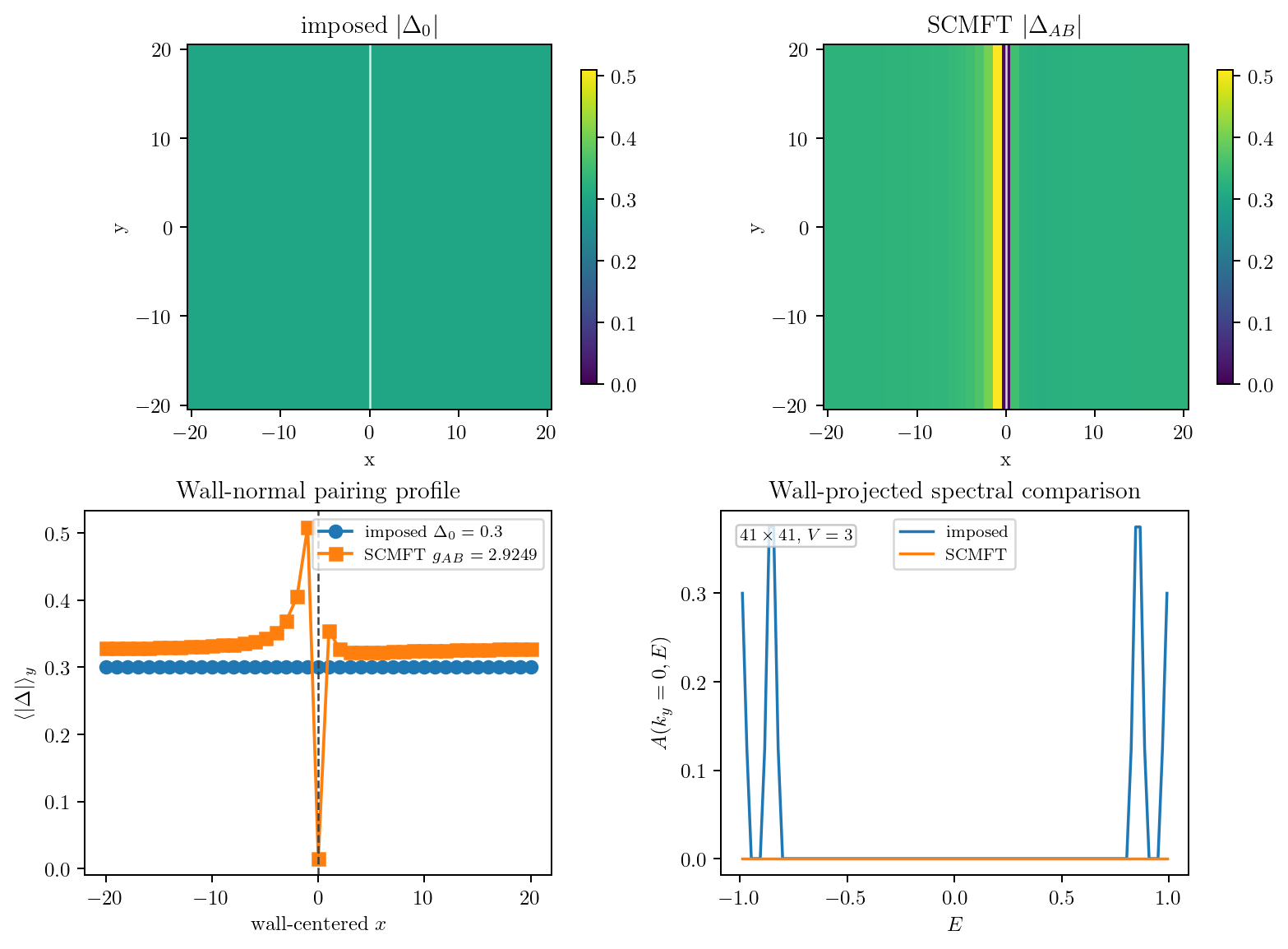
Figure 11.9: Direct fixed-pairing versus SCMFT comparison at the same wall. The imposed calculation keeps (|\Delta_0|) uniform, while the SCMFT solution suppresses the local (|\Delta_{AB}(r)|) at the wall and leaves the off-wall condensate finite.
The corresponding spectral check rebuilds the BdG Hamiltonian from fields that interpolate between the imposed reference and the relaxed SCMFT texture,
For the full (41\times41) partition, the atlas uses (V=0,1,2,5,10,100,1000) and (\lambda_{\rm sc}=0,0.5,1). The main observation is that the wall-projected ADOS is not qualitatively reorganized by this interpolation. Self-consistency mainly depletes and reshapes the local pairing amplitude, while the visible arc-like wall spectrum remains controlled primarily by the scalar wall. The SCMFT atlas is therefore a feedback and robustness diagnostic for the fixed-(\Delta_0) branch-promotion story, not a separate onset criterion.
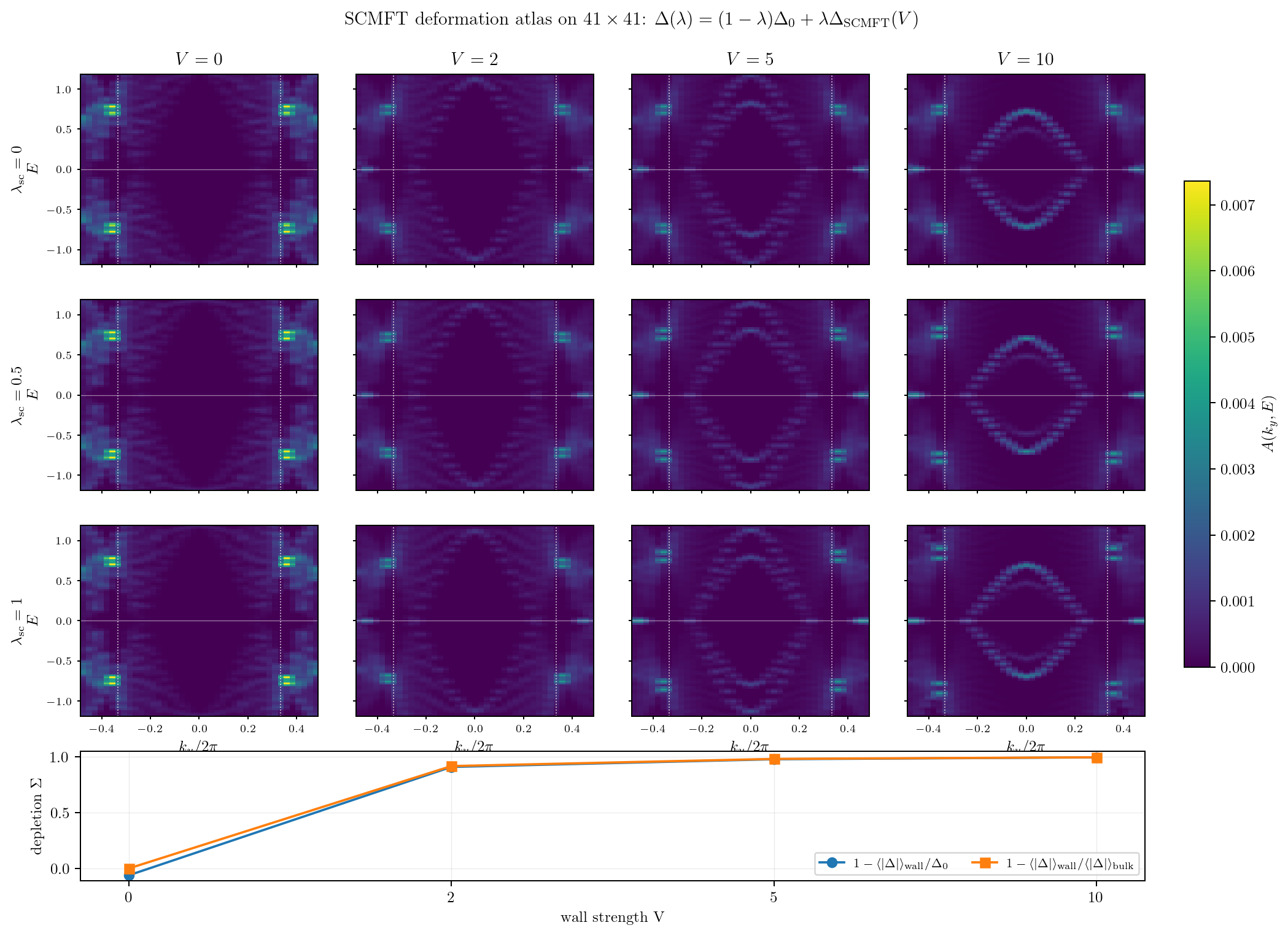
Figure 11.10: SCMFT deformation atlas for the wall-projected spectrum on the (41\times41) torus. Each panel shows (A(k_y,E)) after rebuilding the BdG Hamiltonian with (\Delta_{AB}^{(\lambda)}(\mathbf r)=(1-\lambda_{\rm sc})\Delta_0+\lambda_{\rm sc}\Delta_{AB}^{\rm SCMFT}(\mathbf r;V)). This publication subset uses full-partition SCMFT checkpoints at (V=0,2,5,10), and the rows use (\lambda_{\rm sc}=0,0.5,1). The full cached grid, including (V=1), (V=100), and (V=1000), is retained in the qulab record. The comparison shows that the relaxed pairing texture changes amplitudes and spectral weights more than it changes the qualitative ADOS morphology.
| (V) | wall mean (|\Delta_{AB}|) | off-wall mean (|\Delta_{AB}|) | | —: | —: | —: | | 1.0 | 0.318 | 0.331 | | 1.1 | 0.234 | 0.329 | | 1.2 | 0.139 | 0.326 | | 1.3 | 0.0846 | 0.324 | | 1.5 | 0.0480 | 0.321 | | 2.0 | 0.0271 | 0.327 | | 3.0 | 0.0150 | 0.337 |
Local Marker And Symmetry Controls
The clean winding invariant is exact only in the chiral slices of the translation-invariant model. The scalar onsite wall is a local chiral-symmetry-breaking perturbation because it contributes a same-sublattice onsite term on the wall cells. This does not invalidate the wall-promotion calculation; it clarifies what is being tested. The bulk away from the wall remains governed by the chiral SSH structure, while the wall locally breaks that symmetry and acts as a boundary-forming perturbation.
The local chiral marker is therefore used as a diagnostic, not as a final quantized invariant:
where (\Gamma=+1) on (A), (\Gamma=-1) on (B), and (Q=1-2P_-) is the flattened occupied-state projector. In the translationally invariant limit, this expression is the real-space form of the class-AIII winding density, obtained by replacing (i\partial_k) with the position commutator ([X,\cdot]). The comparison below shows that a scalar onsite wall and a chiral hopping cut are distinct boundary mechanisms.
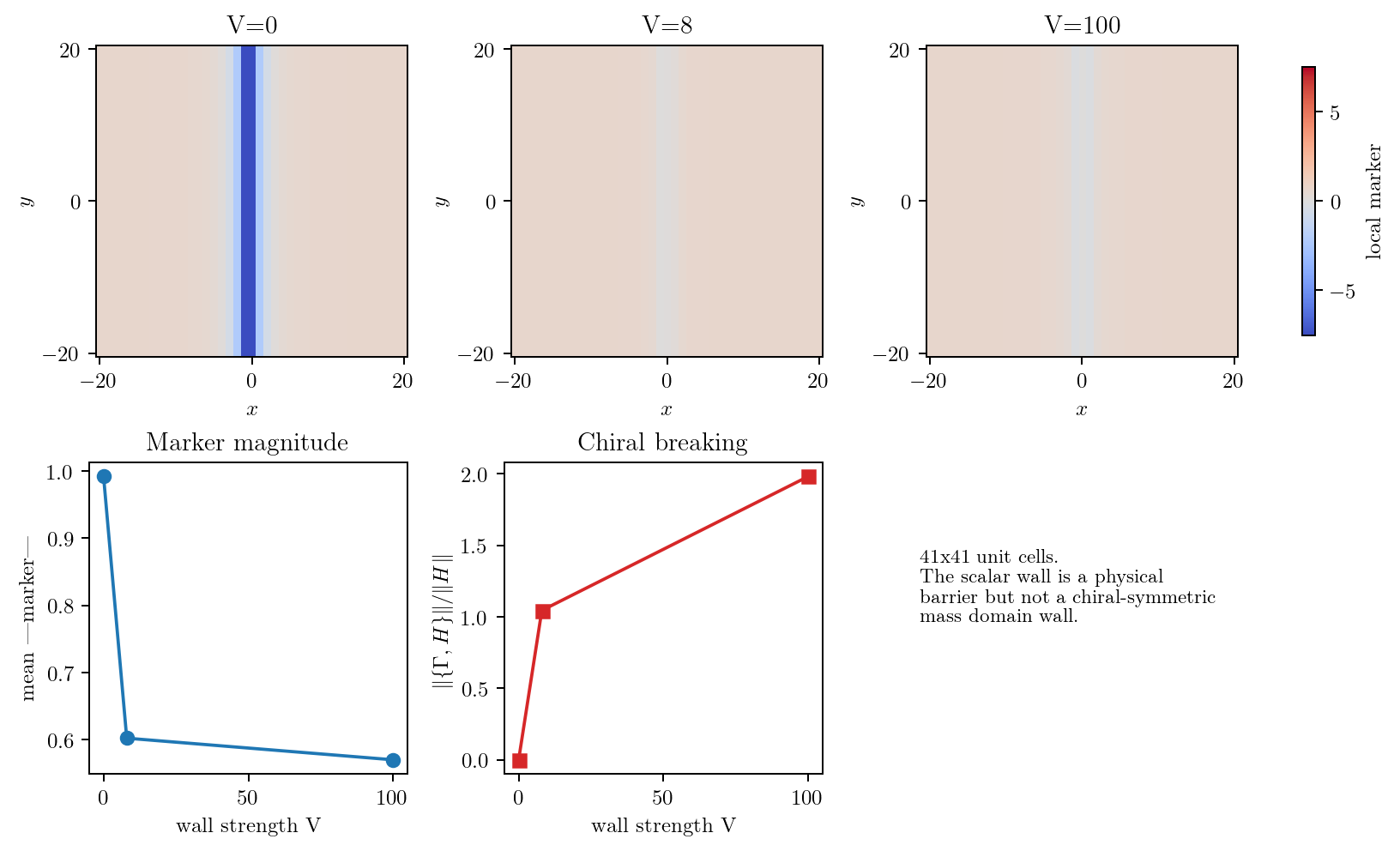
Figure 11.11: Local marker for the scalar onsite wall on (41\times41) unit cells. The bulk retains the clean chiral SSH structure, but the onsite impurity wall is a local chiral-symmetry-breaking defect.
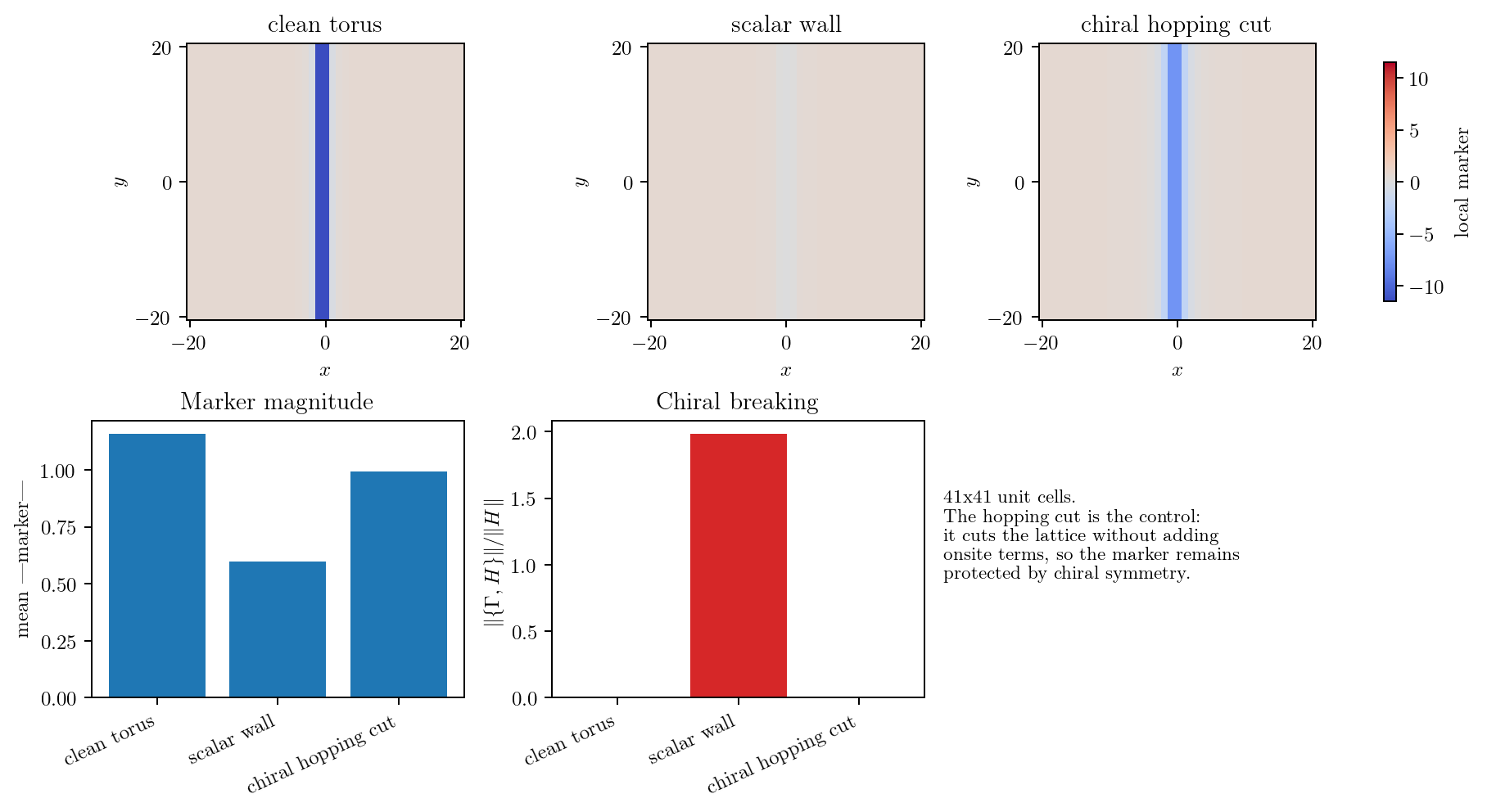
Figure 11.12: Chiral hopping-cut control on (41\times41) unit cells. This control changes inter-sublattice hopping terms rather than adding onsite potentials, showing that a scalar wall and a chiral-symmetric cut are distinct boundary mechanisms.
Finite-Size Diagnostics
The completed scaling audit identifies finite-device branch promotion rather than a thermodynamic quantum critical point. The diagnostics below are kept in this chapter because they document the negative result: the onset can be sharp on a single device, but the fitted exponent and finite-size onset do not stabilize. The transition audit uses the same hard-wall-descendant branch definition across sizes. A thermodynamic transition would require a stable collapse of (\eta_{\rm hw}) or (\Omega_{\rm hw}), a consistent onset bracket for the same selected branch, and a matching branch-neighbor or lowest-positive gap diagnostic that closes at the same scale. The production run through (L=141) shows a decreasing gap proxy, but the collapse and zero-intercept gap criteria are not stable. The self-consistent wall-depletion result is therefore treated as mean-field feedback on the boundary, not as independent critical-scaling evidence.
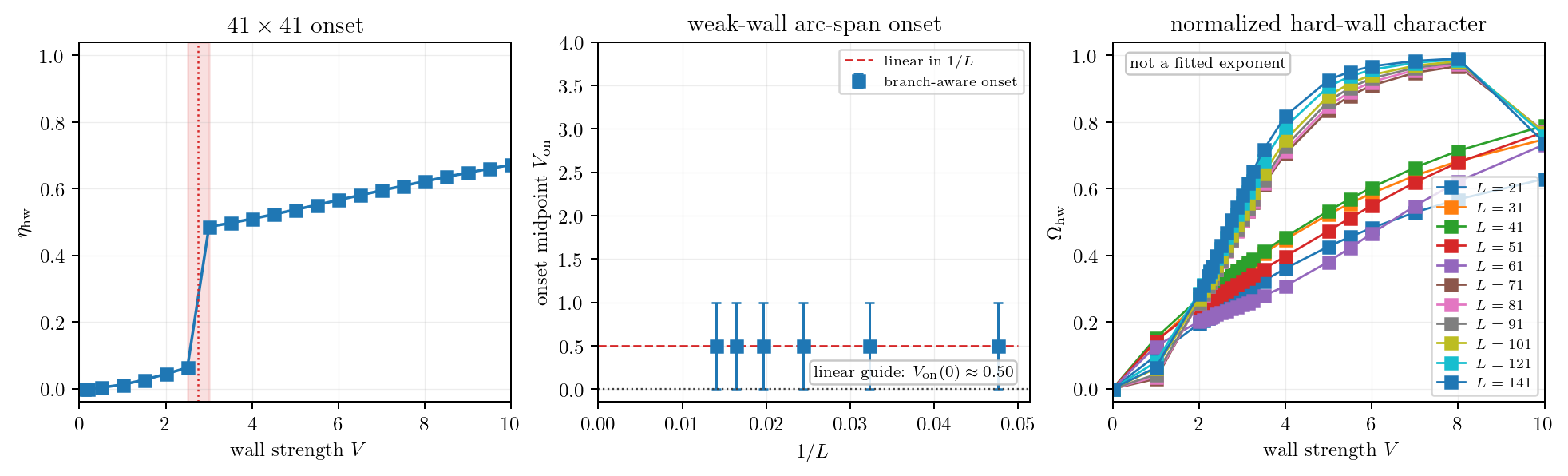
Figure 11.13: Finite-size checks for a possible critical interpretation of the branch-promotion onset. The (41\times41) branch-promotion diagnostic has its largest jump between (V=2.5) and (V=3), but the branch-aware emergence onset drifts with increasing (L), and the fit-window scan does not give a stable cluster of (V_c) and (\beta).
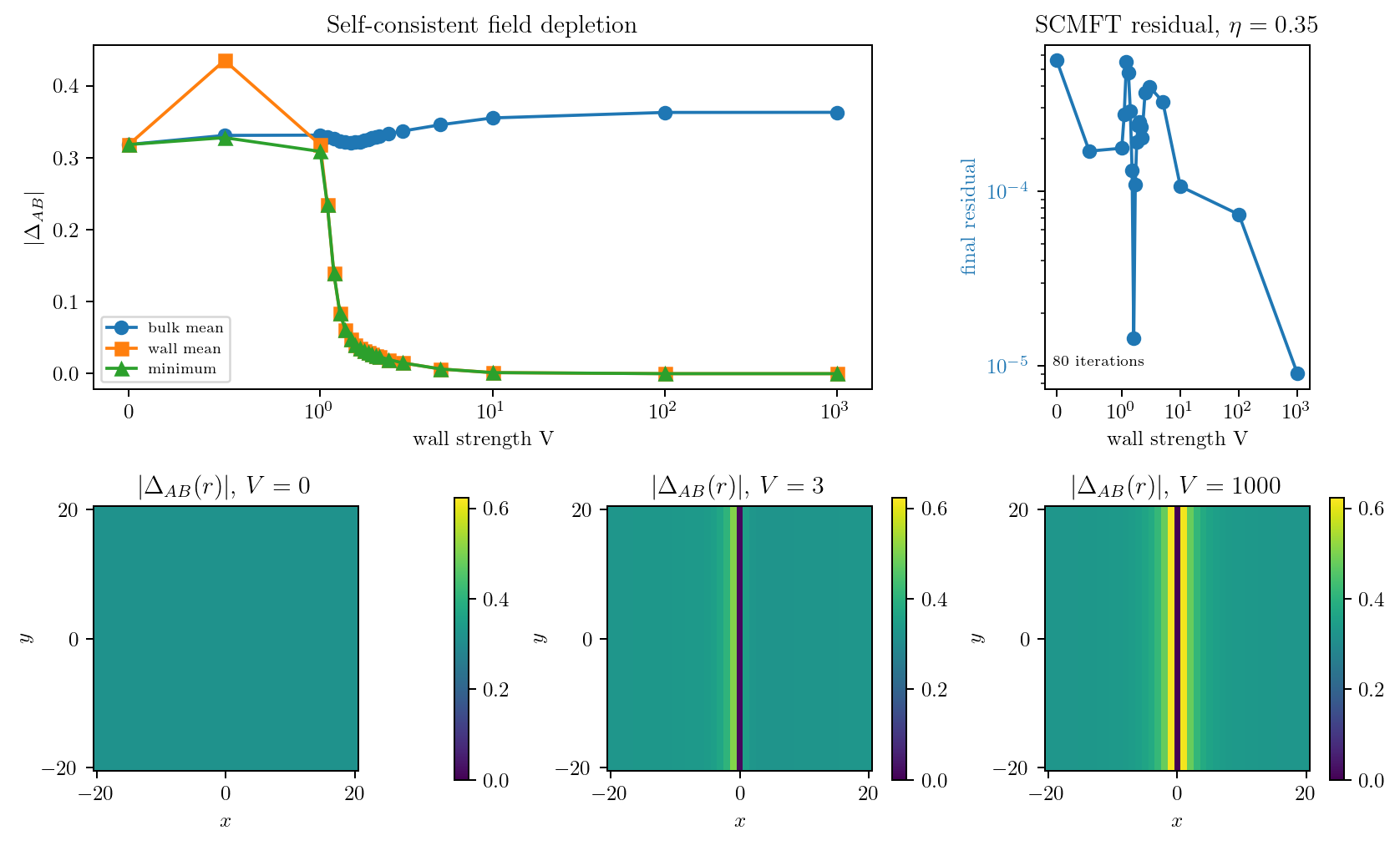
Figure 11.14: Self-consistent mean-field wall response. The summary curves and representative field maps show that the wall suppresses the local Gor’kov field and expels the pairing amplitude from the wall support while the off-wall condensate remains finite.
Conclusion
Soft impurity walls provide a controlled finite-device route from clean momentum-space topology to a real-space internal boundary in a superconducting SSH lattice. In the fixed-(\Delta_0) problem, the lowest positive bulk-like (k_y=0) excitation is continuously promoted into a wall-local near-zero hard-wall descendant as (V) grows. In the self-consistent problem, the same wall suppresses (\kappa_{AB}(r)) and (\Delta_{AB}(r)) on the wall support while preserving a finite off-wall condensate.
The conclusion is a linked chain of evidence: clean slice winding, slab Majorana arcs, wall-projected spectral evolution, eigenvector-continuous arc tracking, real-space mode localization, and self-consistent suppression of the wall pairing field. The current evidence does not justify a reported critical exponent. The finite-size audit through (L=141) fails the required collapse and zero-intercept gap tests, so the result is sharp finite-device branch promotion, not an identified thermodynamic phase transition.
Numerical data and figures were generated with the qulab.research.ssh_2d
module in QuLab [4].
Topological superconductivity in a 2D Weyl—SSH model (archive note)
This detailed reproduction note is now maintained in the canonical Notebook bundle:
~/Projects/Research/Notebook/content/unconventional-superconductivity/2D-SSH-model-with-impurities-to-walls
The PhD tree now keeps the thesis-facing chapter text, figure assets, and
stable outputs only. The active reproduced and self-consistent QTT workflows
live in src/qttree/examples/studies/weyl_ssh_mean_field/; the old
chapter-local weyl_ssh_native_figures.py driver has been removed so the
Weyl–SSH calculation has one maintained implementation path.
References
- W. Su, J. Schrieffer, and A. Heeger,
Solitons in polyacetylene,
Phys. Rev. Lett., vol. 42, pp. 1698–1701, 1979. doi:10.1103/PhysRevLett.42.1698 (↩︎) - C. Li,
Topological states in two-dimensional su-schrieffer-heeger models,
Frontiers in Physics, vol. 10, 2022. doi:10.3389/fphy.2022.861242 (↩︎) - P. Rosenberg and E. Manousakis,
Topological Superconductivity in a two-dimensional Weyl SSH model,
arXiv:2203.12004, 2022. [Online]. Available: https://arxiv.org/abs/2203.12004 (↩︎) - H. Sheehy,
QuLab research module for two-dimensional SSH soft walls,
2026. (↩︎)