A Self-Consistency Obstruction to Internally Antisymmetric Nonunitary Triplet Pairing
Muon-spin-relaxation experiments report time-reversal-symmetry breaking in both noncentrosymmetric LaNiC(_2) and centrosymmetric LaNiGa(_2) [1, 2]. Thermodynamic probes also indicate multigap, largely nodeless superconductivity [3, 4]. Internally antisymmetric nonunitary triplet (INT) pairing was proposed to reconcile these facts by combining equal-spin triplet structure with an antisymmetric orbital label [2, 3, 5].
This chapter does not claim that nonunitary superconductivity, Hund-assisted interorbital triplet pairing, or competing-order routes to multiorbital nonunitarity are new ideas. They are part of the established context for complex superconductors [6, 7, 8]. The contribution here is the narrower audit: whether the LaNiX(_2)-motivated INT ansatz is selected by the tested local, Stoner-like, screened-proxy, and survey-material mean-field loops, rather than merely imposed as a phenomenological gap. The result is best read as an obstruction statement: amplitude support and spontaneous nonunitary imbalance are distinct self-consistency directions.
That obstruction is the reason this chapter is not simply a failed material calculation. It identifies a reusable design principle for microscopic TRSB theories: first prevent superconducting amplitude starvation, then supply a source-free selector for the time-reversal-odd coordinate. In this INT chapter the coordinate is the pair-spin imbalance (q_z=(i\mathbf d\times\mathbf d^*)_z). In the later loop-supercurrent chapter the analogous coordinate is phase/current winding. The two mechanisms are physically different, but the self-consistency lesson is the same.
The chapter asks a narrower question than the phenomenology. If the INT gap is imposed, the algebraic and spectral signatures are straightforward. The nontrivial test is whether a controlled microscopic mean-field calculation selects that nonunitary branch over singlet, unitary triplet, mixed, or normal alternatives. The result is a benchmark, not an exclusion theorem: under the local Hubbard-Kanamori-like assumptions and survey-quality LaNiX(_2) Hamiltonians tested here, robust spontaneous nonunitary INT order is not obtained. For LaNiC(_2), the completed full-window Wannier continuation is a better normal-state candidate, but checkpointed reruns on that HR file keep the reduced robustness grid and full 88-Wannier-basis scans through (n_k=3) at numerical-zero order parameter rather than nonunitary INT. For LaNiGa(_2), the conclusion is even more limited: the material input should be treated as provenance-level because the normal-state validation route is blocked by repeated QE c_bands failures and a rejected PAW-SOC reproduction on the current QE stack. Completing a production-quality LaNiX(_2) material study would be valuable, but it is not required for this chapter’s claim.
Normal State and Local Interaction
The minimal toy model uses two active orbitals (a,b) and spin. In the basis ((c_{a\uparrow},c_{a\downarrow},c_{b\uparrow},c_{b\downarrow})), the normal Hamiltonian is
For the retained two-dimensional figures,
Here (t) sets the hopping scale, (\mu) is the chemical potential, (s) is the orbital splitting, (v_0,v_1) are interorbital hybridisations, and the baseline spin-orbit term is longitudinal with respect to the chosen (\uparrow/\downarrow) quantization axis. Projection-repair scans additionally allow transverse texture terms such as (\lambda_x\tau_y\sigma_x).
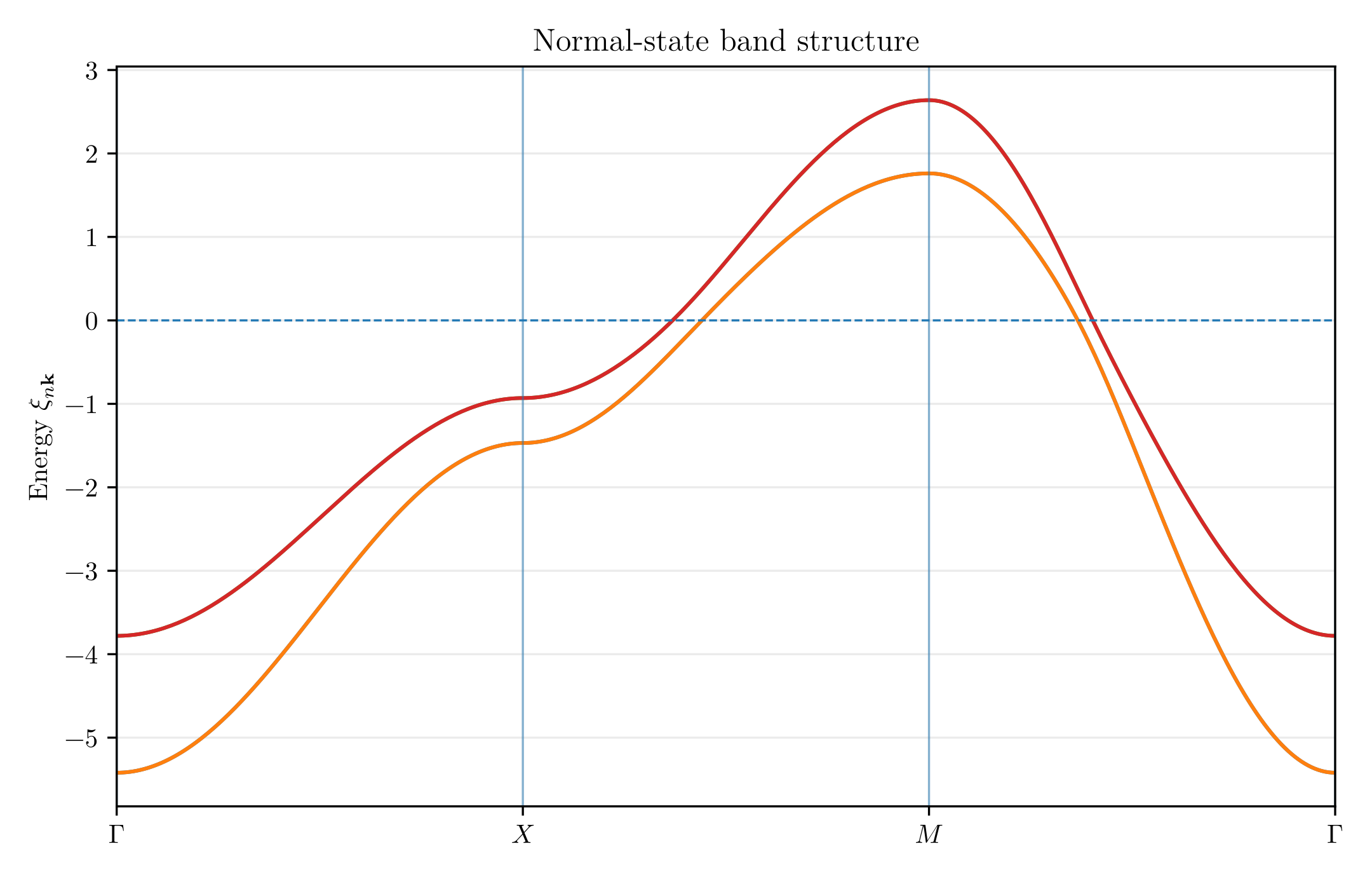
Figure 12.1: Normal-state band structure for the two-orbital toy model.
The local interaction is the two-orbital Hubbard-Kanamori form [9],
with
Positive (U,U’,J_H,J_P) denote repulsive microscopic parameters. With the exchange operator ordered as above,
so the equal-spin interorbital triplet scale is
Hund exchange lowers the equal-spin interorbital triplet channel relative to interorbital singlet competitors. That is not the same as proving a superconducting instability: for ordinary repulsive parameters the INT channel may be the least repulsive descendant without being attractive unless the effective vertex is renormalized or supplied phenomenologically. Additional atomic and multiorbital background for this sign convention is kept in the appendix on Hund’s rule.
Linearized Channel Diagnostic
The inverse scalar pairing susceptibility is defined by the channel kernel
where (\chi_\alpha) is the normal-state pair susceptibility projected onto channel (\alpha), and (\mathbf U_\alpha) is the relevant component of the local interaction tensor. Equivalently, the plotted dimensionless eigenvalues are
for which (\lambda_\alpha=1) is the scalar linearized instability condition. For the retained diagnostic, the toy susceptibilities are held fixed at (T=0.05), while
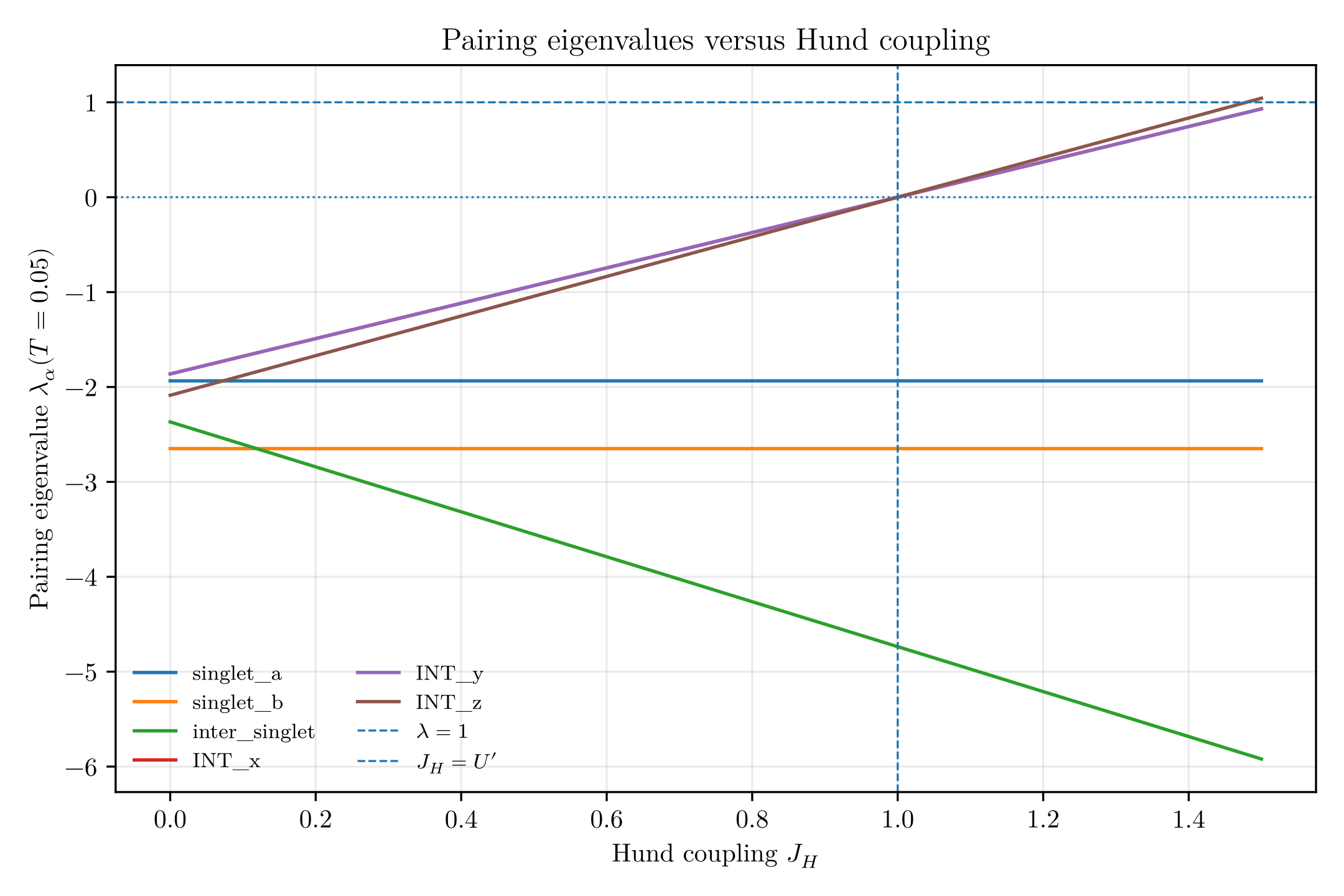
Figure 12.2: Linearized local-channel diagnostic. The plotted eigenvalues are (\lambda_\alpha=-\mathbf U_\alpha\chi_\alpha), equivalently the scalar inverse-susceptibility kernel (\mathcal K_\alpha=\chi_\alpha^{-1}+\mathbf U_\alpha) crossing zero at (\lambda_\alpha=1). Hund exchange lowers the internally antisymmetric equal-spin triplet sector relative to interorbital singlet competitors, but the conservative bare hierarchy remains repulsive unless (J_H>U’) or an effective attractive INT vertex is supplied.
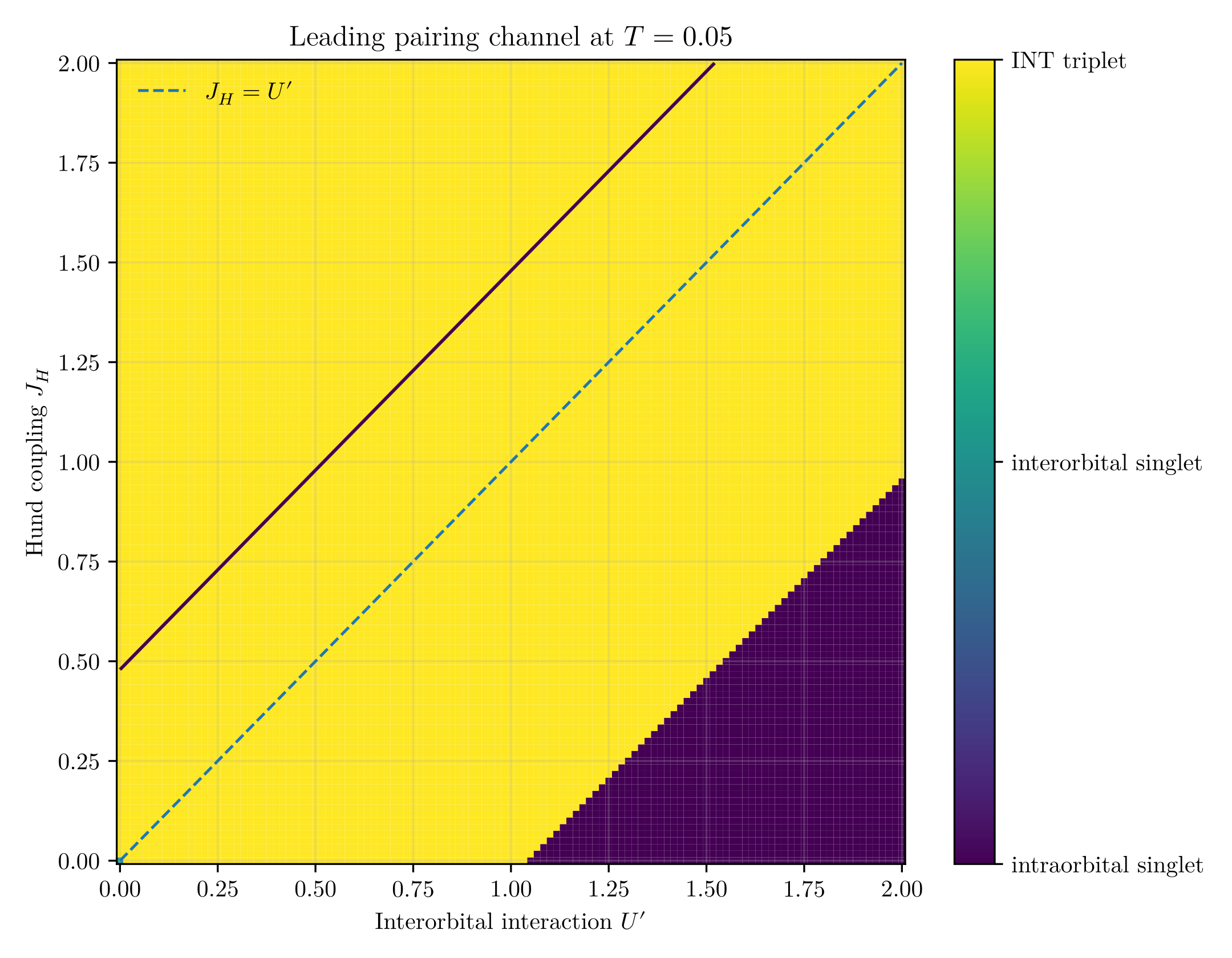
Figure 12.3: Leading local channel map. The map records the leading channel label, not a nonlinear self-consistent ground state.
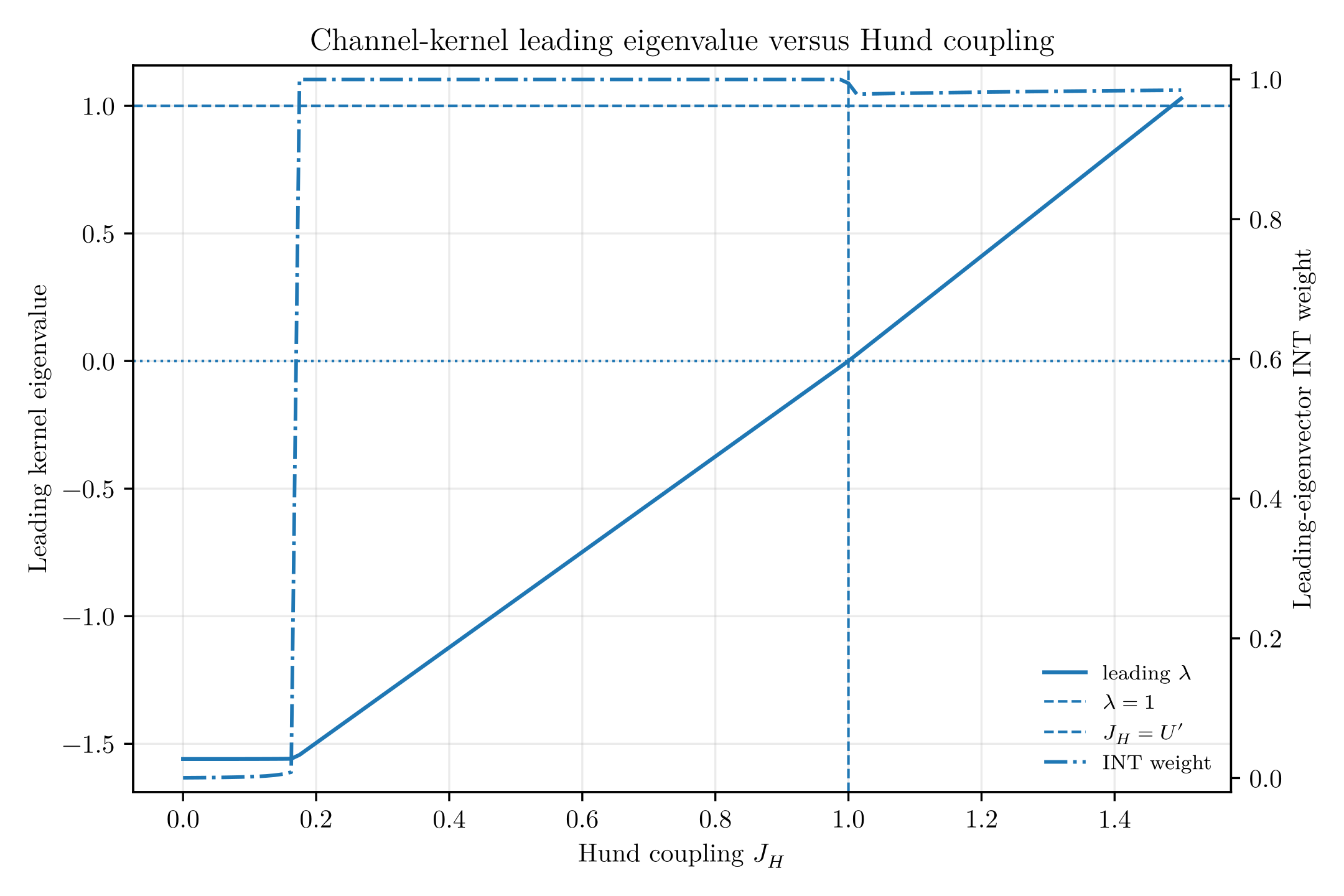
Figure 12.4: Projected coupled-kernel scan versus Hund exchange.
INT Gap and Nonunitarity
The local INT gap is even in momentum and spin triplet, so the antisymmetry required by Fermi statistics resides in the orbital labels. In the internal basis ((a\uparrow,a\downarrow,b\uparrow,b\downarrow)),
Equivalently,
The minus signs in the matrix are the entries of the antisymmetric orbital tensor (i\tau_y). The state is nonunitary when
in the paired subspace, equivalently (i\mathbf d\times\mathbf d^*\ne0) [10]. Unequal equal-spin amplitudes, (|\Delta_{\uparrow\uparrow}|\ne|\Delta_{\downarrow\downarrow}|), split the nonzero eigenvalues of (\Delta\Delta^\dagger). This algebraic split is the diagnostic used below.
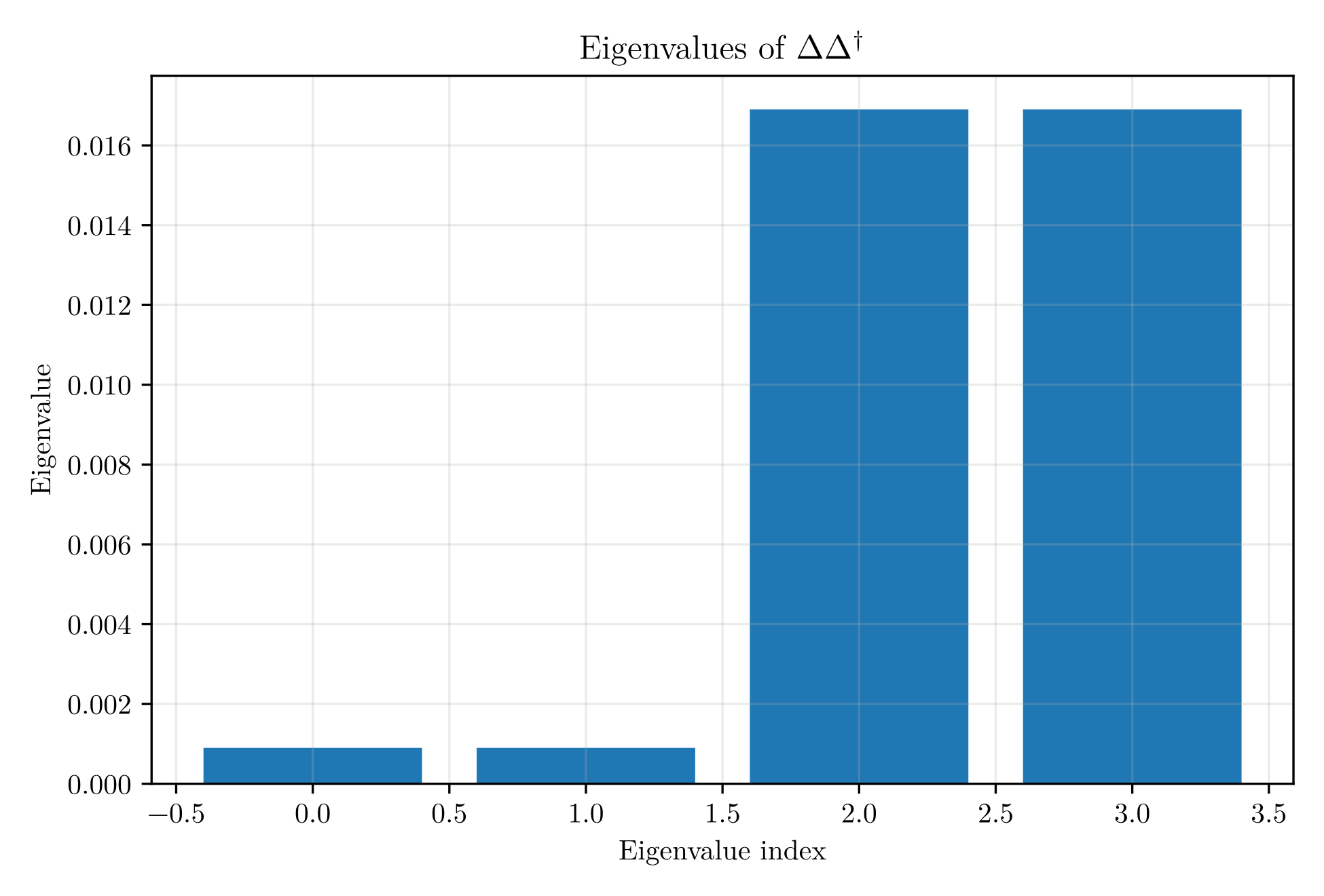
Figure 12.5: Eigenvalues of (\Delta\Delta^\dagger) for the imposed nonunitary INT gap. Unequal equal-spin components split the eigenvalues, showing that (\Delta\Delta^\dagger) is not proportional to the identity in the paired subspace.
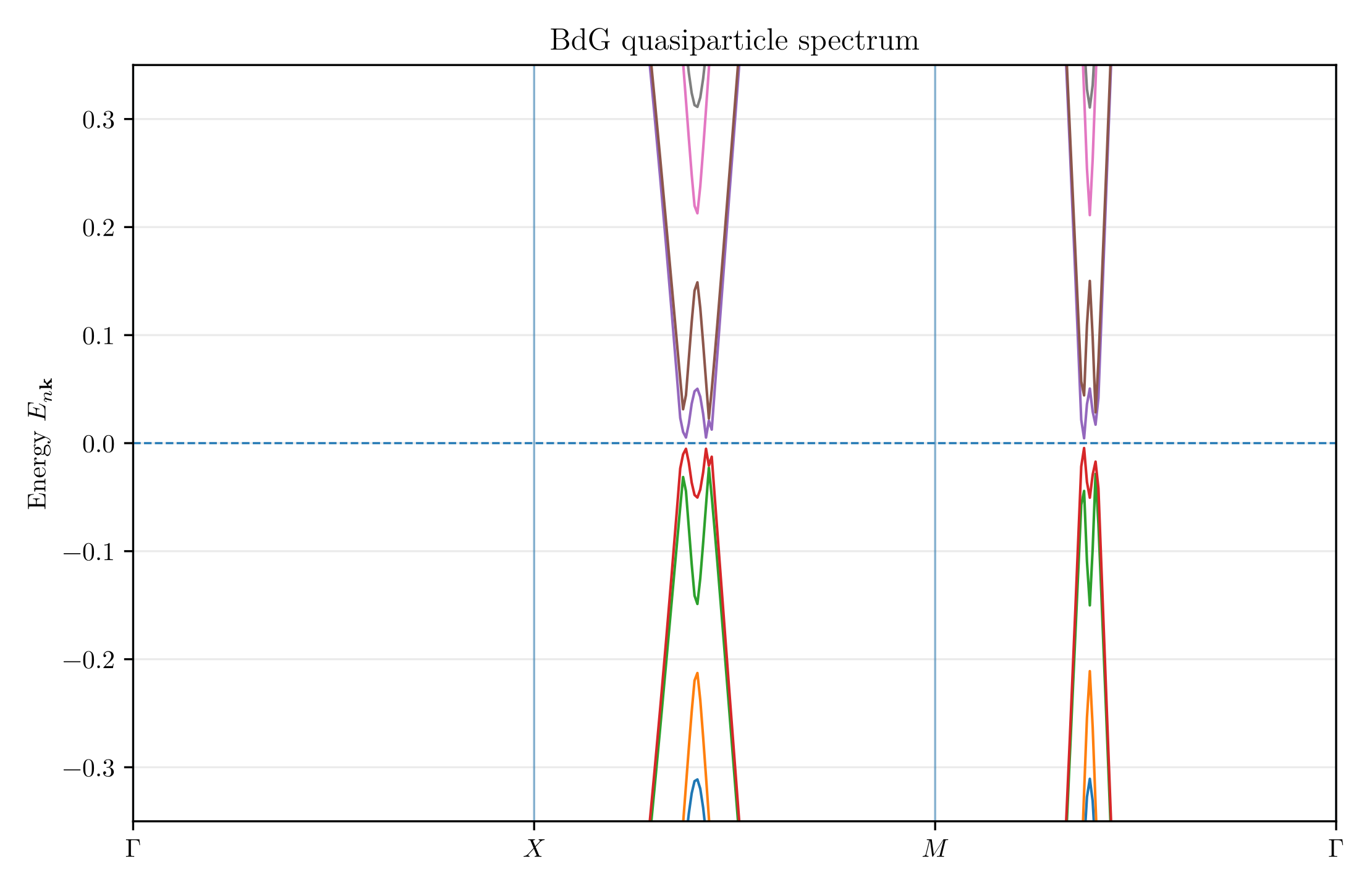
Figure 12.6: BdG quasiparticle spectrum for the imposed INT state.
The spin-resolved density of states is computed from the electron block of the retarded BdG Green function,
where (\Pi_s) projects onto spin (s=\uparrow,\downarrow), and (\eta) is the Lorentzian broadening. Before the impurity/Dyson step this is the spectral sum
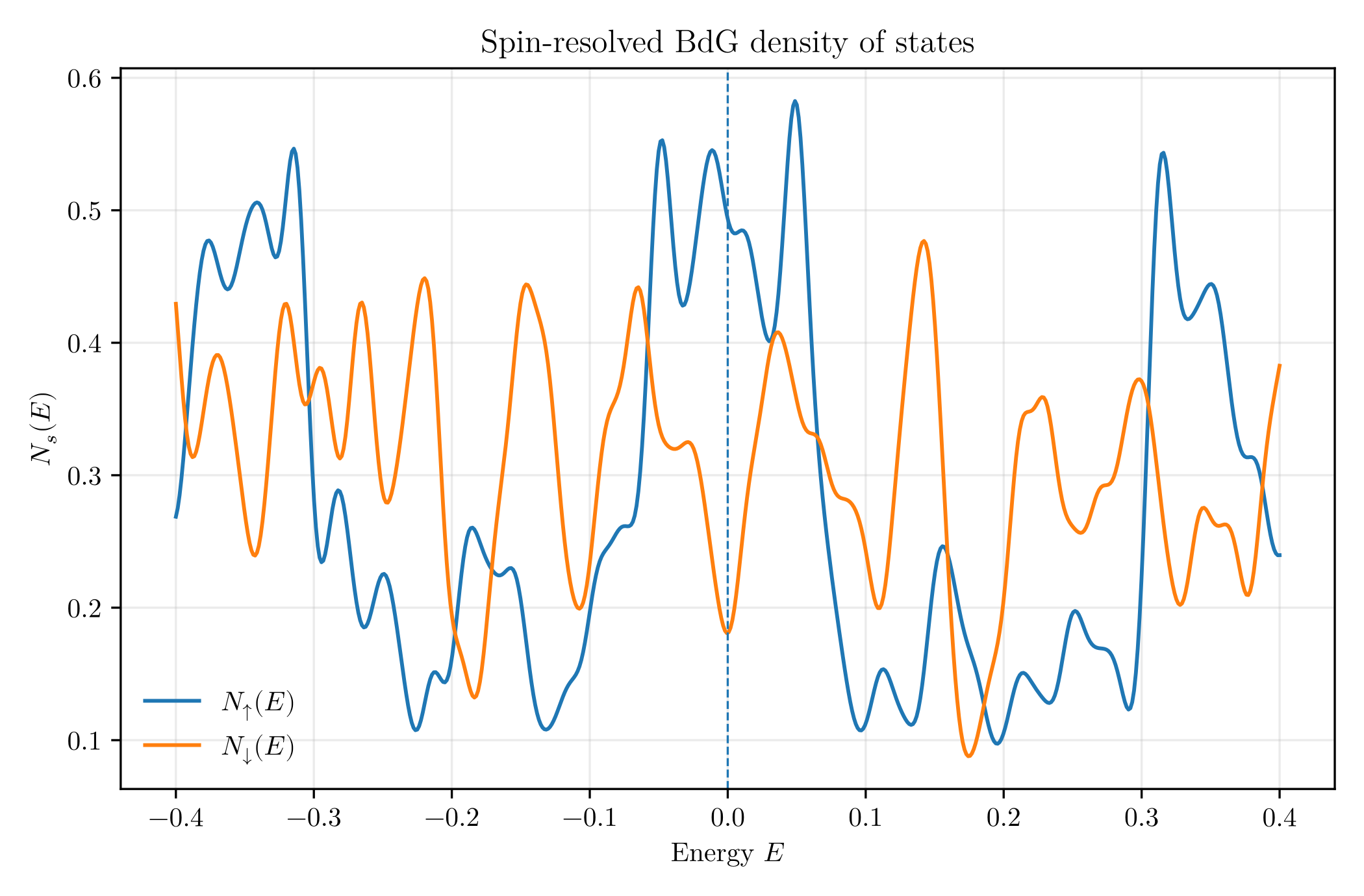
Figure 12.7: Spin-resolved density of states for the imposed INT ansatz. The nonunitary gap produces spin-resolved spectral asymmetry, but this imposed diagnostic does not by itself prove self-consistent phase selection.
Fermi-Subspace Projection
Channel selection is not enough. The weak-pairing gap is the local INT matrix projected into the Fermi subspace,
A large local gap is ineffective if it maps a Fermi-level state mainly to a partner outside the retained low-energy subspace. This obstruction is clear in the representative Hamiltonian
Here (\xi(\mathbf k)) is a scalar dispersion, (\tau_y) is the orbital-antisymmetric hybridization/SOC structure, and the (\lambda_x\sigma_x,\lambda_z\sigma_z) terms are spin-orbital texture components. In this convention, (\lambda_z\sigma_z) is longitudinal with respect to the equal-spin quantization axis, while (\lambda_x\sigma_x) is transverse. This terminology is basis dependent.
The helicity projectors are
Using the equal-spin convention
the (\Delta_x) used in the projection rule denotes
For the simplified Hamiltonian above, the nonzero singular values of (P_\nu\Delta_{\rm INT}P_\nu^T) scale as
A purely longitudinal texture therefore leaves the same-helicity INT projection zero in this limit. A transverse spin-orbital component repairs the weak-pairing projection by rotating the normal-state eigenvectors so that the INT-paired partner stays in the low-energy subspace.
The plotted projection diagnostics are evaluated on
with
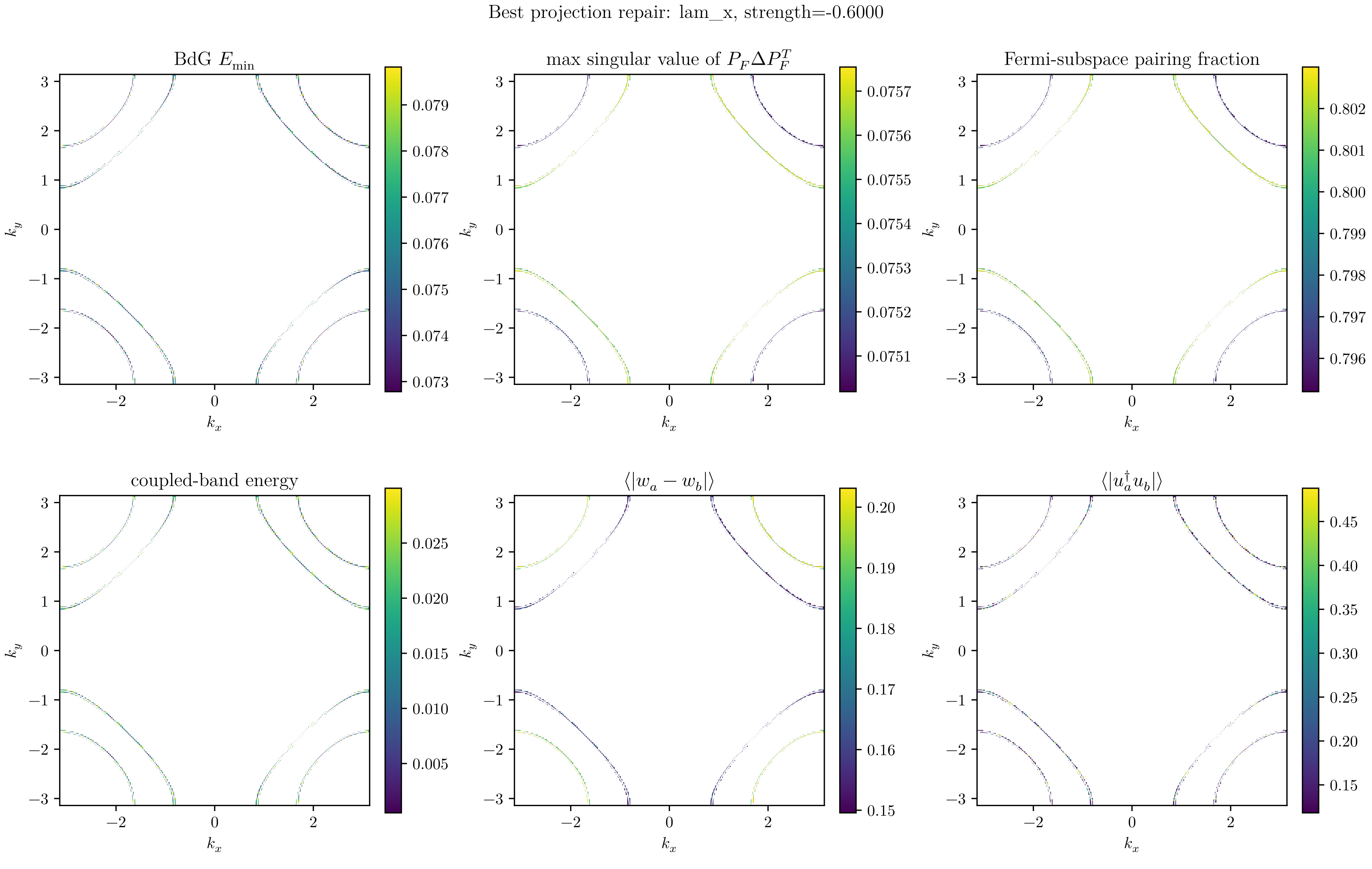
Figure 12.8: Fermi-subspace projection repair. The weak-pairing gap is controlled by (\Delta_F(\mathbf k)=P_F(\mathbf k)\Delta_{\rm INT}P_F^T(-\mathbf k)), not by the local INT matrix alone. In the minimal toy model the INT operator mostly pairs a Fermi-level state with a partner outside the retained low-energy subspace. A transverse spin-orbital texture repairs this by keeping the INT-paired partners in the same Fermi subspace; increasing scalar attraction alone does not solve the projection problem.
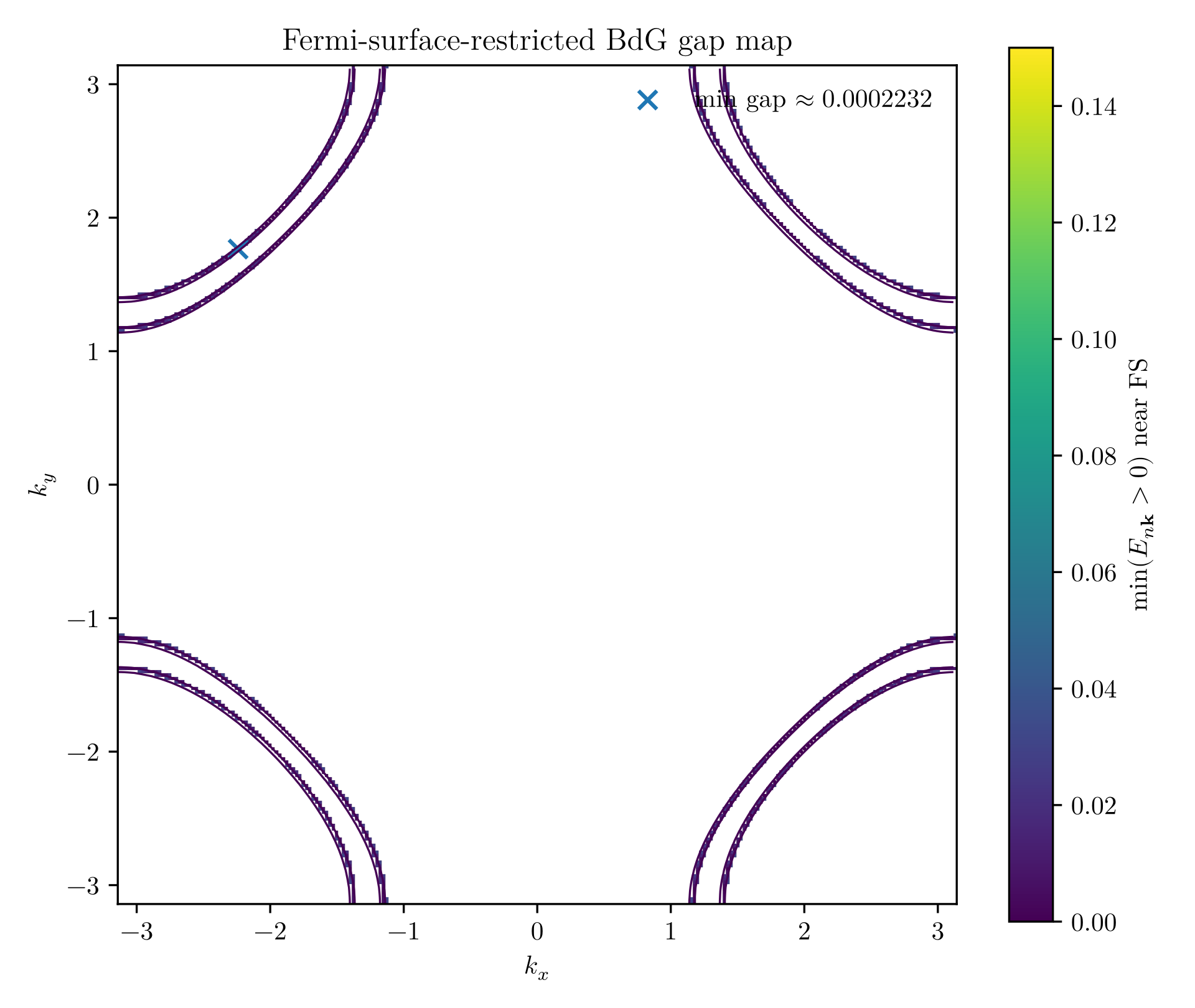
Figure 12.9: Fermi-surface gap map for the toy INT state.
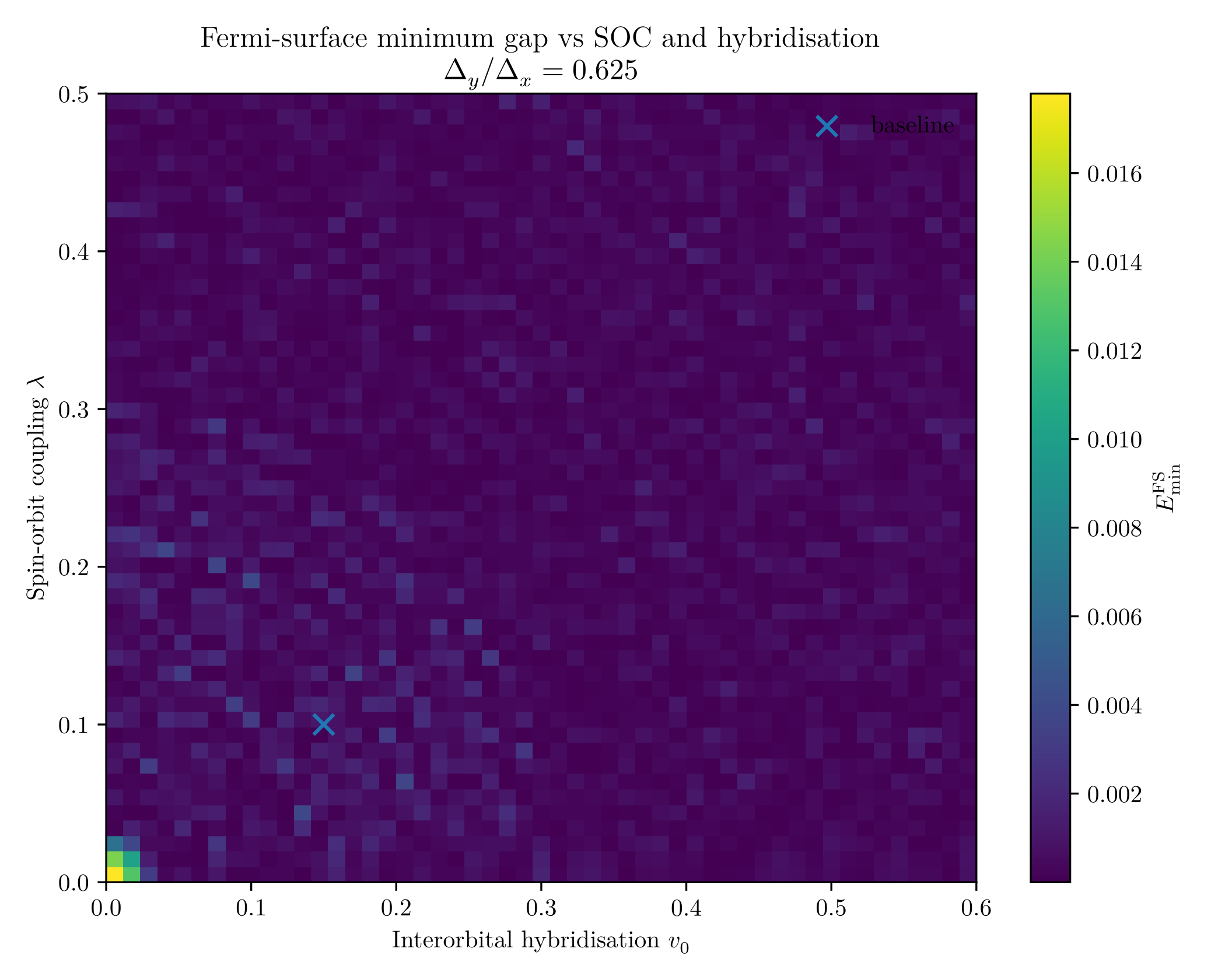
Figure 12.10: Minimum gap scan versus spin-orbit hybridisation.
Self-Consistency and Free Energy
The BdG Hamiltonian used in the self-consistent tests is
For a local antisymmetrized interaction tensor (\mathbf U),
with (\ell) combining orbital and spin. The normal density and anomalous Gor’kov contraction are
The mean-field decoupling is
with self-consistency fields
An anomalous-only update keeps only (\Delta[\chi]). A density-density Hartree update keeps the diagonal direct pieces of (\phi[\rho]). The compact unrestricted Kanamori feedback keeps local Hartree/Fock normal contractions together with the anomalous update. The compact tests are reduced-basis benchmarks; the first full-basis material scans remain quick anomalous-first calculations, not production full-Wannier unrestricted Hartree-Fock-Gor’kov minimizations.
The ranked thermodynamic quantity is
where the constants remove the particle-particle and particle-hole double counting introduced by the decoupling. At finite temperature,
up to the common normal-state reference used in branch comparisons.
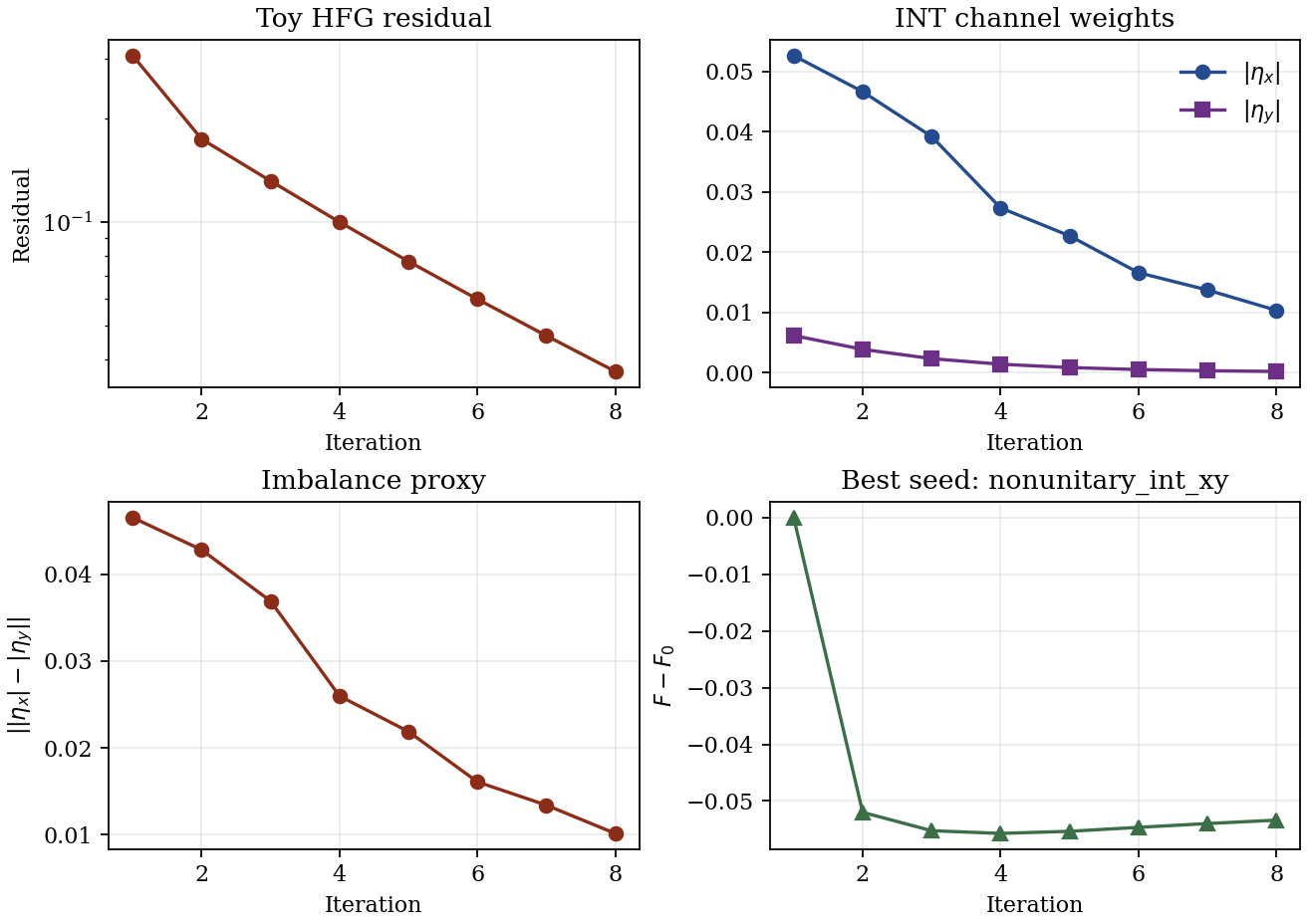
Figure 12.11: Representative toy HFG convergence trace. The residual, INT channel weights, imbalance proxy, and free-energy change converge in the same calculation used for the phase-selection benchmark. Convergence alone does not imply nonunitary phase selection; in this run the imbalance proxy remains small compared with the relaxed pairing scale.
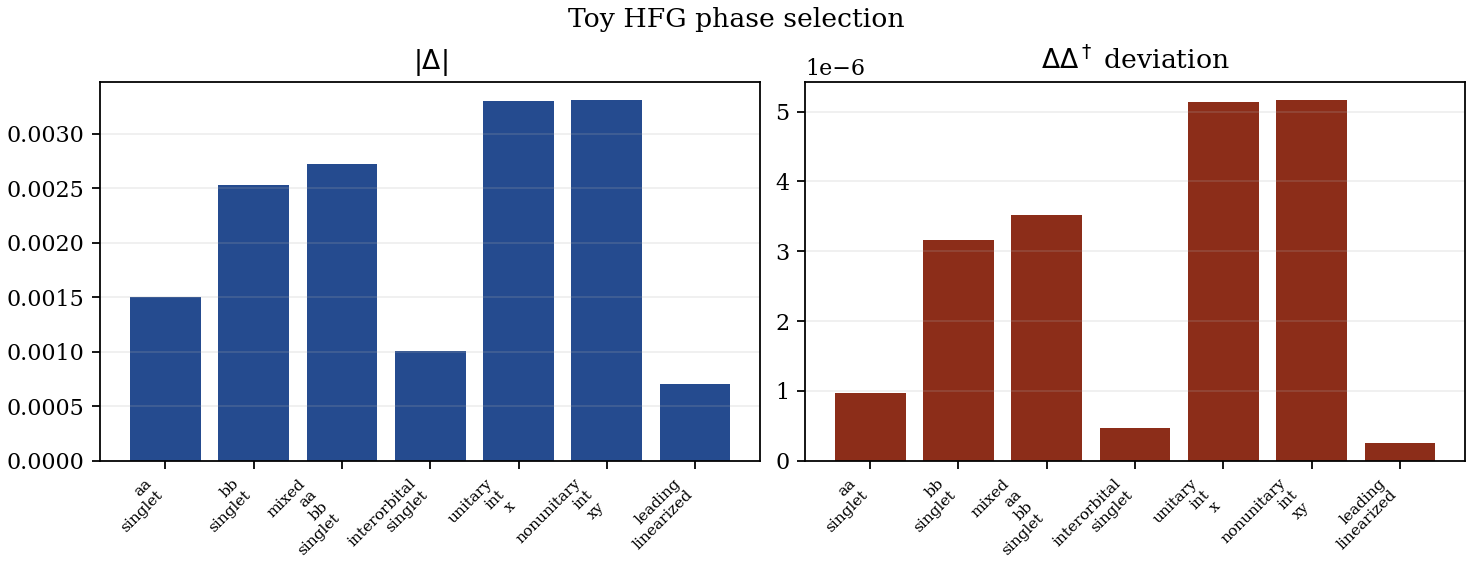
Figure 12.12: Toy Hartree-Fock-Gor’kov phase selection. The constrained nonunitary branch is a diagnostic ansatz, while free relaxation favors a unitary or competing branch unless additional spin-polarization feedback is supplied.
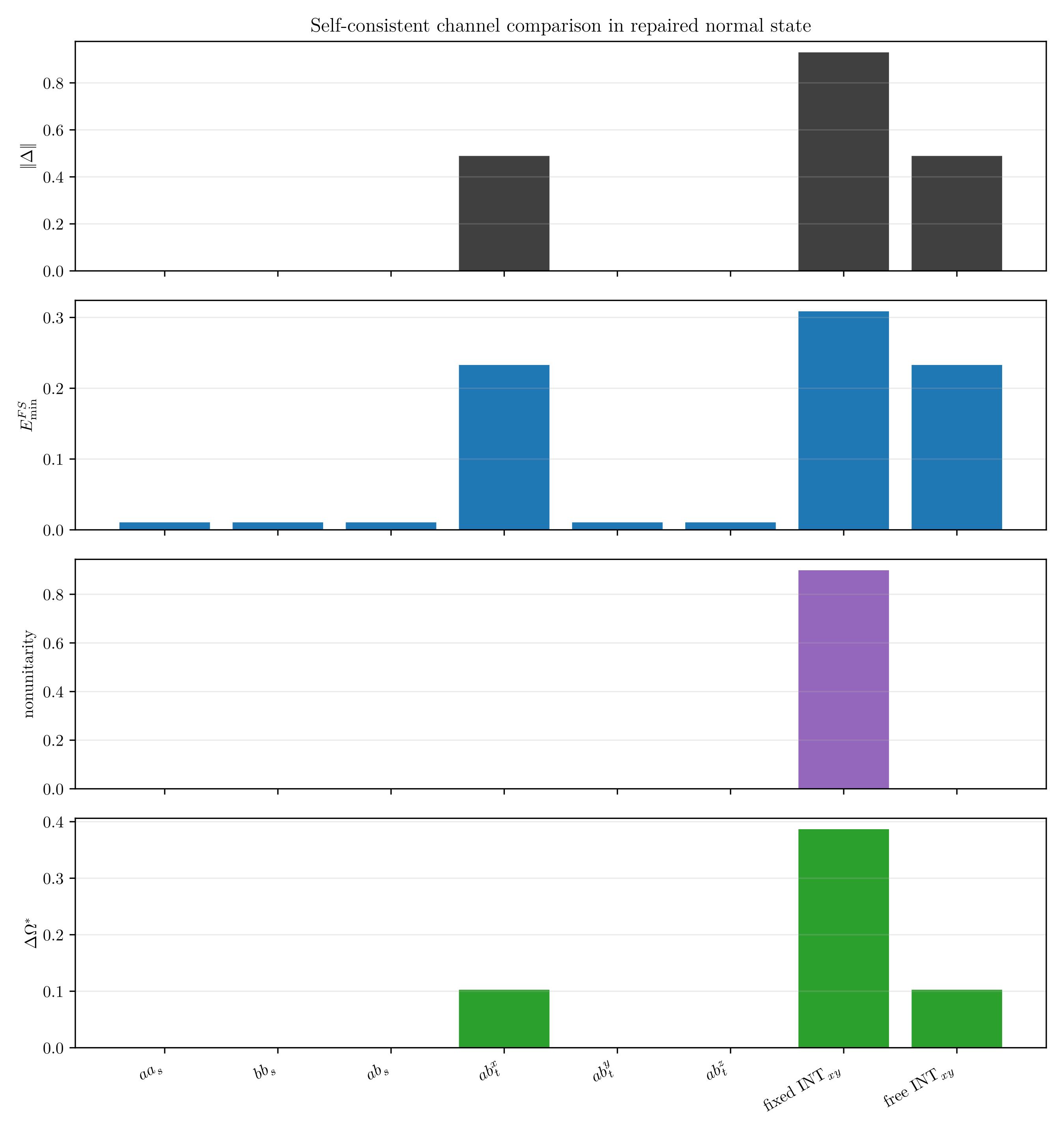
Figure 12.13: Self-consistent channel comparison.
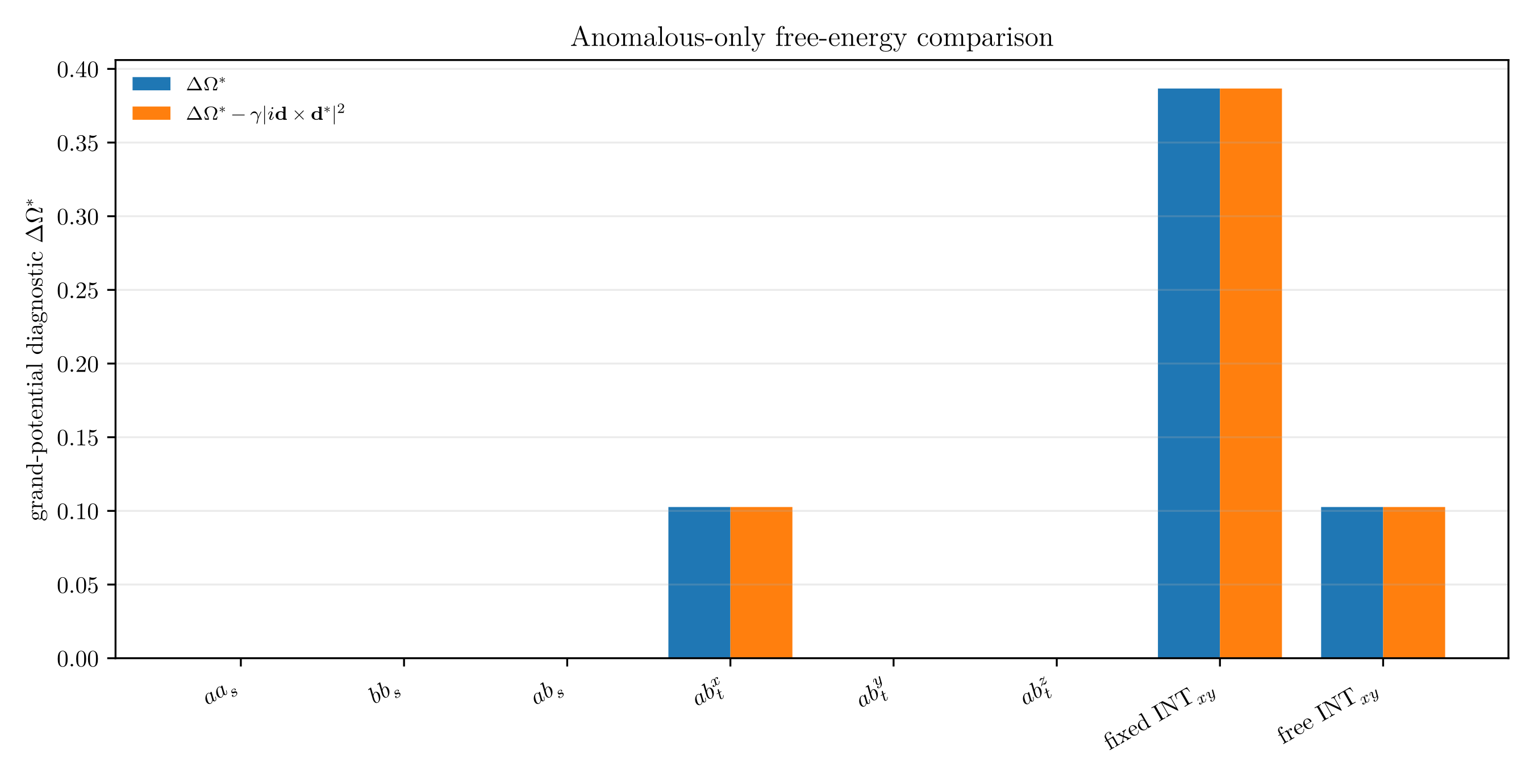
Figure 12.14: Self-consistent free-energy comparison.
Stoner and Kanamori Feedback
The calculations separate scalar pairing attraction from nonunitary imbalance selection. A scalar attractive INT vertex controls the total triplet amplitude. It does not automatically favor (|\Delta_{\uparrow\uparrow}|\ne|\Delta_{\downarrow\downarrow}|). A minimal phenomenological route to stabilize nonunitarity would be a normal spin-polarization feedback term, for example
Both (\mathbf M) and (i\mathbf d\times\mathbf d^*) are odd under time reversal, so this coupling does not impose an external magnetic field. Minimizing over (\mathbf M) gives
leaving the two time-reversed domains to be chosen spontaneously. The present material calculations do not include such a tuned channel unless it is generated by the Kanamori feedback being tested.
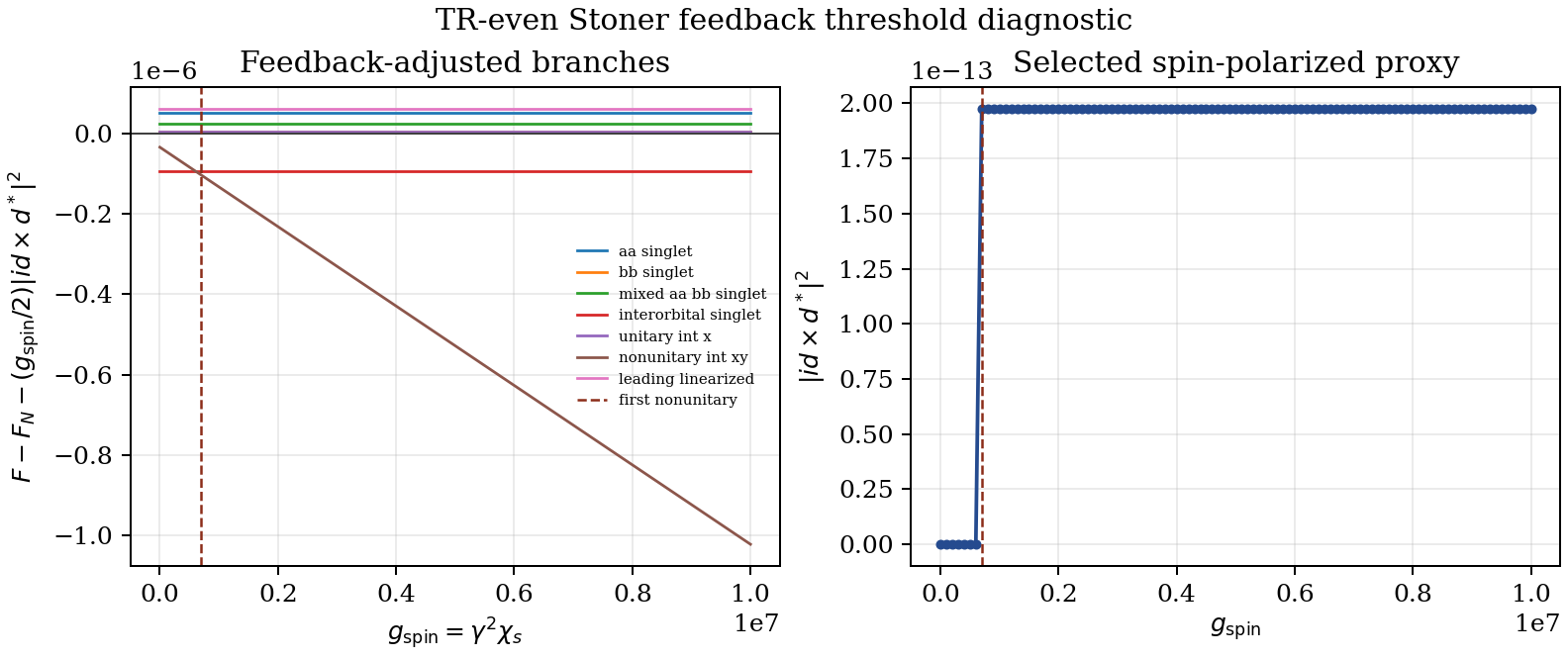
Figure 12.15: Reduced Stoner-feedback threshold diagnostic. A finite feedback strength is required before the spin-polarized nonunitary seed becomes the lowest branch in this reduced landscape.
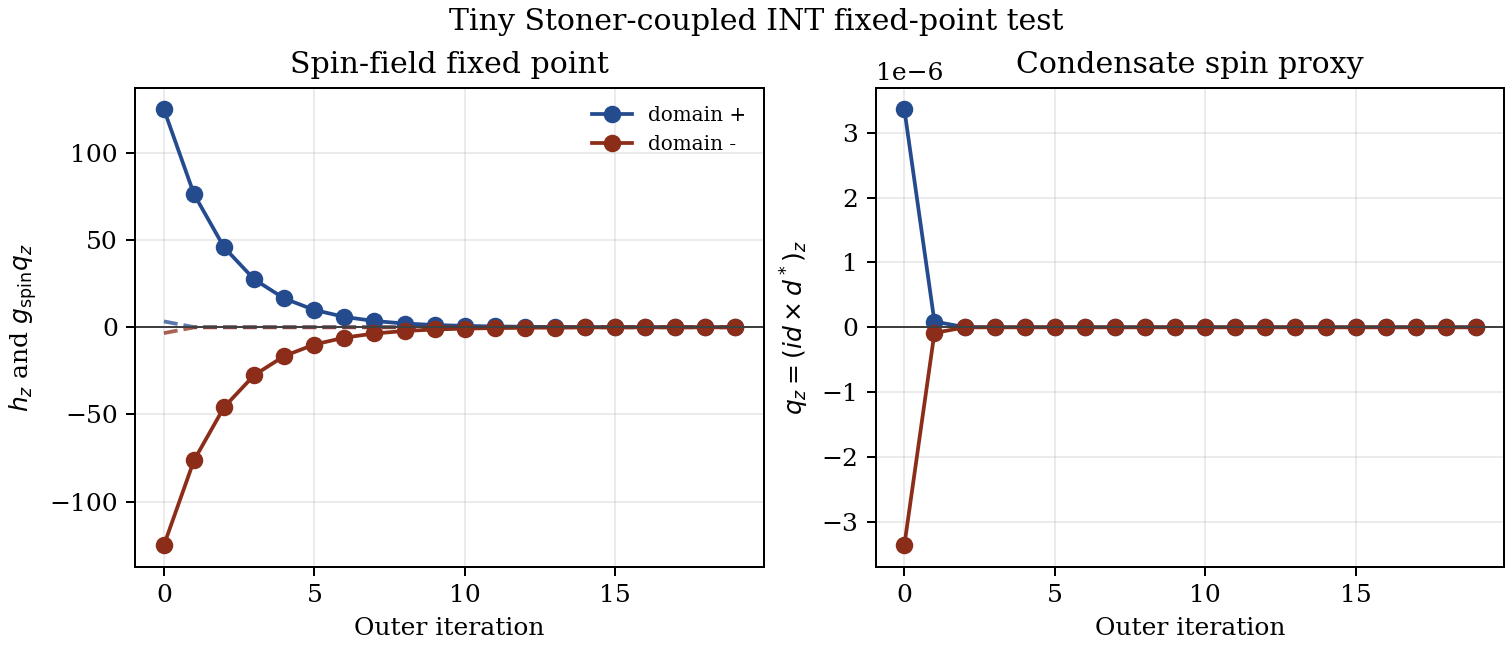
Figure 12.16: Tiny Stoner-coupled INT fixed-point test. The two time-reversed nonunitary seeds start with opposite normal spin fields and condensate spin proxies, but the coupled loop relaxes back toward zero field and zero (i\mathbf d\times\mathbf d^*) for the tested toy parameters.
The Stoner comparison is an implementation benchmark, not an additional material claim. It follows the density-channel functional used in Whittlesea’s thesis [11],
The ordinary density Stoner benchmark magnetizes with the expected sign convention, while the particular INT condensate-coupled loop still relaxes to zero for the tested toy parameters.
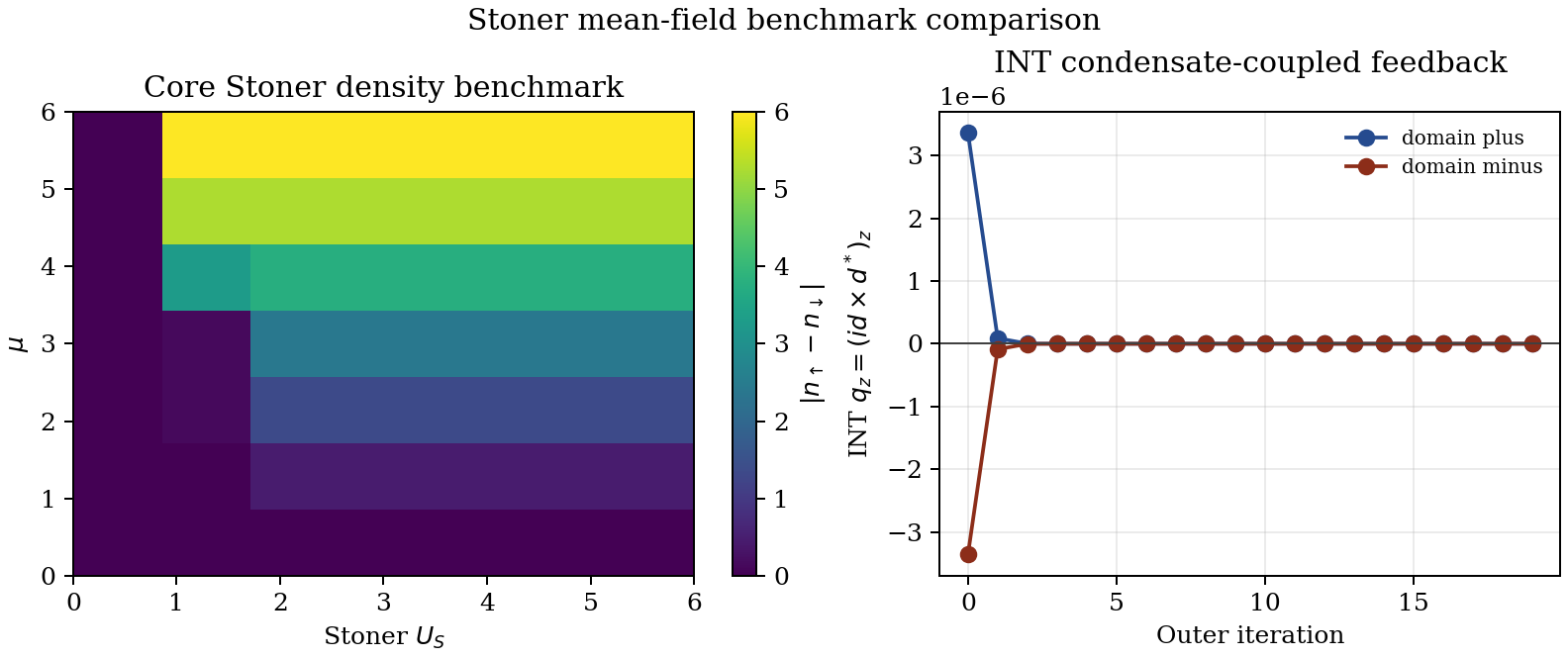
Figure 12.17: Stoner mean-field benchmark comparison. Left: density-channel Stoner benchmark following Whittlesea’s thesis, obtained by minimizing (F_{\rm Stoner}); the magnetic region in the ((U_S,\mu)) plane confirms the implemented sign convention. Right: INT condensate-coupled feedback; the condensate spin proxy relaxes to zero for the tested toy parameters.
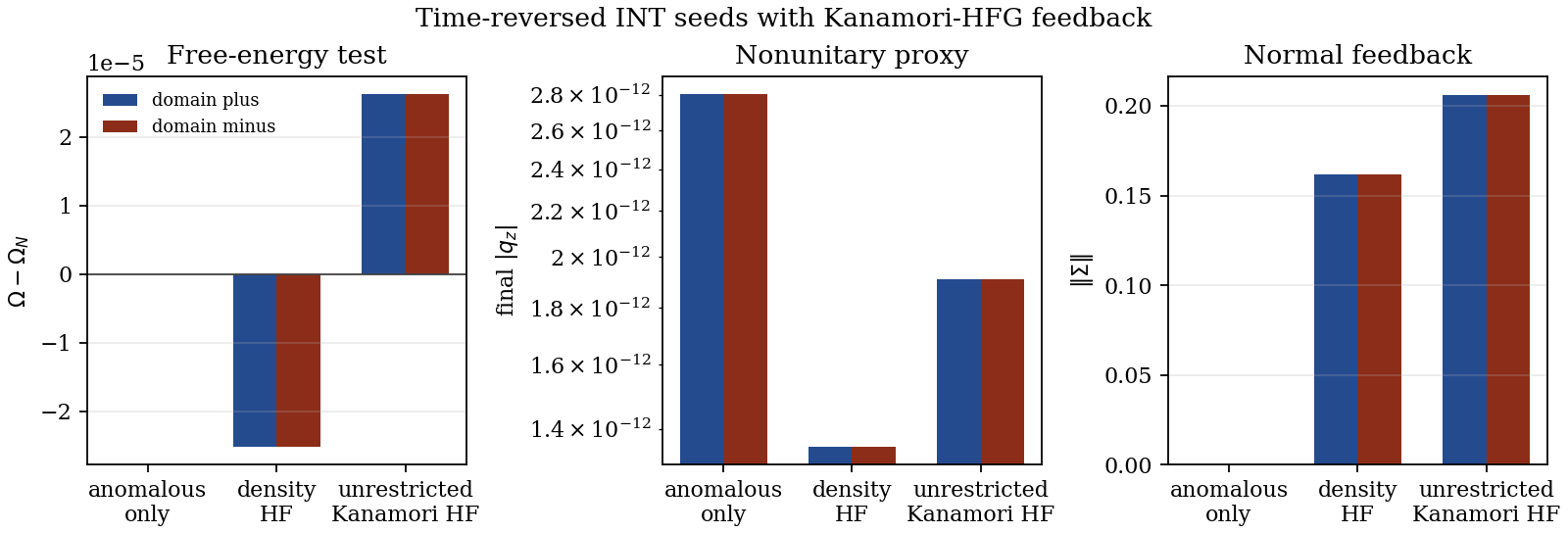
Figure 12.18: Time-reversed INT seeds with compact Kanamori-HFG feedback. The anomalous-only, density-density Hartree/Fock, and unrestricted Kanamori Hartree/Fock updates are run from two nonunitary seeds related by time reversal. The density and unrestricted feedback modes generate finite normal fields, but the final (q_z=(i\mathbf d\times\mathbf d^*)_z) remains at numerical floor for the tested tiny parameters.
Material-Derived LaNiX2 Survey
The material-derived survey applies the same diagnostics to spin-orbit-coupled LaNiC(_2) and LaNiGa(_2) Wannier Hamiltonians. The workflow is Quantum ESPRESSO SCF, Quantum ESPRESSO NSCF on the Wannier mesh, pw2wannier90, Wannier90, import of wannier90_hr.dat, a shift to the QE Fermi reference, and then reduced- and full-basis INT diagnostics. The spin-orbit runs use noncollinear QE inputs with noncolin=.true. and lspinorb=.true.; the retained input files use ecutwfc=80, ecutrho=640, Marzari-Vanderbilt smearing, and degauss=0.02. A later LaNiC(_2) full-window Wannier-only continuation completed and reduced the spread to 33.78 Ang, but Wannier90 reached the 800-iteration disentanglement cap. A twelve-k-point near-(E_F) smoke has RMSE about (0.222,{\rm eV}). Checkpointed reduced and full 88-Wannier-basis scans through (n_k=3) on this HR file remain negative for nonunitary INT.
The LaNiC(_2) orbital-character question is also not settled by the AMN audit alone. The full-window AMN trial-projector summary is C-heavy in raw sums, but AMN is not an orbital-projected density of states and the current projection block duplicates the C-(p) projectors. Per-projector averaging makes C and Ni comparable rather than cleanly C-dominated. Since Hase and Yanagisawa report a LaNiC(_2) Fermi-level DOS that is mainly Ni (3d), with non-negligible La (5d) weight, the direct validation gate is a QE projwfc.x PDOS calculation using the same structure, pseudopotentials, SOC setting, and Fermi reference. That validation is now running as Icarus job 9012215 from qulab/research/ljc/lanix2/pdos_audit/LaNiC2_zhang2018_soc_pdos_validation/; until its PDOS files are retrieved and summarized, the LaNiC(_2) material claim remains survey-level. Live status checked on 2026-07-02 found the job still running after about 38 minutes, with no retrieved pdos_results/ summary yet.
| Input | SCF/NSCF mesh | (N_b/N_W) | final spread |
|---|---|---|---|
| LaNiC(_2) SOC | (8^2\times6 / 6^2\times4) | (320/88) | (206.16,{\rm A}^2) |
| LaNiGa(_2) SOC | (6^2\times4 / 6^2\times4) | (360/176) | (929.75,{\rm A}^2) |
| LaNiC(_2) SOC full-window candidate | (10^2\times8 / 8^2\times6) | (320/88) | (33.78,{\rm A}^2) |
The active dense LaNiGa(_2) SOC Hamiltonian came from Icarus job 9011002. A later staged segmented full-path smoke check generated the overlay below. It gives a near-(E_F) RMSE of about (0.47,{\rm eV}) and the QE runs retain c_bands warnings. A subsequent (N_b=360) (\Gamma)–Z diagnostic completed, but it is only a narrow band-count check. This is provenance for a survey Hamiltonian, not production-quality validation.
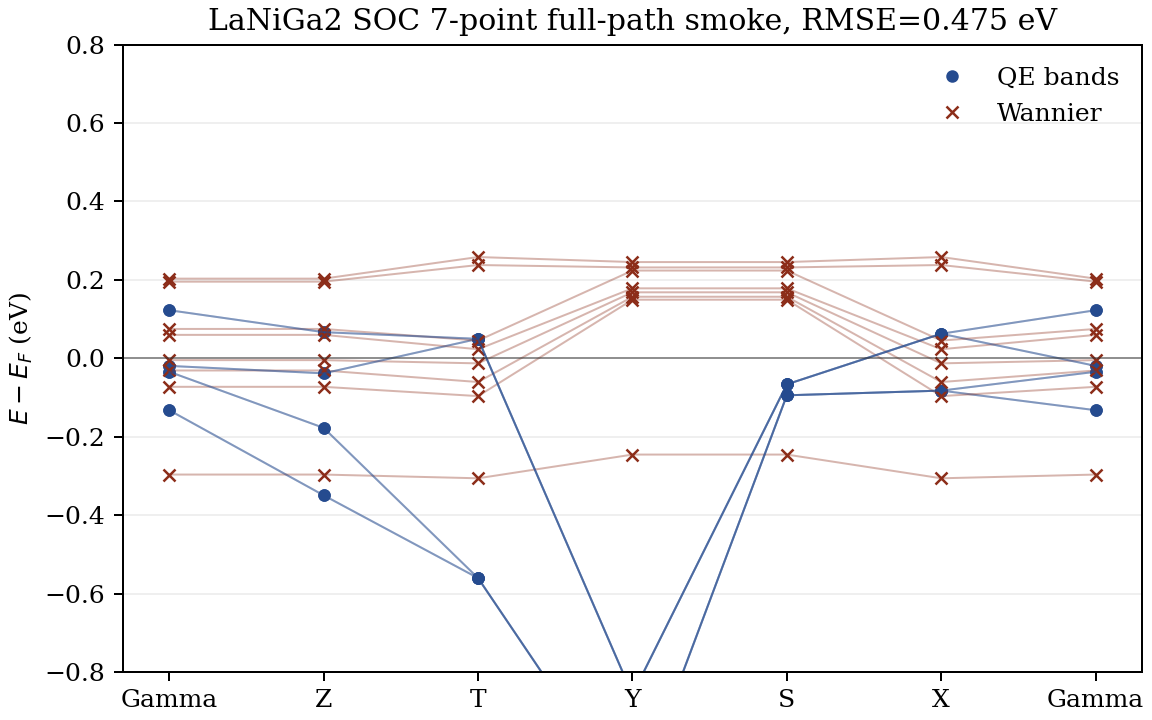
Figure 12.19: LaNiGa(_2) SOC Wannier partial overlay smoke check. QE-direct bands and the Wannier interpolation are overlaid on the staged segmented high-symmetry-path calculation near (E_F). The comparison is useful provenance, but the mismatch and QE warnings mean this is not a production Wannier validation.
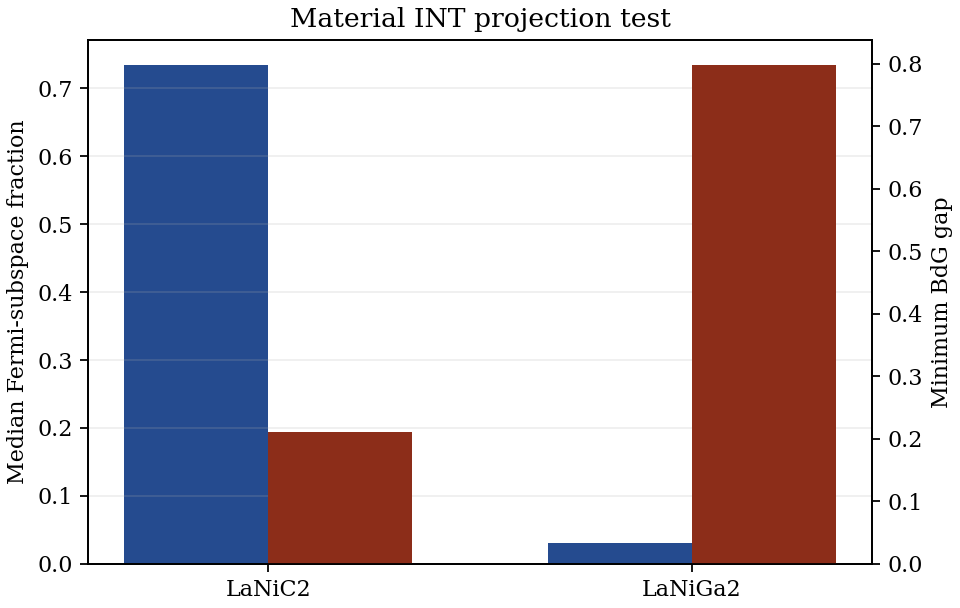
Figure 12.20: Reduced material INT projection. The active dense LaNiGa(_2) SOC reduction has weak INT Fermi-subspace projection in the current four-state truncation, and projection alone does not determine the relaxed phase.
| Material | (R) | (P_{\rm INT}) | best seed | (\Omega_{\rm MF}-\Omega_N) | (q) |
|---|---|---|---|---|---|
| LaNiC(_2) SOC | 245 | 0.735 | unitary INT | (4.68\times10^{-6}) | (1.16\times10^{-6}) |
| LaNiGa(_2) SOC | 245 | 0.031 | unitary INT | (1.37\times10^{-5}) | (2.14\times10^{-6}) |
Here (R) is the number of retained Wannier real-space translation blocks, (P_{\rm INT}) is the median retained INT Fermi-subspace projection, and (q) is the scalar-identity deviation of (\Delta\Delta^\dagger). Values (q\sim10^{-6}) are numerical-noise scale in these scans.
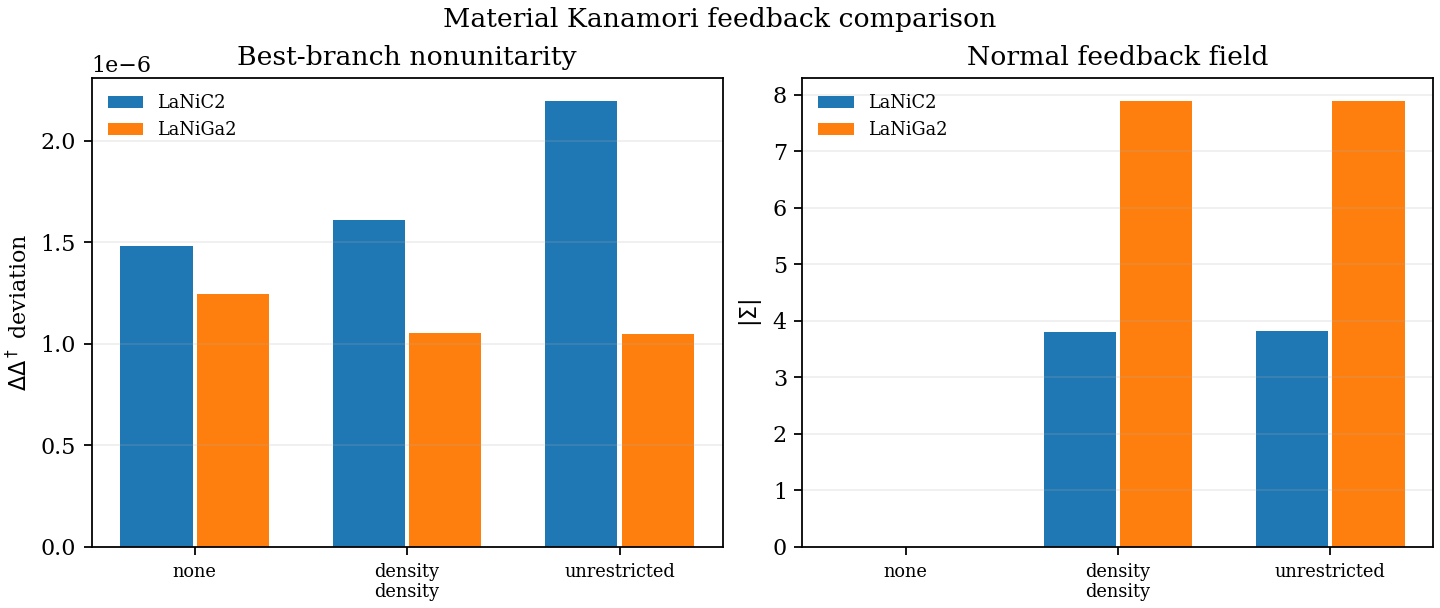
Figure 12.21: Kanamori feedback comparison in the reduced material basis. Including normal-field feedback changes the compact free-energy landscape but does not stabilize a robust nonunitary INT branch.
The next reduced LaNiC(_2) check asks whether normal-state material response structure can provide the missing momentum dependence. The code computes finite-(q) Lindhard responses on an eight-state reduction of the 88-spinor LaNiC(_2) SOC survey Hamiltonian, using diagonal density, spin-tag, and orbital-tag proxy operators. The strongest generic quick response is the identity-density proxy at ((\pi,\pi)). Feeding the corresponding normalized envelope into the k-resolved HFG bridge does not select a nonunitary INT branch in the three-iteration seed competition. A focused scan that removes the generic density response and keeps only spin/orbital proxy operators is also negative: its strongest row is the orbital-staggered proxy at ((\pi,0)), but the short HFG bridge still relaxes away from nonunitary INT. This closes the current response-envelope route as a material mechanism. It is not yet a screened material four-fermion tensor in the Wannier basis.
The first tensor-bookkeeping step is now present, however. The reduced LaNiC(_2) response rows can be assembled into an antisymmetric pair-space matrix on the eight-state basis, giving (8\times7/2=28) pair states. The stored quick payload has Hermiticity and left/right antisymmetry diagnostic errors at numerical zero and eigenvalues spanning roughly ([-5.6\times10^{-2}, 5.1\times10^{-3}]) for unit response scale. This checks the signs and pair counting needed for a material-basis tensor. The normalized channel projection of the quick tensor is most attractive in the unitary-INT channel, with matrix element about (-2.53\times10^{-2}). A companion three-iteration local HFG bookkeeping smoke driven directly by this tensor does not select nonunitary INT: its lowest short-run seed is mixed singlet–INT and is not converged. The entries still come from diagonal Lindhard proxy operators rather than ab-initio screened matrix elements, so this is not yet a production HFG interaction.
The full-basis quick scan removes the four-state truncation but remains anomalous-first. Both active materials select onsite singlet rather than INT in this first scan, remain above the normal reference in the quick free-energy estimate, and have best nonunitarity at numerical-noise scale.
| Material | active dimension (N) | best seed | (\Omega_{\rm MF}-\Omega_N) | (q) |
|---|---|---|---|---|
| LaNiC(_2) SOC | 88 | onsite singlet | (5.76\times10^{-5}) | (9.45\times10^{-7}) |
| LaNiGa(_2) SOC | 176 | onsite singlet | (5.54\times10^{-6}) | (8.99\times10^{-8}) |
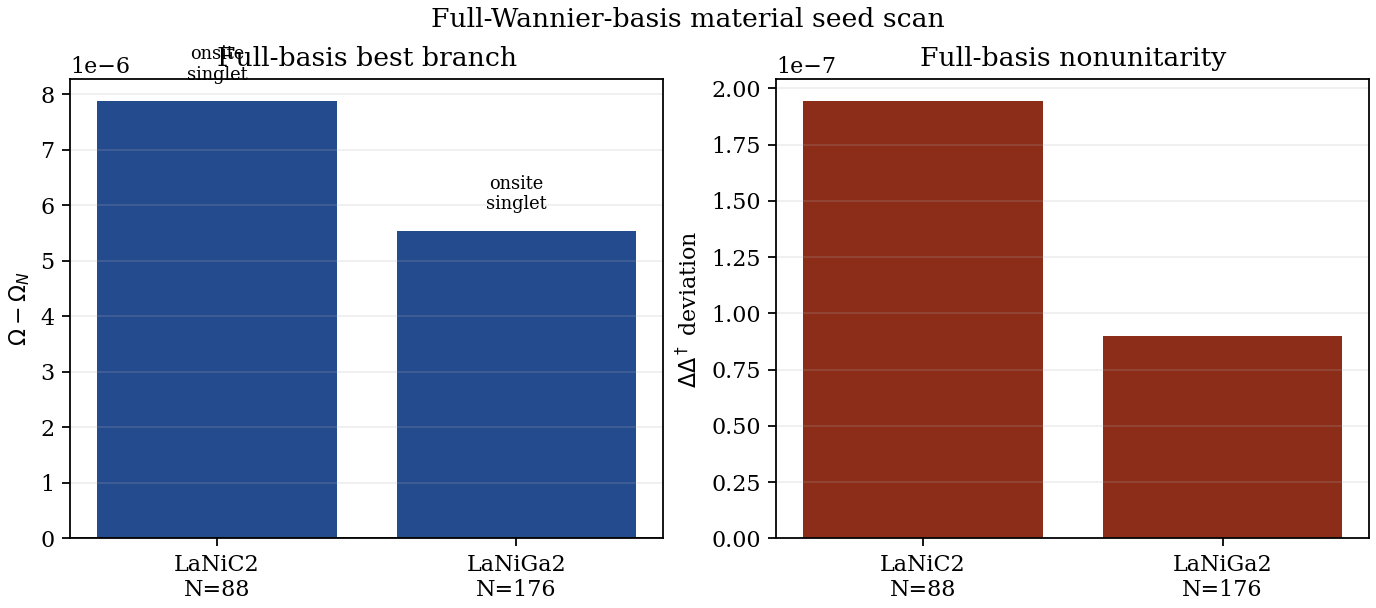
Figure 12.22: Full-basis material seed scan. Keeping the full active Wannier basis removes the reduced four-state truncation and gives onsite-singlet-like winners for both LaNiC(_2) and LaNiGa(_2) SOC survey Hamiltonians.
Parameter and Provenance Summary
The code reserves (\mathbf U) for the bare local Kanamori interaction tensor. In self-consistency scans, the bare tensor (\mathbf U=(U,U’,J_H,J_P)) is distinct from the attractive vertex used in a normalized anomalous channel. Legacy figure parameters still quote the positive effective channel magnitude as (g_{\rm pair}); in this chapter it should be read as (|U^{\rm eff}{\rm INT}|), not as the bare repulsive (V{\rm INT}=U’-J_H).
The retained two-orbital toy normal state uses (t=1), (\mu=-2.7), (s=0.1), (v_0=0.15), (v_1=0), and baseline longitudinal spin-orbit coupling (\lambda_z=0.1). The displayed repaired toy example turns on (\lambda_x=0.6). The toy HFG convergence uses (|U^{\rm eff}{\rm INT}|=2.8), (U=3.0), (J_H=0.6), temperature (T=0.03), a (3\times3) mesh, mixing (\gamma=0.35), and 8 iterations. The reduced material figures use (|U^{\rm eff}{\rm INT}|=1.6), a (3.0,{\rm eV}) Fermi window, a (5\times5) projection grid, and a (2\times2) HFB mesh for 5 iterations. The feedback comparison uses (U=3.0), (J_H=0.6), a (3\times3) HFB mesh, (\gamma=0.3), and tolerance (10^{-7}). The first full-basis scan uses (|U^{\rm eff}_{\rm INT}|=1.2), a (1\times1) HFB mesh, (\gamma=0.35), and tolerance (10^{-6}).
For material-derived calculations, the normal-state hoppings are read from Wannier90 real-space Hamiltonian files. All material Hamiltonians are shifted so that the chosen QE Fermi reference is zero; the quick scans therefore use (\mu=0) after this shift and do not impose an additional fixed-filling constraint.
The retained figures are generated from the QuLab INT module, qulab.research.int. The main regeneration command in the publication source is:
1python -m qulab.research.int.scripts.generate_figuresAdding --include-retained-scans regenerates the older scan inventory. The material inputs live under the QuLab lanix2_wannier data directory. The active survey Hamiltonians are the LaNiC(_2) Zhang-2018 SOC and LaNiGa(_2) full SOC wannier90_hr.dat files, with QE/Wannier provenance in the colocated manifest.json, scf.in, nscf.in, wannier90.template.json, and wannier90.wout files. The improved LaNiC(_2) full-window candidate is bundled separately in LaNiC2_zhang2018_soc_dense_icarus/, with checkpointed reruns recorded in lanic2_full_window_candidate_scan.json and lanic2_full_window_production_scans/. The AMN character audit and direct-PDOS validation payload live in qulab/research/ljc/lanix2/: the submitted PDOS job is 9012215, and its post-processing helper is qulab.research.ljc.lanix2.scripts.summarize_lanic2_projwfc_pdos. The reduced LaNiC(_2) response-envelope bridge payloads are stored under material_realistic_int_program/ as lanic2_material_lindhard_response_kernel_quick.json, lanic2_material_lindhard_envelope_hfg_quick.json, and lanic2_material_lindhard_envelope_hfg_spin_orbital_quick.json; the first pair-space tensor bookkeeping payload is lanic2_material_screened_pair_tensor_quick.json, with the companion local HFG smoke in lanic2_material_screened_pair_tensor_hfg_quick.json. The curated PRB manuscript snapshot for this thesis chapter is archived as the INT self-consistency PRB manuscript in publication/; the canonical paper source remains ~/Workspaces/henry/publications/int-self-consistency-prb at commit 0512cfb.
The fuller scan inventory and supporting diagnostic plots are collected in the appendix on INT pairing supplementary diagnostics, and the thesis-local manuscript PDFs are collected in the final appendix on publication manuscripts.
Limitations
The material Hamiltonians used in the seed tables are survey Wannier models, not production-quality interpolations. This is especially important for LaNiGa(_2): the staged overlay is a smoke check, not a validated full-path interpolation near (E_F). LaNiC(_2) has an improved full-window candidate, but its reduced/full-basis reruns through (n_k=3), fixed-filling smoke at (N=N_0-0.1,N_0,N_0+0.1), and near-Fermi orbital-selective channel smoke are still negative for nonunitary INT. These are not production evidence because the normal-state validation gate remains incomplete and the spin-polarization feedback route is only an executable spin-pair Stoner proxy, not a material-derived exchange tensor. The full interaction feedback is also incomplete at production scale. The compact tests include unrestricted Kanamori feedback, but the full-basis scans are quick anomalous-first calculations rather than production full-Wannier unrestricted Hartree-Fock-Gor’kov minimizations.
| Evidence item | Current status | Interpretation |
|---|---|---|
| LaNiC(_2) survey basis | negative reduced/full-basis survey | channel diagnostic only |
| LaNiC(_2) full-window candidate | negative through full-basis (n_k=3), fixed-(N), and orbital-selective smokes; AMN audit complete; direct PDOS job 9012215 running | candidate basis, not production evidence |
| LaNiGa(_2) SOC survey basis | blocked by normal-state validation | requires a c_bands-clean QE/Wannier route |
| Spin-polarization feedback | spin-pair Stoner proxy only | scaffold, not material exchange tensor |
| Material pair tensor prototype | signs/counting, channel projection, and three-iteration HFG smoke verified on reduced LaNiC(_2) basis | Lindhard proxy, not cRPA; no nonunitary selection |
| Composite pair-spin selector | positive reduced (Q,-Q) target, negative first HFG callbacks | stronger-mechanism target, not yet a material mechanism |
The completed evidence is a local-channel diagnostic, imposed BdG algebraic and spectral diagnostics, toy and compact HFG feedback tests, Stoner sign-convention benchmarking, quick reduced/full-basis material surveys, first fixed-filling/orbital-selective smokes, reduced material-response envelope bridge tests, and a reduced pair-space tensor bookkeeping/HFG smoke. The explicit promotion gates for a separate material-realistic follow-up are stricter: a production-quality SOC Wannier basis, a clean full-path DFT/Wannier overlay near (E_F), production fixed-filling control, a cRPA-derived or otherwise physically justified material interaction tensor suitable for full-basis HFG feedback, and robustness against interaction, seed, mesh, and Wannier-window choices.
For a stronger mechanism paper, the next target is a source-free pair-spin selector rather than a larger scalar INT attraction. The required promotion step is a screened local or (k)-resolved interaction kernel that supports finite INT amplitude, selects finite (q_z=(i\mathbf d\times\mathbf d^*)_z), preserves the zero-field degeneracy of the two time-reversed domains, and survives seed competition inside the HFG loop. The detailed transient/proxy-kernel audit is kept in the appendix on INT pairing supplementary diagnostics and in the QuLab provenance records; the main chapter retains only the status summary.
The compact mechanism comparison is:
| Mechanism | Source | Result | Status |
|---|---|---|---|
| Scalar INT attraction | imposed channel | finite amplitude only | negative selector |
| Local Kanamori feedback | local (U,U’,J_H,J_P) | relaxes to unitary/mixed | negative |
| Stoner feedback | spin-polarization proxy | benchmark only | not material |
| Static pair tensor | reduced pair space | signs pass, no selection | negative |
| Toy (Q,-Q) exchange | prescribed form factor | finite transient | not converged |
| Material (Q,-Q) proxy | band matrix elements | mixed seed wins | negative proxy |
| Screened (\Gamma\chi\Gamma) | fluctuation exchange | finite transient | not converged |
The next kernel should be specified before more scans:
The vertex must be antisymmetrized in incoming and outgoing pair labels before projection into the INT sector. This is the first next route that can plausibly connect a normal-state spin/orbital fluctuation to both amplitude support and pair-spin selection, but the tested toy and material-proxy rows have not yet passed the strict converged, source-free, seed-competition gate. The obstruction therefore remains the defended result.
Conclusion
INT pairing remains a coherent constrained channel and a useful diagnostic ansatz. It naturally connects Hund-favored interorbital triplet pairing, even-parity orbital antisymmetry, split (\Delta\Delta^\dagger), spin-resolved spectra, and condensate spin-polarization diagnostics. The self-consistency tests are the restrictive step. Scalar INT attraction does not by itself select a nonunitary imbalance, and the current material-derived LaNiC(_2)/LaNiGa(_2) survey Hamiltonians relax to unitary or onsite-singlet-like branches with nonunitarity at numerical-noise scale.
The defensible conclusion is therefore negative at survey level: the present local Hubbard-Kanamori-like calculations validate the INT ansatz as a channel and observable diagnostic, but they do not derive it as a robust self-consistent material ground state.
INT manuscript revision changelog
Changed
- Added literature-positioning text and references clarifying that the INT symmetry idea, Hund-favoured interorbital triplet pairing, and competing-order routes to nonunitarity are established context; the manuscript contribution is the LaNiX2-motivated self-consistency audit.
- Capped the LaNiX2 material-realistic interpretation explicitly: the manuscript now treats the result as a bounded INT self-consistency audit and survey-level negative test. A production LaNiX2 DFT/Wannier plus screened-interaction study is follow-up work, not an unfinished requirement for this paper.
- Expanded the Hubbard-Kanamori definitions, INT tensor notation, nonunitarity diagnostic, projection argument, Kanamori feedback description, numerical settings, and reproducibility note in
main.tex. - Added publication figures:
figures/self_consistent_convergence_example.pngfigures/wannier_band_validation.png
- Added
FIGURE_PROVENANCE.mdand Makefile targets that map each publication PNG to the exact QuLab-generated source filename. - Updated publication index metadata to name the LaNiX2 (X = Ga, C)-inspired scope explicitly.
Data and scripts used
- Figure generation code:
henry/qulab/qulab/research/int/scripts/generate_figures.py; publication copy mapping:FIGURE_PROVENANCE.md. - Convergence data source:
qulab.core.scmft.benchmarks.self_consistent.repaired_int_kanamori.repaired_int_seed_comparison_benchmark. - Wannier validation data source:
henry/qulab/qulab/research/int/data/lanix2_wannier/LaNiGa2_full_soc_icarus/qe_bands_fullpath_stage9_segmented_aligned.jsonwhen available; the older seven-point and partial Gamma-Z payloads remain archived. - Material Hamiltonians:
LaNiC2_zhang2018_soc_icarus/wannier90_hr.datLaNiGa2_full_soc_icarus/wannier90_hr.dat
- Additional completed provenance after the seed-scan figures: LaNiC2 full-window
Wannier continuation
9011684, bundled inLaNiC2_zhang2018_soc_dense_icarus/, reduces the spread to 33.78 Ang^2 but does not satisfy the disentanglement convergence criterion before the 800-iteration cap. Checkpointed candidate reruns are stored inqulab/research/int/data/lanic2_full_window_candidate_scan.jsonandqulab/research/int/data/lanic2_full_window_production_scans/; reduced robustness and full 88-Wannier-basis scans throughnk=3relax essentially to normal, not nonunitary INT. - Added the LaNiC2 AMN-vs-PDOS validation gate: raw full-window AMN
trial-projector weights are C-heavy but are not directly comparable to the
literature orbital-projected DOS. A direct QE
projwfc.xPDOS validation is running as Icarus job9012215fromqulab/research/ljc/lanix2/pdos_audit/LaNiC2_zhang2018_soc_pdos_validation/. The manuscript now records this as a pending validation step rather than a strengthened material claim. - Additional LaNiGa2 diagnostic provenance:
9011697completed a narrownbnd=360Gamma-Z band-count check, but it is not a full-path replacement. - Added a reviewer-facing claim-readiness table and recorded the post-survey LaNiC2 mechanism smokes: fixed-filling offsets and near-Fermi orbital-selective channels remain negative on the current full-window candidate, while the spin-pair Stoner proxy is only an implementation scaffold.
- Consolidated the reduced LaNiC2 material-response envelope tests: the generic finite-q Lindhard response and the focused spin/orbital proxy response both run through the k-resolved HFG bridge but do not select a nonunitary INT branch in the three-iteration quick scans. These payloads are recorded as negative response-envelope evidence, not as screened interaction tensors.
- Added the first reduced LaNiC2 antisymmetric pair-space tensor payload,
lanic2_material_screened_pair_tensor_quick.json. It verifies pair counting and sign conventions for a material-basis tensor representation (28pair states for the reduced eight-state basis; Hermiticity and left/right antisymmetry errors at numerical zero). Its normalized channel projection is most attractive in the unitary-INT channel for this quick tensor. - Added the companion three-iteration tensor-HFG bookkeeping payload,
lanic2_material_screened_pair_tensor_hfg_quick.json. It exercises the reduced pair tensor in the local HFG solver but does not select nonunitary INT; it remains a Lindhard-proxy smoke, not a cRPA interaction. - Expanded the reviewer-facing material evidence table with explicit promotion
gates. The source audit is the generated QuLab search matrix,
qulab/research/int/data/lanix2_material_search_matrix.{json,md}, and the stronger-mechanism roadmap is tracked inqulab/research/int/STRONGER_MECHANISM_PROGRAM.md. - Added the first tiny k-resolved selector-gate payload,
int_composite_kresolved_selector_gate_quick.json. It reaches a finite nonunitary best seed with degenerate time-reversed domains in the three-iteration Lindhard-screened smoke, but it fails the promotion gate because the HFG loop is not converged. - Added
int_composite_kresolved_selector_convergence_quick.json, a small damping/iteration scan around the same gate. It finds no converged finite-nonunitary row; longer rows damp the finite signal toward the collapsed branch. - Added the explicit composite (Q,-Q) exchange kernel payloads
int_composite_kresolved_q_exchange_selector_gate_quick.jsonandint_composite_kresolved_q_exchange_selector_convergence_quick.json. The kernel uses a symmetric (W_{{\bf k}{\bf k}’}) built from finite-(Q) form factors. It gives a finite three-iteration nonunitary transient but no converged finite-nonunitary row in the 3/8/16-iteration scan. - Added
int_composite_kresolved_positive_control_quick.json, a designed k-resolved HFG sanity check. It keeps the normal seed at zero and sustains opposite (d_x\pm i d_y) nonunitary domains, confirming the solver/sign plumbing without claiming a microscopic material interaction. - Added
int_pair_tensor_benchmark_quick.json, a tiny static pair-tensor benchmark using the same antisymmetric pair-space convention as the material tensor path. The TR-symmetric INT(_x)/INT(_y) tensor does not pass the spontaneous nonunitary gate; the explicit chiral control splits the domains. - Added
int_pair_spin_feedback_tensor_benchmark_quick.json, a source-free pair-spin feedback HFG check. It uses the condensate’s own (q_z), but the stable quick row still selects a finite unitary INT branch rather than a nonunitary one. - Added
int_pair_spin_feedback_tensor_scan_quick.jsonandint_pair_spin_feedback_tensor_best_long_check.json. The local support/exchange scan finds a finite nonunitary transient at support (20), exchange (500), but the row is not converged; the longer check relaxes to a unitary winner. - Added
int_normal_operator_feedback_quick.json, a direct source-free normal-bilinear feedback benchmark for the selected (\tau_0\sigma_z) auxiliary operator. The operator has the expected time-reversal-odd parity and finite INT spin-overlap proxy, but the stable quick row again selects a unitary INT branch with (|q_z|) at numerical noise. - Added
int_mechanism_status_audit_quick.json, a compact stronger-mechanism status table. It records the finite-(Q) pair-spin/exchange gate as the next target but not material-claim-ready: the Lindhard-proxy row is finite and nonunitary but not converged, the matched convergence scan is negative, and the designed k-resolved row is only a positive control. - Added
int_screened_finite_q_kernel_audit_quick.json, an RPA-style screened finite-(Q) kernel candidate audit. It finds a stable toytau_0_sigma_zcandidate away from the normal-state pole, but this is only the next kernel to compile into HFG, not a self-consistent solution. - Added
int_composite_kresolved_rpa_selector_gate_quick.jsonandint_composite_kresolved_rpa_selector_convergence_quick.json. The compiled RPA-screened toy kernel shows a finite nonunitary transient, but the convergence scan remains negative. - Added
int_composite_kresolved_nonlocal_selector_gate_quick.json. The finite-(Q) nonlocal screened-exchange toy kernel selects a finite nonunitary seed in the three-iteration gate, but it is not converged and is not a material-derived screened tensor. - Added
lanic2_material_nonlocal_screened_exchange_hfg_gate_quick.jsonandlanic2_material_nonlocal_screened_exchange_spin_proxy_quick.json. These reduced LaNiC(2) material-structured (W{\mathbf k\mathbf k’}) proxy gates produce finite nonunitary-channel weight, but the mixed singlet/INT seed wins and the rows are not converged; they are not cRPA-derived screened interactions. - Added
lanic2_material_nonlocal_screened_exchange_convergence_scan_quick.json. The default, spin-proxy, and orbital-staggered material-proxy rows remain negative through 3, 8, and 16 iterations, with no converged nonunitary winner. - Added
lanic2_material_composite_q_exchange_hfg_gate_quick.jsonandlanic2_material_composite_q_exchange_convergence_scan_quick.json. These replace the toy (Q,-Q) form factor by material band-basis response-operator matrix elements, but the quick and convergence gates remain negative: the mixed singlet/INT seed wins and no row is a converged nonunitary selector. - Added a mechanism-comparison table and the next screened (\Gamma\chi\Gamma) fluctuation-exchange kernel specification. This records the next implementation target without claiming a material result.
- Checked Icarus job
9012215on 2026-07-02: the LaNiC2 PDOS validation was still running, with no retrievedpdos_results/summary available yet. - Added
int_composite_kresolved_fluctuation_exchange_selector_gate_quick.jsonandint_composite_kresolved_fluctuation_exchange_selector_convergence_quick.json. The toy (\Gamma\chi\Gamma) gate gives a finite nonunitary transient with degenerate time-reversed domains, but the row is not converged and the convergence scan drives the finite signal down. - Added
int_composite_kresolved_critical_fluctuation_selector_gate_quick.jsonandint_composite_kresolved_critical_fluctuation_selector_convergence_quick.json. This sharper Ornstein-Zernike-like finite-(Q) susceptibility gives the same qualitative result: finite nonunitary transient, domain degeneracy, and no converged finite-nonunitary row. - Added
int_structured_normal_operator_feedback_quick.json, a source-free (h_M({\bf k})=M f({\bf k})O_M) normal-feedback control. The strict selector gate remains closed: onsite feedback is not a converged nonunitary selector, and zero-average nonlocal form factors have vanishing uniform (\lambda_{\rm proxy}). - Added
int_composite_normal_feedback_gate_quick.json, a bridge from the finite-(Q) auxiliary screen to the source-free pair-spin feedback HFG benchmark. It gives a finite nonunitary transient with degenerate domains, but the row is not converged.
TODO / missing data
- Production-quality full high-symmetry DFT-vs-Wannier validation for the active LaNiGa2 SOC basis remains missing; the staged 25-k-point overlay is a convergence-limited survey check with RMSE about 0.47 eV.
- LaNiGa2 is now explicitly marked as blocked by normal-state validation under the tested workflows: SCF/cell/eigensolver smokes retain
c_bandswarnings, and the PSLibrary PAW-SOC route fails before SCF on the current QE stack. - The convergence history stores channel weights, residuals, and free energy; it does not store literal per-iteration
Delta_upupandDelta_downdownamplitudes. - Full-basis unrestricted Kanamori Hartree/Fock feedback remains a production follow-up rather than a completed figure in this manuscript.
- Production-strength LaNiC2 use of the improved HR file still requires a clean full-path validation, filling control, full-basis unrestricted HFG, and robustness scans.
- A true ab-initio screened material four-fermion interaction tensor in the Wannier basis remains missing; the current tensor payload is assembled from diagonal Lindhard proxy operators and the current tensor-HFG payload is only a three-iteration bookkeeping smoke.
- The reduced composite (Q,-Q) pair-spin selector is a target for the next mechanism paper, but it has not yet survived as a compiled screened local or k-resolved HFG interaction against the full seed competition.
- The tiny k-resolved selector gate is partial progress only; it should not be used as material evidence until convergence and robustness are demonstrated.
- The current Lindhard-screened proxy kernel should be treated as negative under convergence controls, not merely under-iterated.
- The designed positive-control kernel is artificial by construction and must not be used as material evidence.
- A static quadratic pair tensor alone is not the stronger mechanism; the next target is source-free pair-spin/exchange feedback that generates an effective quartic selector.
- The first local source-free pair-spin feedback callback is also negative; the next route needs an additional physical ingredient rather than larger local coupling.
- The first direct normal-bilinear feedback callback is also negative for the selected (\tau_0\sigma_z) proxy; it should be treated as a sign/convention benchmark, not as evidence for a self-consistent nonunitary selector.
- The compact mechanism-status audit now provides the reviewer-facing summary of the stronger-mechanism fork; no row is material-claim-ready.
- The screened finite-(Q) candidate audit is not a material claim because it has not yet been run as a converged k-resolved HFG seed competition.
- The compiled RPA-screened k-resolved toy kernel is also not a material claim: it fails the convergence gate.
Assumptions
- The code default
U'=U-2J_HandJ_P=J_His the intended Kanamori convention unless explicitly overridden. - The LaNiGa2 segmented full-path validation overlay is a survey-level check, not publication-grade full-path validation.
Figure Provenance
The paper figures are generated in henry/qulab and copied into this
publication directory. From henry/publications/int-self-consistency-prb, run:
1make regenerate-qulab-figures
2make copy-figures
3make
make regenerate-qulab-figures runs:
1python -m qulab.research.int.scripts.generate_figures \
2  --output-dir qulab/research/int/figs \
3  --include-retained-scans
make copy-figures applies the following filename mapping.
| Paper figure | QuLab source figure |
|---|---|
figures/pairing_eigenvalues_vs_hund.png | qulab/research/int/figs/int_pairing_eigenvalues_vs_hund.png |
figures/projection_repair_best_maps.png | qulab/research/int/figs/int_projection_repair_best_maps_main_soc.png |
figures/delta_delta_dagger_eigenvalues.png | qulab/research/int/figs/int_delta_delta_dagger_eigenvalues.png |
figures/spin_resolved_dos.png | qulab/research/int/figs/int_spin_resolved_density_of_states.png |
figures/hfg_phase_selection.png | qulab/research/int/figs/int_hfg_self_consistent_phase_selection_quick.png |
figures/stoner_feedback_threshold.png | qulab/research/int/figs/int_stoner_feedback_threshold_quick.png |
figures/stoner_coupled_fixed_point.png | qulab/research/int/figs/int_stoner_coupled_fixed_point_quick.png |
figures/unrestricted_kanamori_benchmark.png | qulab/research/int/figs/int_unrestricted_kanamori_benchmark_quick.png |
figures/self_consistent_convergence_example.png | qulab/research/int/figs/int_hfg_self_consistent_convergence_quick.png |
figures/wannier_band_validation.png | qulab/research/int/figs/int_material_lanix2_wannier_validation.png |
figures/material_projection_summary.png | qulab/research/int/figs/int_material_lanix2_projection_summary.png |
figures/material_feedback_comparison.png | qulab/research/int/figs/int_material_lanix2_feedback_comparison.png |
figures/material_full_basis_scan.png | qulab/research/int/figs/int_material_lanix2_full_basis_scan.png |
figures/stoner_benchmark_comparison.png | qulab/research/int/figs/int_stoner_benchmark_comparison_quick.png |
The material-derived inputs remain survey-level. The LaNiGa2 validation overlay
uses LaNiGa2_full_soc_icarus/qe_bands_fullpath_stage9_segmented_aligned.json
when available, with the older seven-point and partial Gamma-Z payloads
retained only as archive provenance. The stage-9 payload improves path coverage
but retains QE c_bands warnings and RMSE around 0.47 eV; a stage-10 cleanup
run converged only the first two segments before failing on T–R. The current
evidence gates still require production-quality
full-path DFT/Wannier validation, fixed filling or chemical-potential control,
full-basis unrestricted HFG feedback, and robustness scans before making a
strong material claim.
Later LaNiGa2 normal-state validation attempts do not upgrade that status.
SCF ladders, cell/primitive smokes, and minor Davidson/CG eigensolver variants
retained explicit QE c_bands warnings. The alternate PSLibrary fully
relativistic PAW route also failed before SCF on the current QE stack, including
the no-force/no-stress legacy LaNiGa2_ultra_soc reproduction, which stopped in
QE routine ylmr2. LaNiGa2 is therefore blocked for production claims until a
material workflow rebuild changes the QE build and/or pseudopotential route.
The LaNiC2 full-window Wannier-only continuation 9011684 completed after the
seed-scan figures were generated. The corresponding HR/checkpoint files are
bundled in LaNiC2_zhang2018_soc_dense_icarus/; the spread improves to
33.78 Ang^2, but Wannier90 reached the disentanglement iteration cap and the
checkpointed candidate seed reruns in
qulab/research/int/data/lanic2_full_window_candidate_scan.json and
qulab/research/int/data/lanic2_full_window_production_scans/ remain negative
for nonunitary INT through full 88-Wannier-basis nk=3 scans.
The separate AMN character audit in qulab/research/ljc/lanix2/ shows that
raw AMN trial-projector weights are C-heavy but are not directly comparable to
published orbital-projected DOS, especially because the projection block
duplicates C-p projectors. A direct QE projwfc.x PDOS validation for the
same LaNiC2 SOC input is running as Icarus job 9012215 from
qulab/research/ljc/lanix2/pdos_audit/LaNiC2_zhang2018_soc_pdos_validation/.
The helper
python -m qulab.research.ljc.lanix2.scripts.summarize_lanic2_projwfc_pdos
will summarize the retrieved PDOS files. Until that comparison is available,
the LaNiC2 orbital-character discussion remains a validation gate, not a
material claim.
Live Icarus status checked on 2026-07-02: job 9012215 was still running after
about 38 minutes, and no pdos_results/ summary had been retrieved.
The post-survey material-realistic program files in
qulab/research/int/data/material_realistic_int_program/ add fixed-filling,
orbital-selective, and Stoner-proxy smokes; these are provenance for the
claim-readiness table rather than figure inputs.
The stronger-mechanism quick JSON payloads
int_composite_kresolved_q_exchange_selector_gate_quick.json and
int_composite_kresolved_q_exchange_selector_convergence_quick.json record the
explicit toy (Q,-Q) exchange kernel test. They are not figure inputs and do
not change the paper claim: the kernel gives a finite transient but no
converged finite-nonunitary row.
The same directory now also stores reduced LaNiC2 material-response envelope
bridge diagnostics:
lanic2_material_lindhard_response_kernel_quick.json,
lanic2_material_lindhard_envelope_hfg_quick.json, and
lanic2_material_lindhard_envelope_hfg_spin_orbital_quick.json.
These payloads test generic and spin/orbital-proxy finite-q Lindhard response
envelopes in the k-resolved HFG bridge. They remain negative for nonunitary INT
selection and should not be read as screened material four-fermion tensors.
The file lanic2_material_screened_pair_tensor_quick.json is the first
pair-space tensor bookkeeping payload derived from the same response proxies.
It stores a 28-by-28 antisymmetric pair matrix for the reduced eight-state
LaNiC2 basis, together with Hermiticity, antisymmetry, and normalized channel
projection diagnostics. The companion file
lanic2_material_screened_pair_tensor_hfg_quick.json is generated by
python -m qulab.research.int.scripts.material_screened_pair_tensor_hfg_scan
and exercises that tensor in a three-iteration local HFG bookkeeping smoke.
The smoke does not select nonunitary INT. These files are useful for checking
signs, counting, and solver plumbing, but they are not cRPA-derived material
interactions and are not figure inputs.
The material evidence audit is generated in QuLab by
python -m qulab.research.int.scripts.material_search_matrix, which writes
qulab/research/int/data/lanix2_material_search_matrix.json and .md.
Those files record branch status, evidence type, promotion gates, next actions,
and stop rules. The stronger-mechanism roadmap is
qulab/research/int/STRONGER_MECHANISM_PROGRAM.md; it treats the composite
Q,-Q pair-spin selector as a target to be promoted into a screened local or
k-resolved HFG interaction, not as a completed material result.
The first executable gate for that track is
python -m qulab.research.int.scripts.int_composite_kresolved_selector_gate,
which writes int_composite_kresolved_selector_gate_quick.json; the current
payload is partial progress only because the finite nonunitary branch is not
converged in the three-iteration smoke.
The companion command
python -m qulab.research.int.scripts.int_composite_kresolved_selector_convergence_scan
writes int_composite_kresolved_selector_convergence_quick.json and records
that damping/iteration controls do not produce a converged finite-nonunitary
row for the same proxy kernel.
The designed solver sanity check is
python -m qulab.research.int.scripts.int_composite_kresolved_positive_control;
it writes int_composite_kresolved_positive_control_quick.json. This payload
is a sign/plumbing positive control only, because the kernel is constructed to
project finite INT seeds into the (d_x\pm i d_y) sector.
The static pair-tensor benchmark is
python -m qulab.research.int.scripts.int_pair_tensor_benchmark; it writes
int_pair_tensor_benchmark_quick.json. It uses the material tensor
antisymmetric pair-space convention and records that a TR-symmetric static
INT(_x)/INT(_y) pair tensor is not enough to select spontaneous
nonunitary order.
The source-free pair-spin feedback check is
python -m qulab.research.int.scripts.int_pair_spin_feedback_tensor_benchmark;
it writes int_pair_spin_feedback_tensor_benchmark_quick.json and records a
finite converged but unitary INT branch in the stable quick row.
The local support/exchange scan is
python -m qulab.research.int.scripts.int_pair_spin_feedback_tensor_scan; it
writes int_pair_spin_feedback_tensor_scan_quick.json. The longer best-point
check is
python -m qulab.research.int.scripts.int_pair_spin_feedback_tensor_benchmark --support 20 --exchange 500 --max-iter 80 --output qulab/research/int/data/int_pair_spin_feedback_tensor_best_long_check.json.
Together these show that the finite nonunitary row is a transient, not a
converged mechanism.
The direct normal-bilinear feedback check is
python -m qulab.research.int.scripts.int_normal_operator_feedback_scan; it
writes int_normal_operator_feedback_quick.json. The current benchmark uses
the selected tau_0_sigma_z auxiliary operator, verifies its time-reversal-odd
parity and INT spin-overlap proxy, and still converges to a unitary INT branch
with (|q_z|) at numerical noise. This is a data/provenance benchmark rather
than a paper figure input.
The compact stronger-mechanism audit is
python -m qulab.research.int.scripts.int_mechanism_status_audit; it writes
int_mechanism_status_audit_quick.json. It collects the local-feedback,
pair-tensor, finite-(Q) selector-gate, convergence, and positive-control
results into one promotion table. The current audit has no material-ready
mechanism row.
The screened finite-(Q) kernel audit is
python -m qulab.research.int.scripts.int_screened_finite_q_kernel_audit; it
writes int_screened_finite_q_kernel_audit_quick.json. It estimates
(K_Q=g_Q^2\lambda_Q^2\chi_Q/[2(1-I\chi_Q)]) with a denominator gate. Stable
rows are candidates for a later k-resolved HFG kernel, not figure inputs or
self-consistent material evidence.
The corresponding compiled toy-HFG checks are
python -m qulab.research.int.scripts.int_composite_kresolved_rpa_selector_gate
and
python -m qulab.research.int.scripts.int_composite_kresolved_rpa_selector_convergence_scan.
They write the int_composite_kresolved_rpa_selector_*_quick.json payloads.
The current result is a finite transient but no converged nonunitary selector.
The first nonlocal screened-exchange gate is
python -m qulab.research.int.scripts.int_composite_kresolved_nonlocal_selector_gate.
It writes int_composite_kresolved_nonlocal_selector_gate_quick.json; the
quick result is again a finite nonunitary transient, not a converged
material-screened interaction.
The first material-structured proxy gate is
python -m qulab.research.int.scripts.material_nonlocal_screened_exchange_hfg_gate.
It writes lanic2_material_nonlocal_screened_exchange_hfg_gate_quick.json.
The focused spin-proxy variant is generated with
--operator spin_z_pair_proxy --q-label pi_y --output qulab/research/int/data/material_realistic_int_program/lanic2_material_nonlocal_screened_exchange_spin_proxy_quick.json.
Both are negative promotion tests and not cRPA-derived screened interactions.
The material-proxy convergence scan is
python -m qulab.research.int.scripts.material_nonlocal_screened_exchange_convergence_scan.
It writes
lanic2_material_nonlocal_screened_exchange_convergence_scan_quick.json and
finds no converged nonunitary winner through 16 iterations.
The material-projected composite (Q,-Q) proxy is generated with
python -m qulab.research.int.scripts.material_composite_q_exchange_hfg_gate
and
python -m qulab.research.int.scripts.material_composite_q_exchange_convergence_scan;
these write the lanic2_material_composite_q_exchange_*_quick.json payloads.
They are not figure inputs and remain negative promotion tests, not
cRPA-derived material evidence.
The mechanism-comparison table in the manuscript is text-only provenance. It
summarizes the JSON gates listed here and introduces the next screened
(\Gamma\chi\Gamma) kernel target; no new figure is generated from it.
The first tiny toy implementation is generated with
python -m qulab.research.int.scripts.int_composite_kresolved_fluctuation_exchange_selector_gate
and
python -m qulab.research.int.scripts.int_composite_kresolved_fluctuation_exchange_selector_convergence_scan.
These write the int_composite_kresolved_fluctuation_exchange_*_quick.json
payloads. They are not figure inputs and remain negative convergence-control
tests.
The sharper critical-fluctuation control is generated with
python -m qulab.research.int.scripts.int_composite_kresolved_critical_fluctuation_selector_gate
and
python -m qulab.research.int.scripts.int_composite_kresolved_critical_fluctuation_selector_convergence_scan.
These write the
int_composite_kresolved_critical_fluctuation_selector_*_quick.json payloads.
They are not figure inputs and remain negative convergence-control tests.
The structured normal-feedback control is generated with
python -m qulab.research.int.scripts.int_structured_normal_operator_feedback_scan.
It writes int_structured_normal_operator_feedback_quick.json. This is not a
figure input; it is a negative source-free feedback gate for
(h_M({\bf k})=M f({\bf k})O_M).
The composite finite-(Q) normal-feedback bridge is generated with
python -m qulab.research.int.scripts.int_composite_normal_feedback_gate.
It writes int_composite_normal_feedback_gate_quick.json. This is not a
figure input; it is a compact toy bridge from finite-(Q) normal screening to
the source-free pair-spin feedback benchmark.
INT self-consistency paper archive
This directory is a curated thesis-local snapshot of the PRB-style manuscript for the internally antisymmetric nonunitary triplet pairing project.
Canonical manuscript source:
1~/Workspaces/henry/publications/int-self-consistency-prbSnapshot provenance:
- publication commit:
0512cfb - QuLab material/figure commits:
be000508,f7ecd88c,fc00ed3e - thesis import target:
content/results/spin-triplet-multiorbital-theory/
Included files:
main.texmain.pdfreferences.bibmainNotes.bibMakefileCHANGELOG.mdfigures/*.png
Excluded files:
- LaTeX build artifacts such as
.aux,.bbl,.blg,.fdb_latexmk,.fls, and.log - caches and temporary build outputs
The thesis chapter is the readable PhD narrative. This archive is retained for reviewer/coauthor provenance and should not be treated as the source of truth for future paper edits unless the repository ownership is explicitly changed.
A Wannier Hamiltonian is the real-space tight-binding representation of the DFT bands:
which is then Fourier transformed into the Bloch Hamiltonian used in the superconductivity code,
For our project, the goal is to replace the toy model
with a DFT-derived spinful Wannier Hamiltonian for LaNiGa or LaNiC.
Workflow
1. Run a spin-orbit-coupled DFT calculation
Use Quantum ESPRESSO, VASP, Wien2k, Elk, or another DFT code with a Wannier90 interface. For our purposes, the calculation should be:
- nonmagnetic;
- fully relativistic / spin-orbit coupled;
- converged in charge density;
- dense enough to resolve the Fermi surface;
- performed using the experimental crystal structure.
For Quantum ESPRESSO, the usual sequence is:
1pw.x < scf.in > scf.out
2pw.x < nscf.in > nscf.out
3wannier90.x -pp material
4pw2wannier90.x < pw2wan.in > pw2wan.out
5wannier90.x material
The pw2wannier90.x interface reads the .nnkp file generated by wannier90.x -pp and writes the overlaps, projections, eigenvalues, and related quantities used by Wannier90. ([Quantum Espresso][1])
2. Choose the Wannier orbital manifold
For LaNiGa or LaNiC, we should not guess a two-orbital model immediately. Instead, inspect the DFT band structure and projected density of states near .
A practical starting basis would likely include:
1Ni 3d orbitals
2Ga 4p orbitals, or C/Ni/La-derived states if they cross EF
3possibly La 5d orbitals if they contribute near EF
The actual set should be chosen by comparing the DFT orbital-projected bands to the Fermi-level bands. The goal is to include all bands crossing or close to , plus enough nearby bands to obtain well-localised Wannier functions.
The projections block in seedname.win defines the initial local orbitals used to construct the Wannier functions. Wannier90 supports site- and angular-momentum-resolved projection functions, which are used as the initial guess for the Wannierisation. ([wannier90.readthedocs.io][2])
Example:
1begin projections
2Ni:d
3Ga:p
4end projections
For a spin-orbit-coupled calculation, the Wannier Hamiltonian will be spinful. If there are spatial Wannier orbitals, the final Hamiltonian dimension is usually
because of spin.
3. Set the energy windows
For metals, the bands of interest are often entangled with other bands. Wannier90 handles this using an outer disentanglement window and an inner frozen window. The disentanglement procedure extracts an optimal subspace from entangled bands. ([wannier.org][3])
A typical strategy is:
1dis_win_min  = -5.0
2dis_win_max  =  5.0
3dis_froz_min = -1.0
4dis_froz_max =  1.0
relative to the Fermi energy, then adjust.
For our superconductivity calculation, the frozen window should at least include all bands crossing . The outer window should be large enough to produce localised orbitals but not so large that irrelevant high-energy states degrade the fit.
4. Run Wannier90 and generate *_hr.dat
After convergence, Wannier90 writes the real-space Hamiltonian file, typically:
1material_hr.datThis file contains the real-space hopping matrices
Wannier90 has routines for writing the Hamiltonian in a Wannier basis, including the real-space Hamiltonian format used by downstream tight-binding tools. ([wannier.org][4])
WannierTools, for example, reads the standard wannier90_hr.dat format directly as its tight-binding Hamiltonian input. ([wannier-tools.readthedocs.io][5])
5. Validate the Wannier Hamiltonian
Before using it for superconductivity, compare:
- DFT bands;
- Wannier-interpolated bands;
- Fermi surfaces;
- orbital weights near .
The Wannier model is acceptable only if it reproduces the DFT bands near the Fermi level.
For this chapter, the validation figure should be:
1Add a DFT/Wannier overlay figure, using the available validated path and
2actual filename once the input data are present.
A second useful figure is:
1Add a Wannier Fermi-surface/orbital-weight figure after the corresponding
2data are generated.
Minimal seedname.win structure
A typical Wannier90 input file would look like this:
 1num_bands = 80
 2num_wann  = 20
 3
 4spinors = true
 5
 6begin projections
 7Ni:d
 8Ga:p
 9end projections
10
11dis_win_min  = -6.0
12dis_win_max  =  6.0
13dis_froz_min = -1.0
14dis_froz_max =  1.0
15
16num_iter = 1000
17dis_num_iter = 1000
18
19write_hr = true
20write_tb = true
21
22begin kpoints
23...
24end kpoints
The exact values of num_bands, num_wann, and the energy windows depend on the DFT band structure.
For a spin-orbit-coupled calculation, spinors = true is important because our superconducting gap acts in orbital-spin space.
How it enters our Python code
Once we have material_hr.dat, we replace the toy h0(kx, ky, kz, p) function with a Wannier Fourier transform.
The Wannier Hamiltonian is stored as real-space hoppings:
The Bloch Hamiltonian is then
where is the degeneracy factor listed in the Wannier90 file.
The replacement Python structure is:
 1class WannierHamiltonian:
 2    def __init__(self, hr_file):
 3        self.nwann, self.rvecs, self.degeneracies, self.hr = read_hr(hr_file)
 4
 5    def h0(self, k_frac):
 6        Hk = np.zeros((self.nwann, self.nwann), dtype=complex)
 7
 8        for R, deg, HR in zip(self.rvecs, self.degeneracies, self.hr):
 9            phase = np.exp(2j * np.pi * np.dot(k_frac, R))
10            Hk += phase * HR / deg
11
12        return 0.5 * (Hk + Hk.conj().T)
Then all of our existing code changes from:
1hk = h0(kx, ky, kz, model)to:
1hk = wannier.h0(k_frac)The BdG Hamiltonian becomes:
Important complication: defining the INT channel
In the toy model, the orbital structure was simply
In a realistic Wannier basis, there may be many orbitals. So we must define which pair of orbitals forms the internally antisymmetric triplet channel.
For example, if the active orbitals are and , then the orbital-antisymmetric matrix is
The INT pairing matrix becomes
Then the gap equation should test all important orbital pairs:
rather than assuming a single two-orbital channel.
That is probably where the real microscopic result will come from: identifying which Wannier orbital pair gives the largest INT susceptibility.
Practical plan for our project
Step 1: Build the DFT/Wannier model
Generate:
1LaNiGa2_hr.dator
1LaNiC2_hr.datwith spin-orbit coupling included.
Step 2: Validate the Wannier fit
Produce:
1Add a DFT/Wannier band-comparison figure after the DFT and Wannier bands are
2available in the same plotting format.
The Wannier fit must reproduce the DFT bands near .
Step 3: Replace the toy Hamiltonian
Modify the Python scripts so that
comes from *_hr.dat.
Step 4: Recompute pairing susceptibilities
For each candidate orbital pair and spin-triplet direction :
Then compare channels.
Step 5: Recompute BdG observables
Once the leading INT channel is identified, recompute:
1DOS
2spin-resolved DOS
3minimum Fermi-surface gap
4specific heat
5condensate magnetisation
This will tell us whether the material-specific orbital structure removes the near-nodes found in the toy model.
Thesis framing
The transition from the toy model to the Wannier model can be written as:
1The minimal two-orbital model established that the internally antisymmetric nonunitary triplet state has the correct algebraic structure and produces the expected spin-resolved signatures, but it did not produce a robust nodeless spectrum. The next step is therefore to replace the analytic two-orbital Hamiltonian by a DFT-derived Wannier Hamiltonian. This retains the full material-specific orbital content, hybridisation structure, spin-orbit coupling, and Fermi-surface geometry. The same pairing-channel projection and BdG analysis can then be repeated without changing the superconducting formalism.The Wannier Hamiltonian is the clean way to test whether the failure of the toy model is due to the simplified Fermi surface rather than the INT mechanism itself.
References
- A. Hillier, J. Quintanilla, and R. Cywinski,
Evidence for time-reversal symmetry breaking in the noncentrosymmetric superconductor LaNiC 2,
Phys. Rev. Lett., vol. 102, no. 11, p. 117007, 2009. doi:10.1103/PhysRevLett.102.117007 (↩︎) - A. Hillier, J. Quintanilla, B. Mazidian, J. Annett, and R. Cywinski,
Non-unitary triplet pairing in the centrosymmetric superconductor LaNiGa,
2012. doi:10.1103/PhysRevLett.109.097001 (↩︎) - Z. Weng, J. Zhang, M. Smidman, T. Shang, J. Quintanilla, J. Annett, M. Nicklas, G. Pang, L. Jiao, W. Jiang, Y. Chen, F. Steglich, and H. Yuan,
Two-gap superconductivity in LaNiGa with non-unitary triplet pairing and even parity gap symmetry,
Phys. Rev. Lett. 117, 027001 (2016), 2016. doi:10.1103/PhysRevLett.117.027001 (↩︎) - S. Sundar, S. Dunsiger, S. Gheidi, K. Akella, A. Côté, H. Özdemir, N. Lee-Hone, D. Broun, E. Mun, F. Honda, Y. Sato, T. Koizumi, R. Settai, Y. Hirose, I. Bonalde, and J. Sonier,
Two-gap time reversal symmetry breaking superconductivity in non-centrosymmetric LaNiC2,
Phys. Rev. B, vol. 103, no. 1, p. 014511, 2021. doi:10.1103/PhysRevB.103.014511 (↩︎) - S. Ghosh, G. Csire, P. Whittlesea, J. Annett, M. Gradhand, B. Újfalussy, and J. Quintanilla,
Quantitative theory of triplet pairing in the unconventional superconductor LaNiGa 2,
Phys. Rev. B, vol. 101, no. 10, p. 100506, 2020. doi:10.1103/PhysRevB.101.100506 (↩︎) - [missing reference] (↩︎)
- [missing reference] (↩︎)
- [missing reference] (↩︎)
- J. Kanamori,
Electron correlation and ferromagnetism of transition metals,
Progress of Theoretical Physics, vol. 30, pp. 275–289, 1963. doi:10.1143/ptp.30.275 (↩︎) - M. Sigrist and K. Ueda,
Phenomenological theory of unconventional superconductivity,
Reviews of Modern Physics, vol. 63, pp. 239–311, 1991. doi:10.1103/revmodphys.63.239 (↩︎) - P. Whittlesea, Unconventional superconductivity: A theoretical study of equal-spin triplet-pairing in LaNiGa2 and the potential application of topological transitions to quench prevention. University of Kent,, 2019. doi:10.22024/UniKent/01.02.76180 (↩︎)